
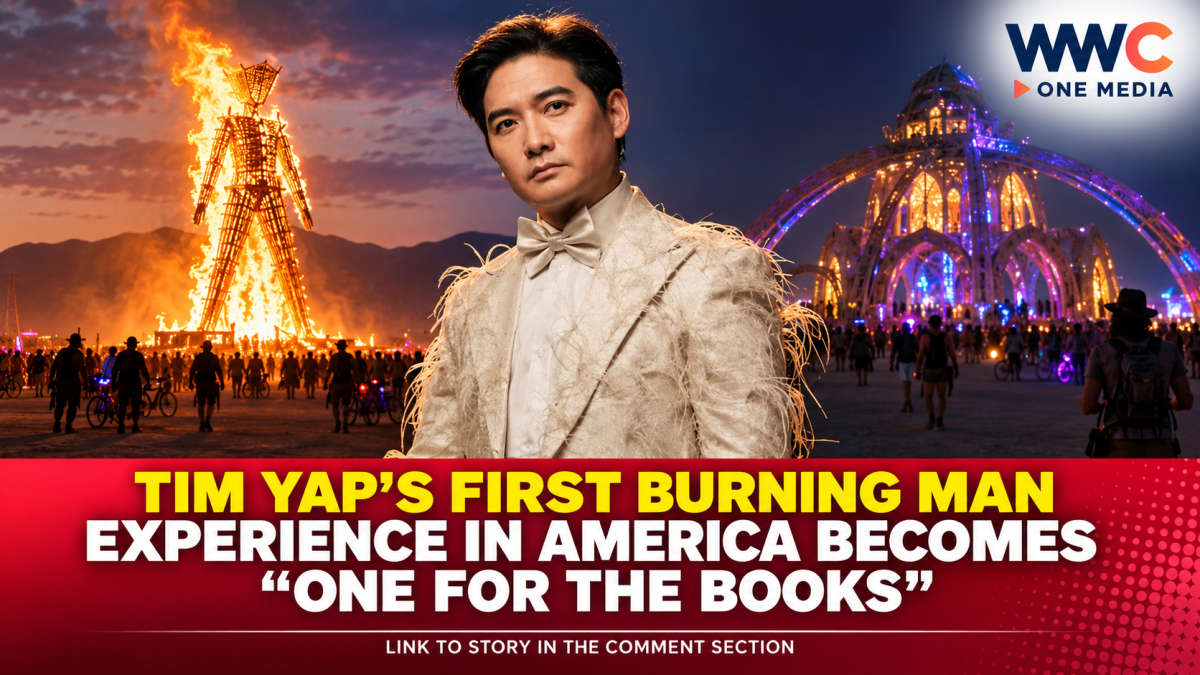
MANILA — Eventologist, television personality and columnist Tim Yap got a firsthand taste of one of America’s most unconventional cultural gatherings when he experienced Burning Man for the first time.
For Yap, the experience was more than simply attending another major event. His first trip to Burning Man became an unforgettable adventure in the middle of the Nevada desert—an environment where art, self-expression, community and radical creativity come together.
The GMA News feature described Yap’s first Burning Man experience as “one for the books,” highlighting the unusual atmosphere and larger-than-life spectacle that make the event unlike traditional festivals.
What exactly is Burning Man?
Held in Nevada’s Black Rock Desert, Burning Man transforms an otherwise barren stretch of desert into a temporary city known as Black Rock City.
The gathering is famous for enormous art installations, elaborate costumes, interactive performances, music, communal activities and the eventual burning of a giant wooden effigy known as the Man.
But organizers and longtime participants emphasize that Burning Man is about more than entertainment.
The U.S. National Endowment for the Arts described it as a combination of art, community-building and radical self-expression, with tens of thousands of people coming together to construct a temporary city that is later dismantled.
That temporary-city concept is one of Burning Man’s most distinctive characteristics: participants arrive in the desert and collectively create an environment that exists for only a short period before disappearing.
From a small beach gathering to a global phenomenon
Burning Man’s origins date back to 1986, when Larry Harvey and friends gathered at San Francisco’s Baker Beach and burned an eight-foot wooden figure.
What began as a small gathering eventually moved to Nevada’s Black Rock Desert and grew dramatically over the decades.
According to the National Endowment for the Arts, the first Black Rock Desert gathering involved roughly 80 people, while later editions grew to tens of thousands of participants.
Today, Burning Man is internationally recognized as a major countercultural and artistic phenomenon.
Its guiding philosophy includes principles such as radical inclusion, gifting, participation, decommodification and civic responsibility—ideas that help distinguish it from conventional commercial festivals.
Why Yap’s experience stands out
For someone accustomed to Manila’s nightlife, entertainment and high-profile events, Burning Man offers a dramatically different setting.
Instead of entering a conventional venue with a fixed program, participants enter an enormous temporary community in the desert where much of the environment is created by the people attending.
That immersive quality is part of what has made Burning Man such a magnet for artists, entrepreneurs, celebrities, creatives and adventure-seekers from around the world.
Yap’s first experience therefore represented more than another stop on an international itinerary. It offered him a glimpse into a community built around creativity, experimentation and self-expression.
And that may be precisely why the experience left such a strong impression.
Burning Man isn’t just about the famous fire
The spectacular burning of the Man is arguably Burning Man’s most recognizable image, but the event encompasses far more than the finale.
Massive art installations, themed camps, mutant vehicles, performances and spontaneous interactions are all part of the experience.
The temporary city itself is an enormous collaborative project, with participants helping create and sustain the environment before eventually leaving the desert behind.
A recent examination of Burning Man by The Guardian likewise described the gathering as a sprawling combination of art, community and self-expression, while also examining the tensions surrounding its growing popularity, cost and commercialization.
That evolution has made Burning Man both fascinating and controversial: it remains rooted in counterculture ideals while simultaneously attracting wealthy travelers, influencers and global personalities.
One unforgettable first trip
For Tim Yap, however, the most important takeaway appears to be the experience itself.
His first Burning Man adventure offered a rare opportunity to step outside the familiar world of Manila’s events and nightlife and enter a completely different kind of cultural environment.
One thing is clear: Burning Man isn’t the kind of place you simply attend—you experience it.
And for Yap, that first encounter with Black Rock City proved memorable enough to earn a place among his most extraordinary travel and lifestyle adventures.
From the desert art to the massive community, the spectacle and the unexpected moments in between, Tim Yap’s first Burning Man experience truly lived up to its “one for the books” reputation.




Leave a Reply