
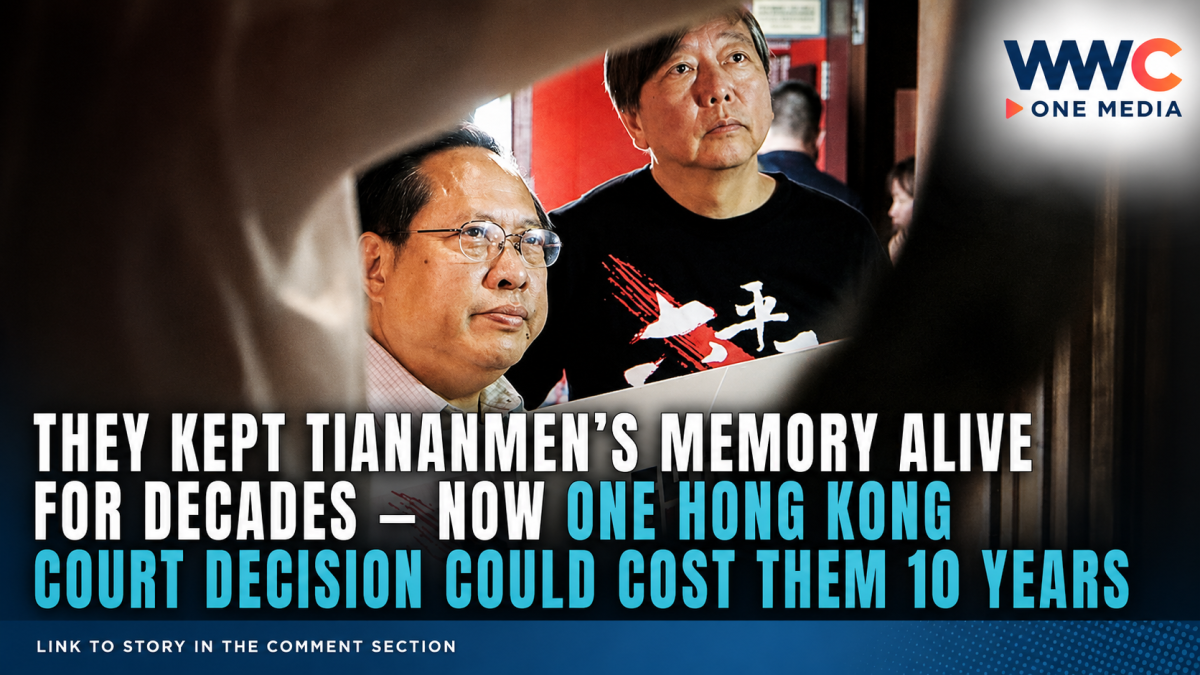
HONG KONG — Three veteran figures behind Hong Kong’s once-massive annual Tiananmen Square vigils are awaiting their punishment after appearing before the High Court for mitigation arguments in one of the city’s most closely watched national-security prosecutions.
Lee Cheuk-yan, Chow Hang-tung and Albert Ho — former leaders of the now-disbanded Hong Kong Alliance in Support of Patriotic Democratic Movements of China — appeared in court Friday, Aug. 28, following their convictions for inciting subversion under the National Security Law imposed by Beijing in 2020.
No sentences have yet been handed down.
Judge Alex Lee said the defendants are expected to be sentenced within two weeks, according to the Associated Press. Depending on how the court classifies the seriousness of the offense, they could face prison terms of up to 10 years.
A case that turned on one explosive political demand
Lee, 69, and Chow, 41, pleaded not guilty but were convicted on Aug. 21. Ho, 74, had pleaded guilty earlier, a decision that could be taken into account during sentencing.
The Hong Kong Alliance itself was also convicted.
At the center of the ruling was one of the Alliance’s longtime political demands: “end one-party dictatorship.”
Reuters reported that the three national-security judges focused heavily on the defendants’ repeated advocacy of that demand. The judges concluded that encouraging people to pursue an end to Communist Party leadership amounted to inciting action aimed at undermining China’s fundamental political system.
Significantly, Reuters reported that the judgment focused on the repeated use of the phrase even though the political advocacy itself was peaceful.
Hong Kong authorities have strongly defended the prosecution.
The Hong Kong government said the defendants were not convicted merely for holding political opinions, arguing instead that their conduct amounted to encouraging others to undermine the leadership of the Communist Party of China and therefore crossed the line into conduct prohibited by the National Security Law.
Chief Executive John Lee welcomed the Aug. 21 convictions, saying the Alliance had attempted to incite people to subvert state power. The government maintains that the court reached its decision according to evidence and law rather than political considerations.
Defense argues there was no violence — and no overthrow
At Friday’s mitigation hearing, lawyer Erik Shum, representing Lee and Ho, emphasized that the defendants’ advocacy did not involve violence.
He also argued that China’s political system and Communist Party leadership remained intact despite the Alliance’s years of campaigning — an argument aimed at persuading the court to impose a lighter punishment.
Chow, a barrister representing herself, took a markedly different approach.
Rather than distance herself from her political beliefs, she continued to challenge the basis of the conviction and told the court she did not believe she deserved even a single day in prison.
She argued that the judgment effectively treated the pursuit of democracy as criminal conduct and indicated that she intends to continue advocating for democracy and the vindication of the 1989 movement regardless of whether she is behind bars.
The National Security Law provides for sentences of five to 10 years when an incitement-to-subversion offense is considered serious. If the circumstances are considered minor, the punishment can fall below five years. The 10-year figure therefore represents a statutory maximum in this case — not an automatic sentence.
Why the Tiananmen vigils mattered
The prosecution carries significance far beyond the three defendants.
For roughly three decades, Hong Kong’s enormous candlelight gatherings at Victoria Park offered a public space where people could commemorate those killed when Chinese troops crushed the 1989 pro-democracy movement in and around Beijing’s Tiananmen Square.
The precise death toll from the 1989 crackdown remains unknown, but estimates range from hundreds to potentially thousands.
Such large-scale public remembrance is politically taboo on mainland China. Hong Kong’s vigils consequently became one of the clearest symbols of the broader civil freedoms the territory retained after its 1997 handover from British to Chinese rule.
The Alliance’s annual vigil was banned in 2020 during the COVID-19 pandemic. The organization later disbanded in 2021 as Hong Kong authorities dramatically expanded enforcement of national-security legislation.
Reuters noted that Lee and Chow have been detained since 2021.
The case could even determine the future of another symbol of Tiananmen remembrance: the Pillar of Shame, the towering sculpture commemorating victims of the crackdown that was removed from the University of Hong Kong campus in 2021. AP reported that the court handling the Alliance case is also expected to decide what happens to the sculpture and whether it could be returned to its owner.
International governments push back
The verdict has triggered unusually strong criticism from several Western governments.
The European Union said the convictions demonstrated a continuing deterioration of freedom of expression and assembly and a shrinking space for independent civil society in Hong Kong. It urged authorities to preserve freedoms guaranteed under Hong Kong’s Basic Law.
Britain said the case demonstrated that even peaceful acts of remembrance were increasingly being treated as national-security threats and again called for the National Security Law to be repealed.
France and Germany issued a joint statement specifically defending Chow, saying peaceful advocacy for human rights should not constitute a crime and calling for her release. Chow received the Franco-German Prize for Human Rights and the Rule of Law in 2023.
Hong Kong authorities reject those criticisms, accusing foreign governments and organizations of interfering in the city’s judicial affairs and insisting that national-security laws are necessary to protect stability.
The real cliffhanger now is the sentence
The convictions are settled at the trial-court level. What remains uncertain is how severely the judges will punish the three former Alliance leaders.
That decision could prove almost as consequential as the guilty verdict itself.
A heavy sentence would reinforce just how dramatically Hong Kong’s legal boundaries around political activism have shifted since 2020. A lighter sentence would still leave intact a precedent in which advocacy targeting Communist Party rule was ruled capable of constituting national-security subversion.
Either way, the case has transformed something that was once a defining feature of Hong Kong civic life — remembering Tiananmen publicly and demanding political change — into the center of a national-security prosecution.




Leave a Reply