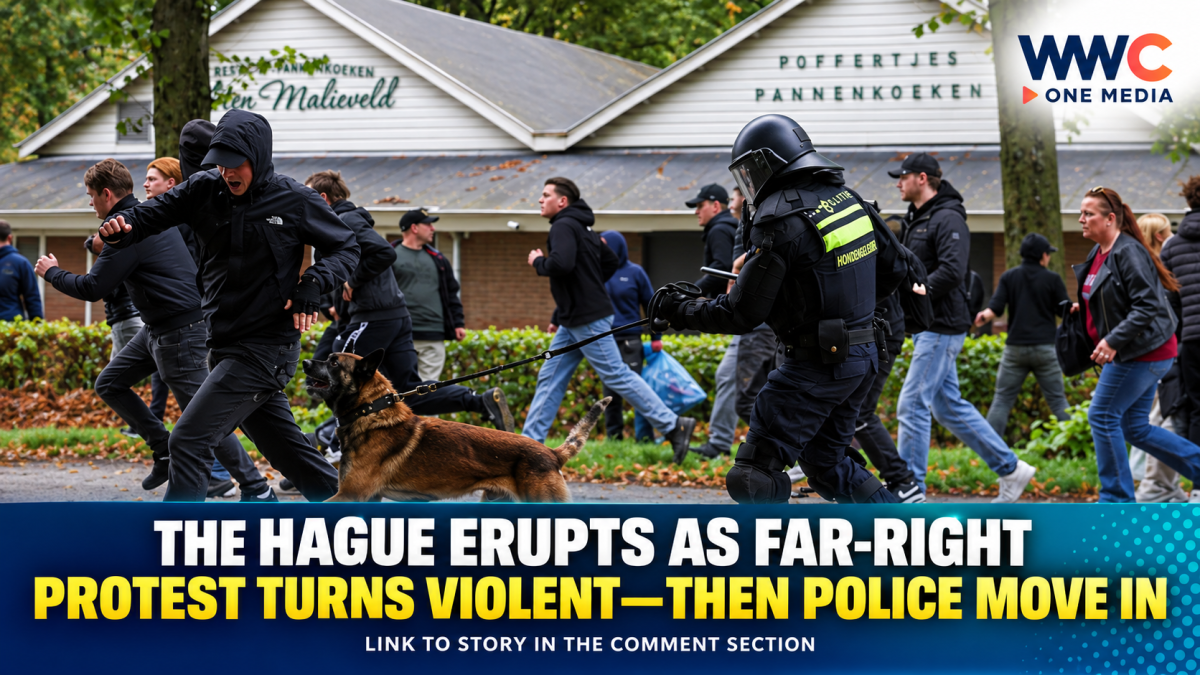
THE HAGUE, Netherlands — A far-right demonstration in The Hague descended into violence on Saturday, September 19, after protesters threw fireworks and other objects at police, prompting Dutch authorities to halt a planned march and deploy riot-control units, water cannon and specialist police dogs.
Around 500 protesters were involved in the demonstration, according to reporting by The Straits Times and AFP. The rally, organised under the banner “We Are The People” (Wij Zijn Het Volk), was held at Malieveld in central The Hague and focused on opposition to the Dutch government’s immigration and asylum policies.
Police use water cannon as violence escalates
The planned march through The Hague was stopped after authorities cited public-order disturbances, violence against police and the continued presence of people wearing face coverings.
According to Dutch public broadcaster NOS, protesters continued throwing fireworks, sticks and smoke bombs even after the march was cancelled. Riot police subsequently formed a line to contain the crowd and used a water cannon and pepper spray while protesters were moved away from Malieveld.
Police said 24 people were arrested, including for failing to comply with an emergency order and suspected prohibited weapons possession. Further investigations were continuing.
AFP reporters also reported that riot police used baton charges and specialist dogs during the operation.
Officials condemn violence and antisemitic slogans
Dutch Prime Minister Rob Jetten condemned what he described as deliberate confrontation with police and referred to far-right and antisemitic slogans during the demonstration.
Justice Minister David van Weel also called for a firm response, saying protesters had used Nazi salutes, antisemitic slogans and fireworks against riot police. These descriptions were also reported by AP, AFP and Dutch broadcaster NOS.
The government statements came as authorities sought to prevent the unrest from spreading beyond the protest area.
The Hague municipality eventually ordered the demonstration to be dissolved and issued an emergency order covering part of the city, giving police additional powers to remove people contributing to public disorder.
Why the protest matters
The confrontation occurred almost exactly a year after another anti-immigration demonstration in The Hague turned violent.
During the September 2025 unrest, protesters clashed with police, a police vehicle was set on fire and the headquarters of the D66 party was damaged. The disturbances also resulted in attacks on journalists and other property in the city.
The latest confrontation therefore comes against a backdrop of recurring tensions surrounding immigration, asylum policy and demonstrations involving far-right groups in the Netherlands.
Dutch public broadcaster NOS reported that authorities had prepared extensively for the possibility of disorder, with police restricting protesters from moving toward the nearby A12 motorway and central areas of The Hague.
Journalists also report incidents
NOS reported that several journalists were confronted or harassed during the demonstration.
The broadcaster also reported an incident involving a Spanish photographer who fell into water during the police operation after an apparent push by an officer. The photographer said he was visibly wearing press credentials and intended to file a complaint. Police said they were aware of the incident and were examining what happened.
The incident adds another dimension to Saturday’s unrest, with questions likely to remain over how police managed the crowd and protected journalists while attempting to contain violence.
What happened after the crackdown?
After the demonstration was formally ended and protesters were directed away from Malieveld, NOS reported that most participants eventually left the area and calm gradually returned.
Authorities, however, continued investigating the arrests and incidents surrounding the demonstration.
The events in The Hague underline the continuing difficulty Dutch authorities face in balancing the right to demonstrate with efforts to prevent violence and protect public safety.
For now, the immediate confrontation has ended—but the political and social tensions surrounding immigration and asylum policy remain at the centre of debate in the Netherlands.