
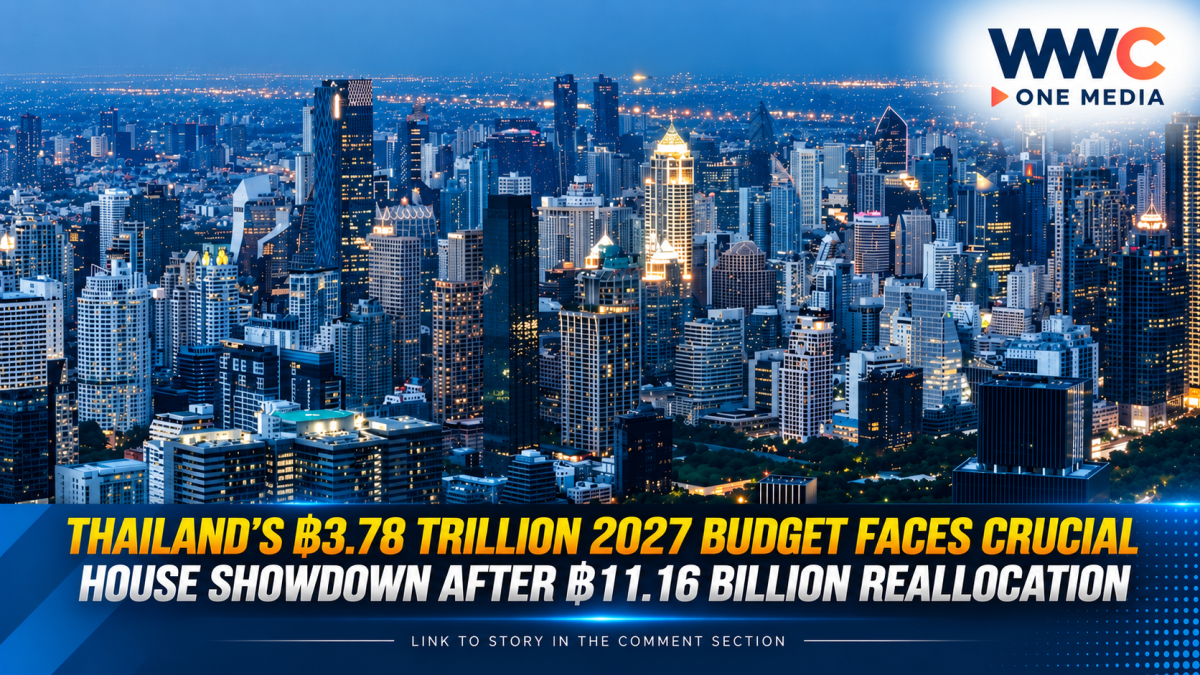
BANGKOK — Thailand’s massive 2027 budget is heading into a crucial parliamentary showdown after lawmakers approved spending changes worth more than 11.16 billion baht ahead of a three-day debate that could expose deeper divisions over government priorities, borrowing and fiscal discipline.
The fiscal 2027 budget bill, worth about 3.788 trillion baht, is scheduled for second- and third-reading debates in the House of Representatives from Sept. 7 to 9.
While the scrutiny committee approved cuts and reallocations totalling 11.162 billion baht, the overall budget remains at roughly 3.788 trillion baht. The changes therefore represent a reshuffling of spending rather than a reduction in the headline size of the national budget.
Billions Shifted as MPs Dig Into Government Spending
The changes follow months of scrutiny by a special House committee examining the government’s proposed spending plan.
The committee has approved the reallocation of the 11.16 billion baht to nine government agencies and spending categories, while rejecting a proposed increase for the Student Loan Fund, according to reporting on the committee’s deliberations.
That decision puts the focus squarely on a question that will dominate the House debate: which programmes deserve more money — and which ones should give way?
The budget fight is particularly sensitive because Thailand is already confronting pressure from rising recurring expenditure, debt-service costs and limited fiscal room for new investment.
Government Says the Numbers Reflect a More Realistic Budget
The government has argued that the 2027 budget is designed to make Thailand’s finances more transparent and realistic.
Finance Minister Ekniti Nitithanprapas previously told Parliament that the government had incorporated recurring expenditure and overlapping welfare spending into the main budget rather than relying on reserves to cover costs later.
That accounting change made investment spending appear to fall by about 70 billion baht, but the government said the shift reflected a correction of budget figures and greater compliance with fiscal discipline rather than simply abandoning investment.
The government is targeting a reduction in the fiscal deficit from an estimated 4.4% of GDP in 2026 to 3.9% in 2027, with a longer-term goal of bringing the deficit below 3% by 2029.
Opposition Warns Thailand Is Running Out of Fiscal Room
Opposition lawmakers have offered a much more alarming interpretation of the numbers.
People’s Party deputy leader Sirikanya Tansakul previously warned that recurring expenditure was rising by around 120 billion baht, while investment spending was falling by roughly 70 billion baht.
She pointed to higher pension obligations, government pension-fund contributions and interest payments as major sources of additional recurring costs. Together, those pressures were estimated at close to 100 billion baht.
The concern is straightforward: the more money the government must devote to fixed obligations, the less flexibility it has to invest in infrastructure, economic development and new policies.
That issue could become one of the most contentious themes during this week’s parliamentary debate.
฿400 Billion Borrowing Plan Adds Another Layer of Pressure
The budget debate is also unfolding against the backdrop of a much larger borrowing programme.
The government has authorised an emergency borrowing framework of up to 400 billion baht, with funding divided between measures to ease the effects of higher living and energy costs and longer-term projects connected to the country’s energy transition.
The borrowing plan has already drawn scrutiny from opposition lawmakers.
Watanya Bunnag, known as “Madam Dear,” has argued that a 12-billion-baht energy allocation in the regular budget should be removed or significantly reduced because it could overlap with spending eligible under the emergency borrowing programme.
She warned that leaving the money as a broadly defined central allocation could give the executive too much discretion over how the funds are ultimately used.
The government has rejected the characterization of the allocation as an unrestricted pool, saying it is intended as a matching-fund mechanism to leverage existing resources rather than simply provide the executive with a blank cheque.
Budget Battle Could Test the Government’s Fiscal Credibility
The House’s first-reading vote in July offered the government a significant political advantage.
MPs approved the 2027 budget bill 288-119, with 86 abstentions, after three days of debate. A special committee was then tasked with examining the spending plan in detail.
But the next stage is potentially more politically explosive.
The second- and third-reading debate comes after weeks of committee-level scrutiny, proposed reallocations and opposition challenges over government spending priorities.
The government says the budget reflects fiscal reality and is designed to strengthen transparency while keeping investment alive through alternative financing mechanisms.
Those mechanisms include state-enterprise investment, public-private partnerships and investment promotion intended to support infrastructure, clean energy, smart grids, data centres and semiconductor development.
What Happens Next?
The House debate from Sept. 7–9 will determine whether the amended spending plan advances through the lower house.
The real battle may not be over the headline 3.788-trillion-baht figure.
Instead, MPs are likely to focus on where the money is being moved, what programmes are losing funding, how much Thailand can afford to borrow and whether the government’s fiscal strategy can deliver economic growth without further squeezing public finances.
Thailand’s government has set an ambitious objective: return economic growth to above 3%, improve national competitiveness and move the country toward high-income status over the coming years.
But with recurring costs rising, investment resources under pressure and billions of baht being shifted before the final votes, the 2027 budget is shaping up to be more than an accounting exercise.
It is becoming a test of how much financial room Thailand’s government really has — and who gets to decide where that room is spent.
SEO Package
Primary Keyword:
Thailand 2027 budget
Secondary Keywords:
- Thailand budget bill 2027
- Thailand 3.788 trillion baht budget
- Thailand budget cuts
- 11.162 billion baht budget cut
- Thailand Parliament budget debate
- Thailand fiscal 2027 budget
- Anutin Charnvirakul government
- Ekniti Nitithanprapas
- Thailand government spending
- Thailand public debt
- Thailand fiscal deficit
- Thailand budget debate September 2026
SEO Title:
Thailand 2027 Budget: ฿11.16 Billion Reallocated Ahead of House Debate
Meta Description:
Thailand’s ฿3.788 trillion 2027 budget faces a crucial House debate after lawmakers approved ฿11.162 billion in spending cuts and reallocations.
Facebook Headline:
THAILAND’S ฿3.78 TRILLION BUDGET UNDER PRESSURE: Billions Moved Before Crucial House Vote
Facebook Caption:
Thailand’s massive 2027 budget is heading into a crucial parliamentary showdown. 🇹🇭💰 Lawmakers have approved more than ฿11.16 billion in spending cuts and reallocations, while opposition MPs warn about rising recurring costs, borrowing and shrinking fiscal space. The headline budget remains around ฿3.788 trillion — but the real fight is over where the money goes.
Accuracy notes
- ฿3.788 trillion: confirmed as the approximate size of the fiscal 2027 budget.
- ฿11.162 billion: confirmed as the amount affected by committee-approved cuts/reallocations ahead of the House debate.
- Overall budget not reduced by ฿11.162 billion: the available reporting describes the money as being reallocated; the headline budget remains about ฿3.788 trillion.
- House debate: scheduled for Sept. 7–9, 2026.
- First-reading vote: 288-119, with 86 abstentions.
- Fiscal deficit target: 3.9% of GDP for 2027, with a goal of below 3% by 2029.
- Additional fiscal pressure: opposition analysis has highlighted rising recurring expenditure, pension costs, interest payments and lower investment spending.




Leave a Reply