
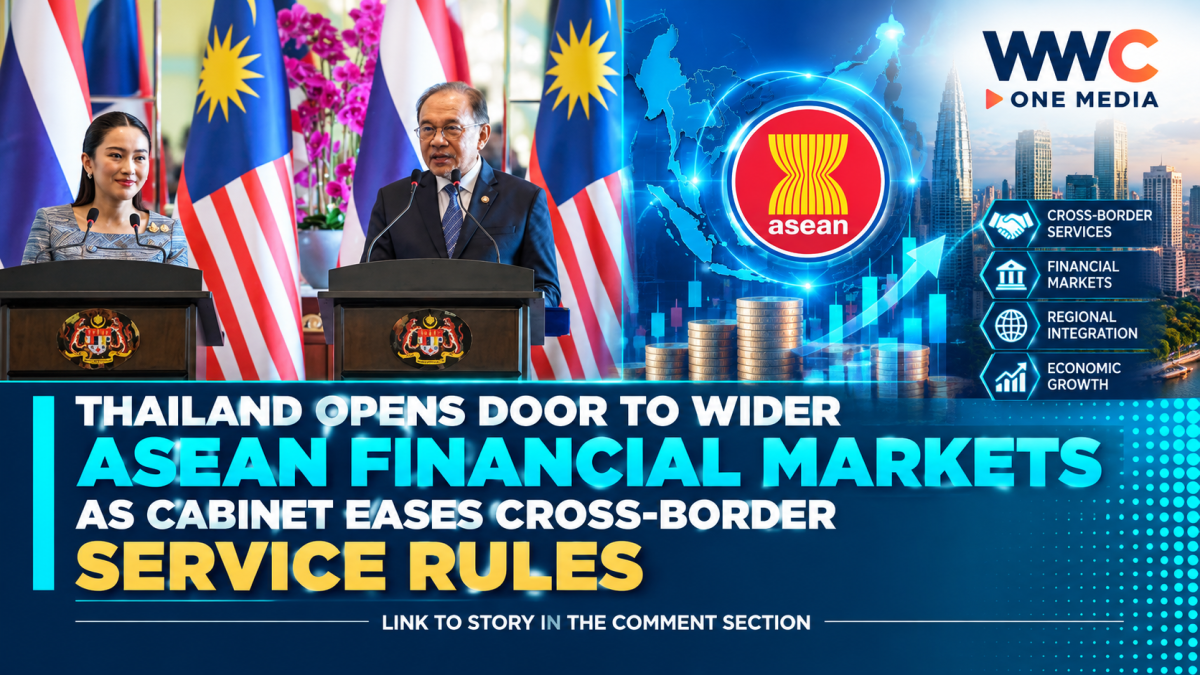
BANGKOK, Thailand — Thailand is moving to give its financial sector greater access to markets across Southeast Asia after the Cabinet approved a new ASEAN agreement aimed at easing restrictions on cross-border financial services.
The Cabinet on September 8 approved Thailand’s ratification of the Ninth Package of Commitments on Financial Services under the ASEAN Framework Agreement on Services (AFAS), a move that could help Thai financial businesses expand their operations across the region. The proposal will now be submitted to Parliament for approval before Thailand completes the ratification process.
The message from Bangkok is clear:
Thai financial companies are being given a bigger opportunity to go regional — without Thailand throwing open its domestic market beyond its current commitments.
Cabinet Approves New ASEAN Financial Services Deal
The agreement covers the ninth package of ASEAN commitments on the liberalisation of financial services.
Under AFAS, ASEAN member states have progressively worked to reduce barriers to trade in services and give businesses from other member countries greater opportunities to operate across borders.
Thailand’s Cabinet approved both the ratification of the protocol and the country’s accompanying schedule of financial-services commitments. However, parliamentary approval is required before the agreement can become binding on Thailand.
The official Thai government position is particularly significant because it says the latest package will not affect Thailand’s existing level of liberalisation.
That means the agreement is intended to create new opportunities for Thai businesses in other ASEAN markets while avoiding a broader-than-agreed opening of Thailand’s own financial sector.
What Does This Mean for Thailand’s Financial Industry?
The agreement could be important for a wide range of financial businesses looking beyond Thailand’s borders.
Potential beneficiaries could include companies operating in areas such as:
- Banking
- Insurance
- Securities
- Investment services
- Financial advisory services
- Other regulated financial activities
However, the actual opportunities available to individual businesses will depend on the commitments, licensing requirements and regulations applied by each ASEAN country.
That distinction matters.
Easier regional market access does not mean every financial company can automatically operate anywhere in ASEAN.
Financial institutions will still need to comply with national laws, licensing rules and regulatory requirements in the countries where they want to do business.
ASEAN’s own framework has long pursued a gradual approach to liberalising services, with commitments made through successive packages and implemented according to the legal and regulatory systems of individual member states.
A Bigger Push for ASEAN Financial Integration
Thailand’s decision comes as ASEAN accelerates efforts to build a more integrated and resilient regional financial system.
At the 13th ASEAN Finance Ministers’ and Central Bank Governors’ Meeting, regional policymakers reaffirmed commitments to deeper financial integration, stronger policy coordination, digital transformation and more efficient cross-border financial activity.
The region is also working on improving regulatory transparency and coordination to reduce uncertainty surrounding cross-border financial services and payments.
ASEAN policymakers have increasingly focused on areas including:
- Cross-border payments
- Financial services liberalisation
- Capital-market development
- Local currency transactions
- Digital finance
- Financial inclusion
- Regulatory coordination
- Financial stability
The ultimate goal is ambitious:
Make it easier for money, services and financial businesses to operate across ASEAN — without sacrificing financial stability or national regulatory control.
Why the Deal Matters Now
The latest agreement arrives as Southeast Asia’s financial sector is being transformed by digital banking, fintech, cross-border payments and increasing competition for regional investment.
Financial companies are no longer competing only within their home markets.
A Thai bank, insurer or financial technology company increasingly has to think about Indonesia, Vietnam, Malaysia, Singapore, the Philippines and other ASEAN markets.
At the same time, ASEAN governments are trying to strike a difficult balance.
They want more competition and investment.
They want stronger regional businesses.
They want faster and cheaper financial services.
But they also need to protect consumers and maintain control over their domestic financial systems.
That is why ASEAN’s financial liberalisation has generally followed a gradual and phased approach, rather than a sudden removal of all restrictions.
The Ninth Package: What Happens Next?
The protocol was signed in Jakarta on April 9, 2026, according to ASEAN’s official agreement records.
Under the agreement, member states are required to complete their own internal procedures for ratification or acceptance before the protocol can take effect for them under the framework’s procedures.
For Thailand, that means the Cabinet’s approval is an important step — but not the final one.
The proposal must now go before Parliament for consideration and approval under the Thai Constitution before the country can proceed with the remaining ratification process.
Will Foreign Financial Companies Get Easier Access to Thailand?
This is one of the biggest questions surrounding any financial liberalisation agreement.
According to the Thai government, the latest move does not increase Thailand’s existing level of financial-services liberalisation.
That means the agreement should not automatically be interpreted as a major new opening of Thailand’s financial market to foreign competitors.
Instead, the arrangement is designed around ASEAN’s negotiated commitments and reciprocal market access.
Thailand’s existing financial-services framework has historically maintained rules over issues such as the type of institution that can provide particular services and the form of commercial presence allowed in the country.
The practical impact will therefore depend heavily on the specific commitments made under the ninth package and how each participating country implements them.
Thai Financial Firms Eye Regional Growth
For Thai companies, ASEAN’s population and economic growth make the region an increasingly attractive expansion market.
A more integrated financial-services environment could potentially help Thai firms:
- Expand into neighbouring markets
- Serve regional customers
- Build cross-border partnerships
- Support Thai businesses investing overseas
- Develop regional payment services
- Compete with larger international financial groups
But increased integration could also intensify competition.
As Thai companies seek greater access to other ASEAN markets, financial firms from across the region will also continue looking for opportunities in Thailand.
The race for ASEAN’s financial customers is becoming increasingly regional.
Digital Finance Could Be the Next Major Battleground
The agreement also comes as technology rapidly reshapes financial services.
ASEAN policymakers are pushing forward with digital transformation and greater connectivity between regional financial systems.
Cross-border payment systems, digital banking and financial technology are increasingly changing how consumers and businesses move money.
Regional finance ministers and central bank governors have also highlighted the importance of improving payment connectivity and reducing regulatory uncertainty across borders.
For consumers, the long-term impact could potentially include more convenient regional financial services.
For businesses, it could mean easier payments and access to customers across borders.
For regulators, however, it means an increasingly difficult challenge:
How do you make regional finance faster and more open without making it less safe?
The Bigger Picture: ASEAN Is Building a More Connected Economy
The financial-services agreement is part of a broader push to make ASEAN a more integrated economic region.
The ASEAN Framework Agreement on Services was created to progressively liberalise trade in services among member states and strengthen the competitiveness of the region’s service industries.
Financial services are among the most sensitive areas because they directly affect national economies, consumers and financial stability.
That is why progress is typically negotiated in stages.
The Ninth Package represents another step in that long-running process.
It may not immediately transform the way Thai consumers bank or buy insurance.
But for financial companies planning regional expansion, it could help remove some of the barriers that have historically made cross-border growth more difficult.
The Bottom Line
Thailand’s Cabinet has taken a significant step toward deeper ASEAN financial integration by approving the ratification of the region’s latest financial-services liberalisation package.
The move could create wider opportunities for Thai financial businesses looking to expand across Southeast Asia — while the government insists that Thailand is not opening its domestic financial market beyond its existing level of commitments.
But Parliament still has to approve the agreement before Thailand completes the ratification process.
The bigger story is about where ASEAN is heading.
The region wants its economies to become more connected. Its payments to move more easily. Its businesses to expand across borders.
And increasingly, the next battle for growth will not be fought inside one country.
It will be fought across ASEAN.
WWC ONE MEDIA J.M.D




Leave a Reply