
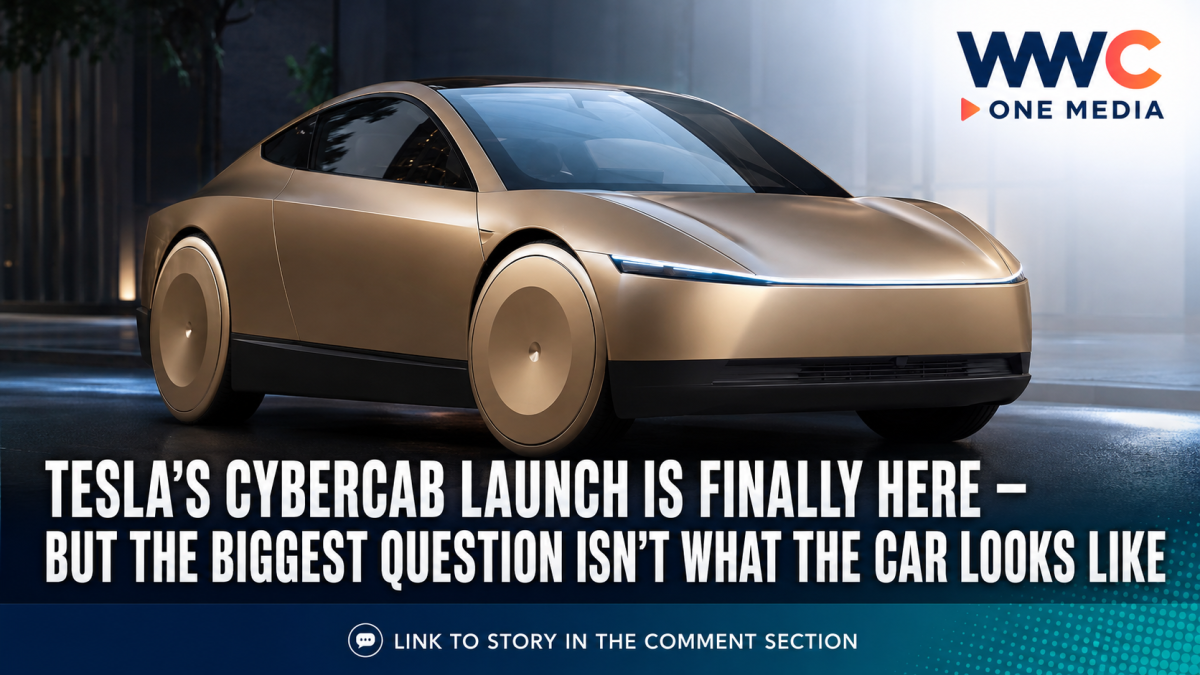
AUSTIN, Texas — Tesla is preparing to put its purpose-built Cybercab in the spotlight again on Thursday, but this time the stakes are considerably higher.
The electric-vehicle maker has scheduled what it calls the “Cybercab Launch Event” in downtown Austin, with Tesla Cybercab engineer Eric Earley saying the event is set to begin at 5:45 p.m. ET on September 3. Tesla has released relatively few details about what will be announced.
What is already clear, however, is that this is no longer simply another futuristic concept reveal.
The two-seat Cybercab has no conventional steering wheel or pedals and is designed specifically for autonomous ride-hailing. Tesla CEO Elon Musk has described the vehicle as a critical part of his plan to transform Tesla from primarily an electric-car manufacturer into an artificial-intelligence, robotics and autonomous transportation company.
And while Thursday’s event could deliver new demonstrations, fleet plans or timelines, the bigger story begins after the stage lights go out:
Can Tesla actually deploy Cybercabs quickly, safely and at the scale Musk has promised?
This Isn’t the First Cybercab Reveal
Tesla originally unveiled the Cybercab at its highly publicized “We, Robot” event in October 2024, when Musk presented the futuristic two-seater alongside a larger autonomous Robovan and Tesla’s Optimus humanoid robots.
At the time, Musk predicted that Tesla could eventually produce Cybercabs for less than $30,000 and build an enormous autonomous ride-hailing network.
Nearly two years later, Tesla has moved beyond the concept stage.
The company said in its second-quarter 2026 disclosure that it had started Cybercab production, begun engineering test drives of production vehicles on public roads and started giving employees rides in Cybercabs at its Gigafactory Texas campus.
TechCrunch reported in June that Tesla had also begun testing a production Cybercab without pedals or a steering wheel on Austin streets, although a human safety monitor was still riding inside during those early tests.
That makes Thursday’s event less about whether Tesla can build the vehicle — and much more about whether it can turn the Cybercab into a practical commercial transportation system.
Tesla’s Robotaxi Network Is Growing — But Slowly
Tesla launched its first limited robotaxi pilot in Austin in June 2025, initially using modified Model Y vehicles.
Since then, the company has expanded operations into additional markets in Texas and Florida.
Tesla’s latest quarterly update said it was ramping unsupervised robotaxi operations in Austin, Dallas and Houston, as well as Miami, Orlando and Tampa, while preparations were underway for Phoenix and Las Vegas. The company listed its San Francisco Bay Area operation as using a safety driver.
But Tesla’s real-world rollout has moved more slowly than some of Musk’s earlier predictions.
In July 2025, Musk said Tesla’s robotaxi network could expand at a “hyper-exponential rate” and reach roughly half of the U.S. population by the end of that year. That did not happen.
Reuters reported that Tesla’s services remain relatively limited in several markets and that its own tests of the Dallas operation encountered long waits and availability problems. On three rides, Reuters said its reporter was dropped around a 15-minute walk from the requested downtown destination despite the destination being inside Tesla’s advertised service area.
That gap between Tesla’s ambitions and its current operating footprint is likely to be one of the biggest issues investors watch during the Cybercab event.
A revealing number: 45 Cybercabs
Perhaps one of the clearest indications of Tesla’s current position comes from Texas registration records cited by Reuters.
As of Wednesday evening, Tesla had 420 autonomous vehicles registered in Texas, including 45 Cybercabs.
Alphabet-owned Waymo, by comparison, had 988 autonomous vehicles registered in the state, according to the same report.
The comparison does not necessarily predict who will ultimately dominate autonomous transportation, but it highlights the scale challenge confronting Tesla.
Waymo has spent years building commercial driverless operations and continues expanding. Reuters reported this week that Waymo is adding Denver, San Diego and Tampa to its network, taking its presence to 14 cities, while Amazon-backed Zoox is also expanding its autonomous-vehicle operations.
TechCrunch likewise noted that Waymo is already serving customers in more than a dozen U.S. cities as Tesla prepares to formally introduce the Cybercab into its much smaller but growing robotaxi network.
In other words, Tesla is entering a race that is already well underway.
Tesla Is Betting on a Very Different Self-Driving Strategy
The technological battle is just as important.
Tesla has largely built its autonomous-driving strategy around cameras, neural networks and artificial intelligence, rejecting the lidar-heavy approach used by competitors such as Waymo.
Musk has repeatedly argued that Tesla’s vision-based system can eventually achieve widespread autonomy more cheaply because cars will not require expensive arrays of lidar sensors and detailed mapping infrastructure.
Waymo strongly disagrees.
Ahead of the Cybercab launch, Waymo publicly argued that cameras alone are not sufficient for reliable autonomous driving and defended its combination of cameras, radar and lidar. TechCrunch described the comments as an unmistakable challenge to Tesla’s approach even though Waymo did not explicitly name its rival.
If Tesla can operate large numbers of Cybercabs safely using its comparatively streamlined hardware strategy, it could significantly change the economics of autonomous ride-hailing.
If it cannot, the Cybercab’s low-cost design becomes far less important.
The Steering-Wheel Problem Hasn’t Completely Disappeared
There is another complication that flashy demonstrations cannot solve overnight: regulation.
Because the Cybercab is designed without traditional driver controls, it does not neatly fit regulations originally written for human-driven vehicles.
The U.S. National Highway Traffic Safety Administration has been modernizing those rules and streamlining exemptions for autonomous vehicles. Under the existing Part 555 exemption process, manufacturers can receive permission to sell up to 2,500 vehicles per year that do not fully comply with certain federal motor-vehicle safety standards, including requirements involving traditional steering wheels and driver-operated brakes.
The federal government has also begun rewriting some safety standards specifically to accommodate vehicles designed exclusively for automated driving.
But regulatory approval could still affect how quickly Tesla can turn Cybercab production into a massive commercial fleet.
California illustrates the challenge.
As of August 2026, the California DMV lists Tesla Robotaxi LLC as authorized for autonomous testing with a safety driver, but Tesla does not appear on the state’s current list of companies authorized for driverless testing or autonomous deployment. Waymo and several other operators do.
For a company envisioning millions of autonomous vehicles, clearing those regulatory hurdles market by market could prove almost as important as perfecting the software itself.
Why Cybercab Matters So Much to Tesla
Tesla is making this bet while its traditional car business faces increasingly aggressive competition worldwide.
Reuters noted that investors increasingly view autonomy as one of the major pillars supporting Tesla’s roughly $1.4 trillion market valuation, particularly as Chinese automakers and other global EV manufacturers intensify competitive pressure on its core vehicle business.
Tesla itself is increasingly describing Cybercab as more than another car.
In its second-quarter report, the company called the Cybercab its “purpose-built autonomous EV” and the future “workhorse” of its Robotaxi fleet. Tesla lists installed annual Cybercab manufacturing capacity in Texas at more than 125,000 vehicles, while cautioning that installed capacity is not the same as actual production output.
Musk has gone further, saying Cybercab could ultimately become Tesla’s highest-volume vehicle.
His longer-term vision is enormous: a Tesla-managed ride-hailing network populated by company-owned Cybercabs and potentially privately owned Teslas that owners could place into the autonomous fleet when they are not using them.
That vision could create recurring software and transportation revenue on a scale very different from simply selling cars.
But it depends on Tesla solving one of the hardest problems in transportation technology: making autonomous driving work reliably across enormous numbers of vehicles, streets, weather conditions and regulatory jurisdictions.
Thursday’s Biggest Question
Tesla has already shown the Cybercab.
It has already built production versions.
It has already begun testing them.
So another dramatic reveal alone may not be enough.
Investors, regulators and competitors will be watching for harder details: How many Cybercabs can Tesla actually produce? When will ordinary customers be able to hail one? How quickly will the network expand? What happens in difficult driving conditions? And how will Tesla navigate rules governing vehicles that do not even have steering wheels?
Thursday could mark an important milestone for Musk’s autonomous-driving strategy.
But Cybercab’s real test will not happen on a stage in Austin.
It will happen when thousands — and eventually potentially hundreds of thousands — of these vehicles have to navigate real roads with nobody behind the wheel.
WWC ONE MEDIA MJE




Leave a Reply