
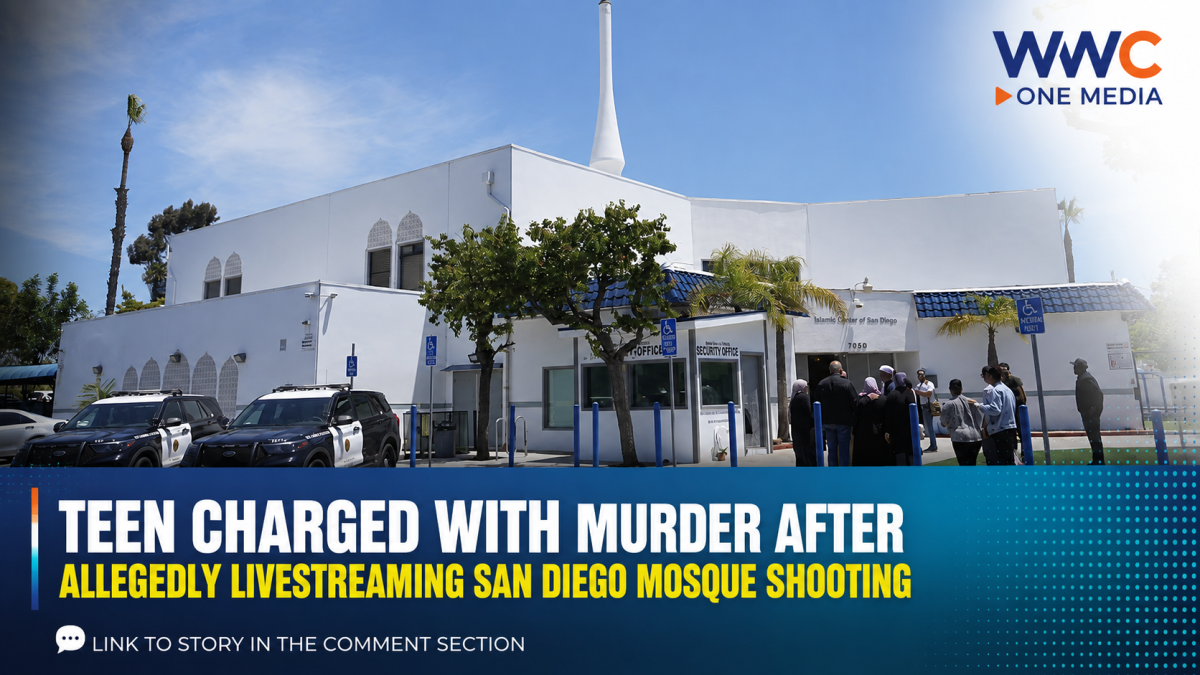
SAN DIEGO — A 17-year-old North Carolina girl has been charged with three counts of murder and one count of conspiracy in connection with the deadly shooting at the Islamic Center of San Diego, after prosecutors alleged that she helped the attackers livestream the violence and distribute their writings.
Sarah Lindsey Santiago was arrested in North Carolina last week and indicted by a grand jury on Aug. 31. Prosecutors are accusing her of aiding and abetting the murders, even though she was not physically present at the California mosque when the shooting occurred.
Under North Carolina law, a person who aids and abets a crime can face the same criminal penalties as someone who directly commits it. Santiago is being prosecuted as an adult and was being held without bond.
Prosecutors allege she helped plan the livestream
According to the indictment, Santiago allegedly agreed before the attack to record and distribute a livestream of the shooting and to publish a document written by the attackers.
Investigators also allege that she purchased a patch bearing a white-supremacist symbol and sent it to one of the gunmen to wear during the attack. Prosecutors say she subsequently carried out the planned distribution of the livestream and the attackers’ writings.
Authorities said three people initially watched the livestream. Investigators have not publicly identified the other viewers or announced whether they face charges.
Santiago’s attorney, Alan Doorasamy Sr., has rejected the allegations, saying his client is innocent and that he had not yet received evidence from investigators.
Those allegations have not been proven in court.
The San Diego mosque attack killed three people
The underlying shooting took place on May 18, 2026, at the Islamic Center of San Diego.
Two teenage gunmen, Cain Clark, 17, and Caleb Vazquez, 18, opened fire at the mosque before fleeing and later dying by suicide in a nearby vehicle.
Three men were killed: Amin Abdullah, Mansour Kaziha and Nadir Awad.
The attack occurred while about 140 children were nearby. Authorities credited Abdullah, a mosque security guard, with confronting the attackers and helping prevent them from reaching the larger group inside the facility. Kaziha and Awad also moved toward the attackers, helping draw them away from others.
San Diego police and the FBI have described the actions of the victims as instrumental in limiting the scale of the attack.
Investigators say the suspects connected online
The case has also raised new concerns about online radicalization.
Authorities say Clark and Vazquez met online and shared extremist material before the shooting. Their writings expressed hatred toward multiple racial, religious and social groups, according to investigators and documents reviewed by news organizations.
Investigators said the pair’s plans extended beyond the mosque. Authorities allege they had discussed attacks against a Jewish temple and Black students at a high school.
The case has therefore become more than an investigation into a single shooting. It is also examining how young people can become involved in extremist online communities and how digital platforms can be used to plan, document and amplify violence.
Massive investigation uncovered alleged online links
The FBI’s San Diego field office said investigators conducted more than 100 interviews, executed more than 30 search warrants and reviewed more than 4 million messages during the investigation, according to local reporting.
That investigation eventually led authorities from California to North Carolina, where Santiago was arrested.
FBI officials emphasized that being physically distant from an attack does not necessarily shield someone from criminal responsibility if evidence shows that person knowingly helped facilitate the crime.
A case that could test the limits of online accountability
The charges against Santiago could become an important test of how prosecutors pursue people accused of supporting violent attacks remotely.
The central question will be whether prosecutors can prove that Santiago knowingly shared the attackers’ criminal intent and deliberately helped facilitate the murders, rather than merely documenting or distributing material after the fact.
That distinction could become crucial as the case moves through court.
For now, Santiago remains an accused defendant, not a convicted murderer.
But the indictment sends a powerful message from investigators: helping organize or amplify an attack from hundreds of miles away can still lead to serious criminal charges if prosecutors can establish intentional participation.
The bigger question
The San Diego shooting has already raised difficult questions about extremist radicalization, online communities and the role of social media in amplifying violent acts.
Now prosecutors are taking that investigation one step further — into the digital network allegedly surrounding the attackers.
If the evidence in court matches the allegations in the indictment, this case could establish a significant precedent for how far criminal responsibility can extend when someone allegedly helps a violent attack from behind a screen.
WWC ONE MEDIA J.M.D



Leave a Reply