
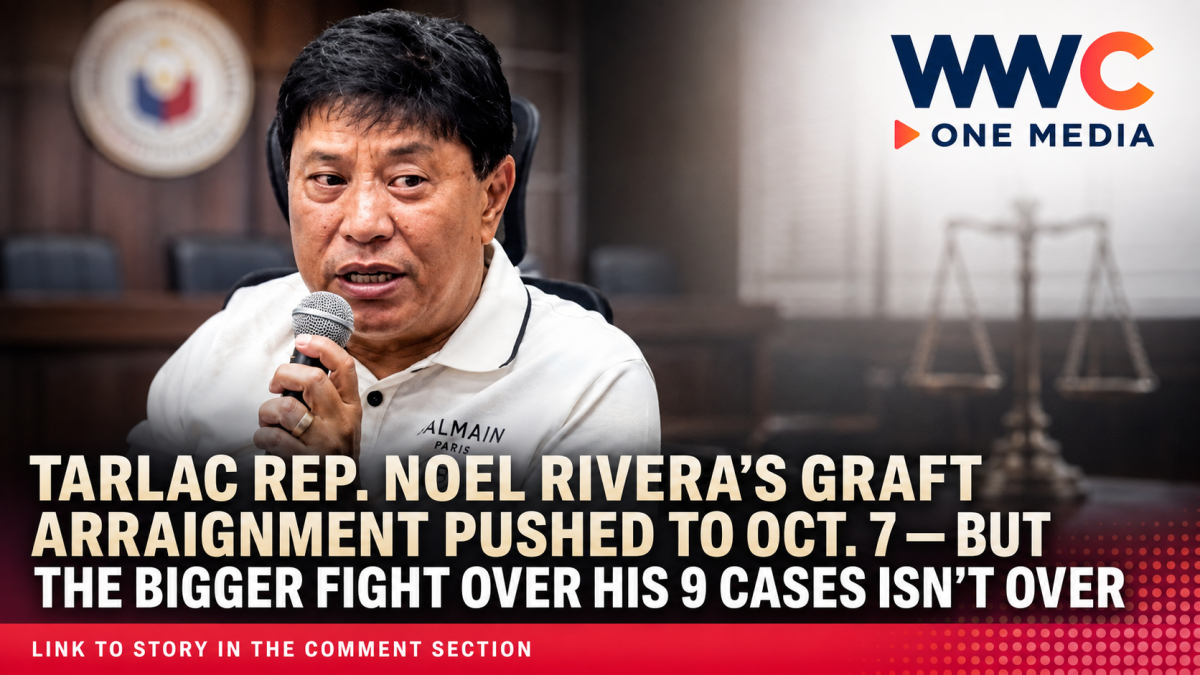
MANILA, Philippines — Tarlac 3rd District Rep. Noel Rivera will have to wait longer before entering a plea in graft cases filed against him, after the Sandiganbayan Fifth Division moved his scheduled arraignment to October 7, 2026 while the court considers pending motions challenging how the cases should proceed.
Rivera is facing nine counts of alleged violations of Section 3(h) of Republic Act No. 3019, or the Anti-Graft and Corrupt Practices Act. Two of those cases are currently before the Sandiganbayan Fifth Division, while the remaining cases were distributed among several other divisions of the anti-graft court.
The postponement is procedural and does not amount to a dismissal of the charges.
During the September 1 hearing, Fifth Division Chairperson Associate Justice Zaldy Trespeses noted that Rivera’s lawyers had filed motions seeking both the consolidation of the cases and the quashing of the criminal informations.
State prosecutors filed a consolidated opposition to those motions on August 28, after which the matters were submitted for resolution. Because the motions remain pending before the Fifth Division, Rivera’s arraignment in the two cases handled by that division was deferred.
Why Rivera wants the nine cases consolidated
Rivera has sought to have his nine graft cases heard together instead of having them proceed before several separate Sandiganbayan divisions.
His camp previously argued that the cases involve the same parties, substantially similar allegations and common legal issues, and that none of the cases had yet proceeded to trial.
But that strategy has already encountered resistance.
On August 27, the Sandiganbayan Sixth Division rejected Rivera’s request to consolidate the cases assigned to it with the other graft charges.
Prosecutors argued that each case involves a separate infrastructure project and that combining all of them could make the proceedings more complicated rather than more efficient.
The Sixth Division agreed, ruling that consolidation could require one court to hear evidence involving all of the different projects before resolving any individual case — potentially producing more documents, more witnesses and a longer proceeding.
That ruling does not automatically resolve the motions pending before every other Sandiganbayan division, which helps explain why Rivera’s Fifth Division cases have not yet reached arraignment.
What are the graft charges about?
The criminal cases center on allegations involving Rivera’s financial connection to Tarlac 3-G Construction and Development Corporation.
According to prosecutors, Rivera and his wife had alleged shareholdings in the construction company while it obtained nine government infrastructure contracts during Rivera’s term from 2022 to 2025.
The Office of the Ombudsman announced the filing of the nine graft counts on August 7.
Ombudsman Jesus Crispin Remulla said the cases involved an alleged conflict of interest connected with infrastructure and flood-control projects. The nine cases were divided among the First, Second, Fourth, Fifth, Sixth and Seventh divisions of the Sandiganbayan.
The Fifth, Sixth and Seventh divisions received two cases each, while the First, Second and Fourth divisions received one each.
The ₱600-million allegation
Separate reporting by The Philippine Star said the complaint that preceded the criminal cases alleged that the Rivera couple’s construction company obtained around ₱600 million worth of government contracts.
The complainant also alleged that Rivera had signed roughly 30 government contracts awarded to the company since 2018.
Those figures are allegations raised in the complaint and should be distinguished from the narrower allegations cited in the nine criminal cases now pending before the Sandiganbayan.
Rivera has denied involvement in corruption and previously said he was prepared to answer the complaints against him.
The Philippine Star also reported that Rivera had posted ₱90,000 bail for each of the nine graft charges before an earlier scheduled arraignment in August.
What does Section 3(h) of the Anti-Graft Law prohibit?
Section 3(h) of Republic Act No. 3019 targets public officials who directly or indirectly hold a financial or pecuniary interest in a business, contract or transaction in which they participate in their official capacity — or in which the Constitution or another law prohibits them from having an interest.
Supreme Court jurisprudence identifies the basic elements as the accused being a public officer, having a direct or indirect financial interest in a business or transaction, and either participating in connection with that interest or being legally prohibited from holding it.
For members of Congress, the constitutional restriction is particularly relevant.
Article VI, Section 14 of the 1987 Constitution provides that a senator or member of the House may not, during his or her term, be directly or indirectly financially interested in a contract with the government or its agencies.
Whether prosecutors can prove that Rivera’s circumstances satisfy those legal requirements is ultimately a matter for the courts. At this stage, the charges remain allegations, and Rivera is entitled to the presumption of innocence unless proven guilty beyond reasonable doubt.
Why October 7 matters
The next significant date for Rivera’s Fifth Division cases is now October 7.
But the more important development may come before the arraignment itself.
The Fifth Division still has to act on Rivera’s pending efforts to challenge the informations and consolidate the cases. Those rulings could determine whether the two cases proceed as currently filed and how quickly the prosecution moves toward trial.
Meanwhile, the Sixth Division’s earlier rejection of consolidation shows that Rivera’s attempt to bring all nine charges before one court division faces a significant legal obstacle.
For now, the nine graft charges remain alive — and Rivera’s legal battle is still focused on what happens before he even enters a plea.



Leave a Reply