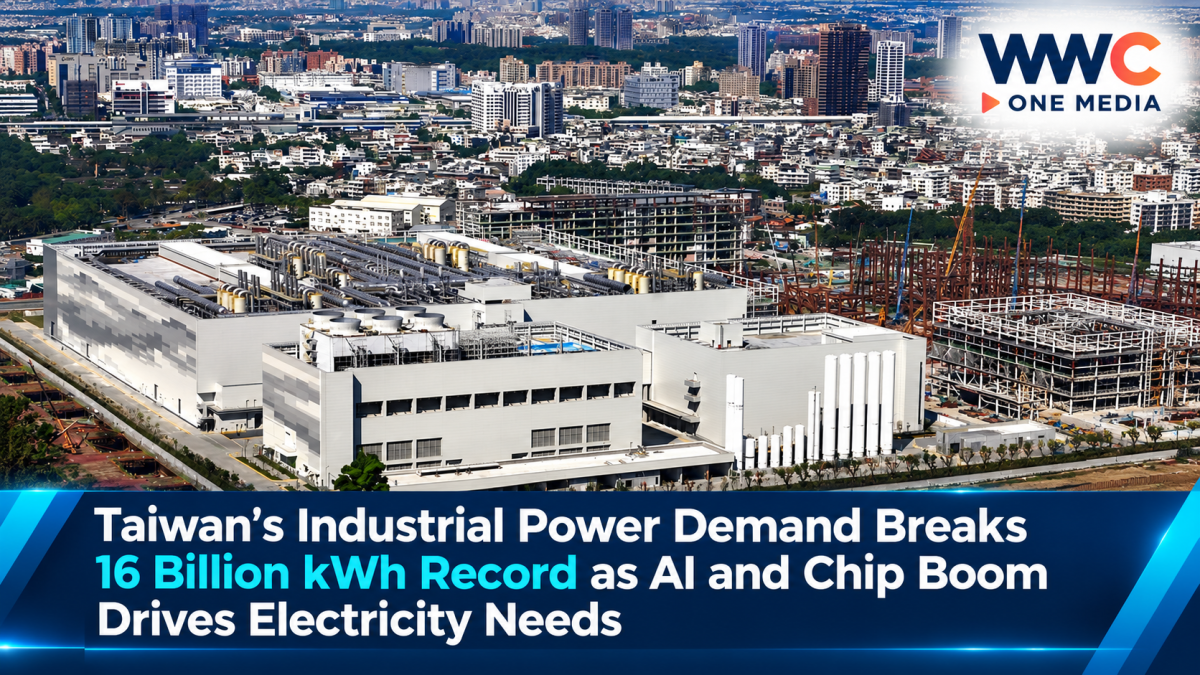
TAIPEI — Taiwan’s electricity demand from high-voltage industrial users crossed a major milestone in August, highlighting the growing amount of power needed to support the island’s semiconductor and artificial-intelligence economy.
Electricity consumption by Taiwan’s high-voltage and extra-high-voltage industrial users reached more than 16 billion kilowatt-hours in August, setting a new record, according to data cited by Taiwan News and Taiwanese economic research. Total consumption in the category increased 0.82% from a year earlier, while consumption among high-voltage and extra-high-voltage manufacturers rose 0.53%.
The figures come as Taiwan continues to expand semiconductor production, AI-related infrastructure and data-center capacity — industries that require increasingly large and reliable supplies of electricity.
AI Boom Pushes Taiwan’s Electricity Demand Higher
The latest power figures are closely connected to the continuing global AI investment boom.
Taiwanese industry researchers said strong demand for high-performance computing, AI servers and data centers is supporting activity across the semiconductor and information-technology supply chains.
Taiwan’s semiconductor industry remains at the center of this expansion, with companies investing in advanced manufacturing and packaging capacity to meet demand for AI-related chips.
The Taiwan Institute of Economic Research said the strong AI investment cycle is contributing to continued demand for semiconductors, servers and related components. Its August electricity indicator remained in the “hot” range, while high-voltage industrial electricity consumption reached a record level.
A Record Despite Lower Taipower Sales
One of the more notable details in the data is that industrial electricity consumption increased even as Taiwan Power Co. reported lower electricity sales to high-voltage users.
Taipower’s sales to high-voltage and extra-high-voltage industrial users declined 2.04% year over year in August. Sales to manufacturers fell 2.79%, while sales to service-sector users increased 1.19%.
The apparent difference is partly explained by the growing use of renewable electricity.
Taiwan News reported that companies — particularly semiconductor and technology firms — have been increasing their purchases of renewable power. As a result, some electricity previously supplied directly by Taipower is now being supplied through renewable-energy providers.
That means Taipower’s sales figures do not necessarily represent the total amount of electricity being consumed by industrial businesses.
Semiconductor Expansion Adds to the Pressure
Taiwan’s electricity needs are expected to remain elevated as semiconductor companies continue expanding production.
The Ministry of Economic Affairs estimates that Taiwan’s electricity consumption could grow by an average of about 2.5% annually over the next decade, substantially faster than the roughly 1.2% average annual growth recorded during the previous decade.
New semiconductor investments and AI data centers are expected to be among the main sources of additional demand.
The issue is particularly important because Taiwan’s technology sector is simultaneously expanding its manufacturing footprint and increasing its reliance on electricity-intensive computing and advanced semiconductor processes.
Taiwan’s Export Boom Adds Another Piece to the Picture
The electricity record comes alongside another major economic milestone.
Taiwan’s export orders exceeded NT$3.17 trillion (about US$100 billion) in August, passing the US$100-billion mark for the first time, according to the Ministry of Economic Affairs.
Reuters reported that August export orders surged as global demand for AI technology continued to boost Taiwan’s semiconductor and technology industries.
The combination of record export orders and record industrial electricity consumption illustrates how strongly the AI boom is influencing Taiwan’s manufacturing economy.
The Electricity Challenge Ahead
The record does not simply signal stronger industrial activity; it also highlights the infrastructure challenge accompanying Taiwan’s technology expansion.
As semiconductor fabs, AI data centers and related facilities increase their operations, Taiwan will need sufficient generation capacity, transmission infrastructure and reliable electricity supplies to keep pace with demand.
The government has already identified rising electricity consumption from AI data centers and semiconductor manufacturing as an important factor in long-term electricity planning. The Ministry of Economic Affairs’ national electricity outlook incorporates those trends into its projections through 2035.
At the same time, the growing use of renewable electricity means that the composition of Taiwan’s power supply is also changing. Businesses are increasingly purchasing green power directly, making the overall electricity market more complex than Taipower sales figures alone might suggest.
What the Record Means for Taiwan
Taiwan’s 16-billion-kWh industrial electricity milestone is therefore more than a single monthly statistic.
It reflects the enormous energy requirements behind the island’s position in the global semiconductor and AI supply chain — from chip fabrication and advanced packaging to servers and data centers.
With global AI investment still expanding and Taiwan’s export orders reaching unprecedented levels, electricity demand is becoming an increasingly important part of the country’s technology-growth story.
The question now is how quickly Taiwan can expand and diversify its power infrastructure while keeping pace with an AI-driven economy that is demanding more electricity than ever before.
WWC ONE MEDIA G,A