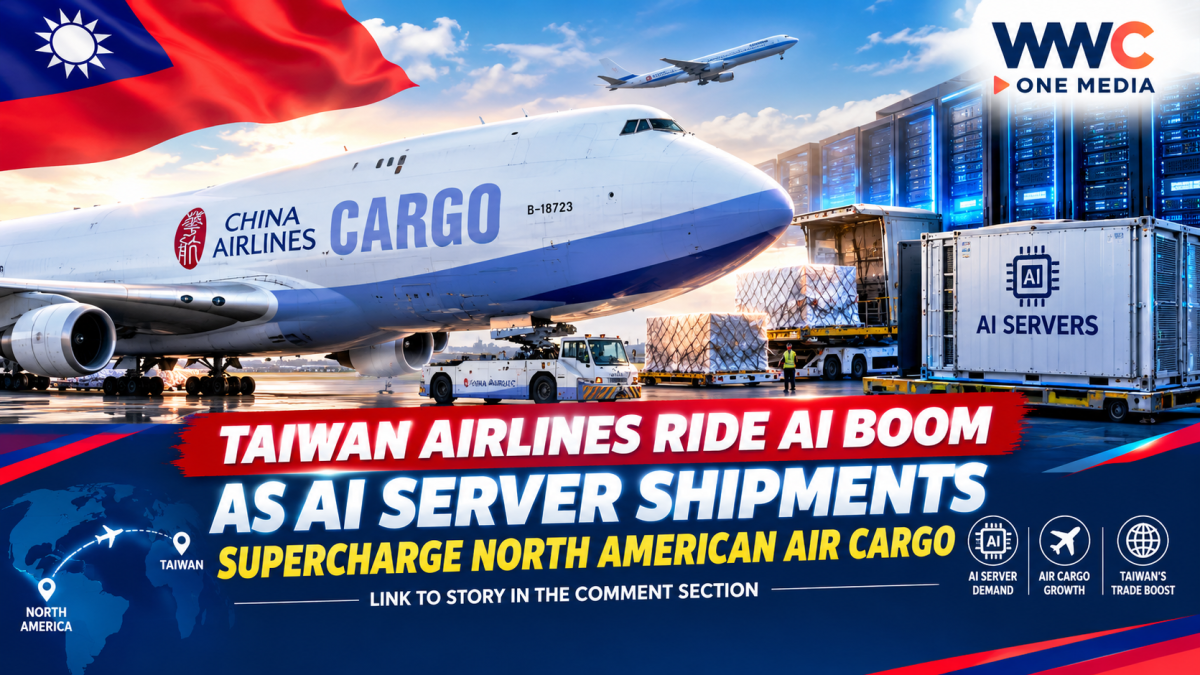
TAIPEI — Taiwan’s aviation industry is gaining another major boost from the global artificial intelligence boom, with AI servers, semiconductor equipment and data-center hardware driving increasingly strong air-cargo flows between Asia and North America.
The surge is creating new opportunities for Taiwan’s three major international carriers — China Airlines, EVA Air and STARLUX Airlines — as technology companies prioritize fast transportation for high-value equipment that is often too large, expensive or time-sensitive for conventional shipping.
AI infrastructure is reshaping the air-cargo market
The latest demand wave is closely tied to the rapid expansion of AI data centers worldwide. As companies and governments invest heavily in computing infrastructure, shipments of AI servers, semiconductor manufacturing equipment, electronic components and networking hardware have become increasingly important sources of air cargo.
China Airlines expects its cargo revenue to rise by roughly 40% to 50% in 2026, according to figures reported by Taiwan’s Central News Agency.
The carrier operates more than 40 freighter flights a week in North America, with the region accounting for more than 60% of its cargo revenue.
The company said the AI-related cargo surge became particularly noticeable after global investment in AI infrastructure accelerated in 2024.
EVA Air prepares for more AI cargo
EVA Air is also seeing strong demand for large AI-related shipments.
The airline said AI servers, server racks, semiconductor equipment and other data-center products are creating demand not only for regular cargo capacity but also for charter flights and reserved cargo space.
Because many of these shipments are bulky, valuable and time-sensitive, airlines need specialized freighter capacity and careful ground-handling arrangements.
EVA Air President Sun Chia-ming previously said AI-related cargo represented roughly 40% to 50% of the airline’s cargo business, while North America accounted for about 70% of cargo revenue.
To accommodate continued demand, EVA Air plans to increase its freighter fleet from nine aircraft to 12 by 2028.
STARLUX joins the competition
STARLUX Airlines is also benefiting from the technology-driven cargo boom, even though it does not yet operate dedicated freighters.
The airline currently relies largely on passenger aircraft belly capacity for cargo, but shipments of AI servers, semiconductor equipment and other high-tech products have helped lift its cargo business.
STARLUX recorded cargo revenue of about NT$713 million in May, up 68% year on year, while August cargo revenue reached about NT$672 million, an annual increase of 41%.
The carrier has ordered 10 Airbus A350F freighters, positioning it to compete more directly for the growing high-value cargo market once the aircraft enter service. Delivery timing could extend into 2028.
Taiwan’s export boom adds another layer
The aviation cargo surge is occurring alongside a broader technology-led expansion in Taiwan’s exports.
Taiwan’s exports reached a record NT$2.62 trillion in August, up 41% from a year earlier, with electronic components and information, communications and audiovisual products among the major growth drivers.
Recent CNA reporting also found that Taiwan’s semiconductor-related air-freight market is experiencing strong demand, with logistics providers describing capacity as tight as AI-related shipments continue to expand.
The trend is increasingly creating a more interconnected logistics network linking Taiwan with North America, Japan and Southeast Asia.
Why the AI boom matters for airlines
Unlike ordinary consumer goods, AI servers and semiconductor equipment can be extremely valuable and time-sensitive. Large systems may require dedicated freighters, chartered capacity or specially reserved space to reach data centers and technology facilities on schedule.
That makes the AI infrastructure buildout more than a technology story — it is also becoming a transportation and logistics story.
For Taiwan’s airlines, the opportunity comes as they navigate higher operating costs and changing global trade routes.
China Airlines said higher fuel costs linked to the conflict in the Middle East have put pressure on cargo operations, but strong AI-related demand has helped support freight rates.
The bigger question now is how long the AI-driven cargo cycle can remain strong.
For the moment, Taiwan’s airlines are expanding capacity, adjusting networks and positioning themselves around one of the fastest-growing segments of global air freight: the physical movement of the infrastructure powering the AI economy.
WWC ONE MEDIA G,A