
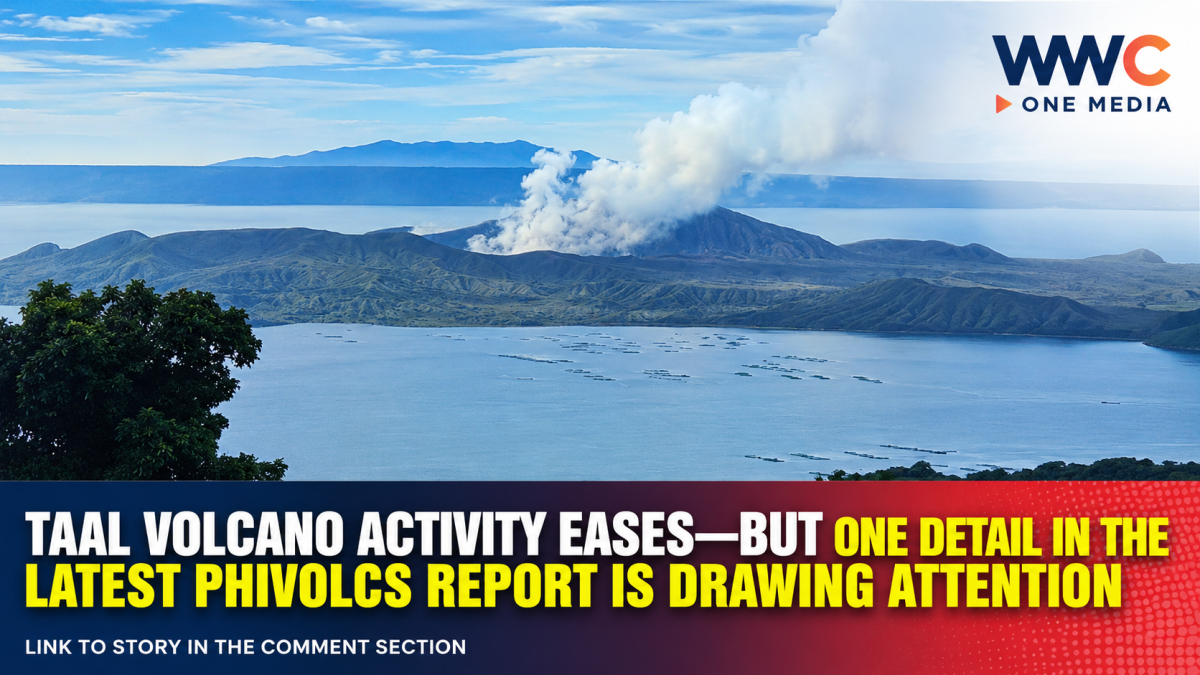
BATANGAS, Philippines — Taal Volcano recorded a noticeable drop in seismic activity over the past 24 hours, but state volcanologists continue to closely monitor the volcano amid its ongoing low-level unrest.
The Philippine Institute of Volcanology and Seismology (PHIVOLCS) reported six volcanic earthquakes and one volcanic tremor lasting 420 minutes in its latest 24-hour monitoring period ending September 1, 2026.
While the latest figures represent a decline from the elevated seismic activity recorded in previous days, PHIVOLCS continues to classify Taal Volcano under Alert Level 1, or low-level volcanic unrest.
The latest monitoring data showed that Taal’s seismic activity had eased considerably compared with the heightened activity observed in late August.
From August 20 to 28, the volcano recorded a total of 229 volcanic earthquakes and 12 tremor episodes, according to PHIVOLCS data cited in recent reports. Taal subsequently registered eight earthquakes on August 29, eight on August 30, and 13 on August 31.
The latest six-earthquake reading therefore marks a significant decrease from those recent daily figures.
A 420-minute tremor was also recorded
Despite the lower number of earthquakes, one detail in the latest bulletin stands out: the recorded volcanic tremor lasted 420 minutes, or seven hours.
PHIVOLCS describes volcanic tremors as continuous seismic signals that can have regular or irregular oscillations and generally occur at low frequencies. Such tremors are among the seismic phenomena monitored to assess volcanic activity.
The occurrence of a tremor, however, does not by itself mean that an eruption is imminent.
PHIVOLCS’ latest observations also indicated no upwelling of hot volcanic fluids in the Main Crater Lake and no observed volcanic smog, or vog, during the monitoring period.
Sulfur dioxide emissions remain weak
Taal Volcano continued to release sulfur dioxide (SO₂), with PHIVOLCS recording 381 metric tons during the latest monitoring period.
The agency classified the emission level as weak.
The latest figure comes after a period of fluctuating sulfur dioxide emissions. On August 28, PHIVOLCS also recorded 381 metric tons of SO₂ amid continued seismic activity.
Recent monitoring therefore shows that while Taal’s earthquake activity has declined, the volcano remains under observation because its overall condition is still considered abnormal.
Alert Level 1 remains in effect
Taal Volcano remains under Alert Level 1, which indicates low-level volcanic unrest.
This status does not mean that the volcano has returned to a completely normal condition. PHIVOLCS has repeatedly reminded the public that Alert Level 1 means the volcano remains in an abnormal state and that volcanic hazards can still occur.
Authorities continue to prohibit entry into Taal Volcano Island, which is designated as a Permanent Danger Zone, particularly around the Main Crater and the Daang Kastila fissure.
Civil aviation authorities are also advised to remind pilots to avoid flying close to the volcano because a sudden eruption could pose an aviation hazard.
Rain brings another concern around Taal
Volcanic activity is not the only hazard being monitored around Taal.
Amid continued rains associated with the southwest monsoon, PHIVOLCS recently warned that prolonged or intense rainfall could generate muddy streamflows and volcanic debris around Taal.
The agency identified portions of the western and northern slopes of Taal Lake as areas that could be affected, including communities in Agoncillo, Laurel and Talisay, Batangas.
Residents in potentially affected areas have been urged to remain alert to weather conditions and take appropriate precautions.
For now, the latest numbers suggest that Taal’s recent surge in seismic activity has eased, but authorities continue to watch the volcano closely.




Leave a Reply