
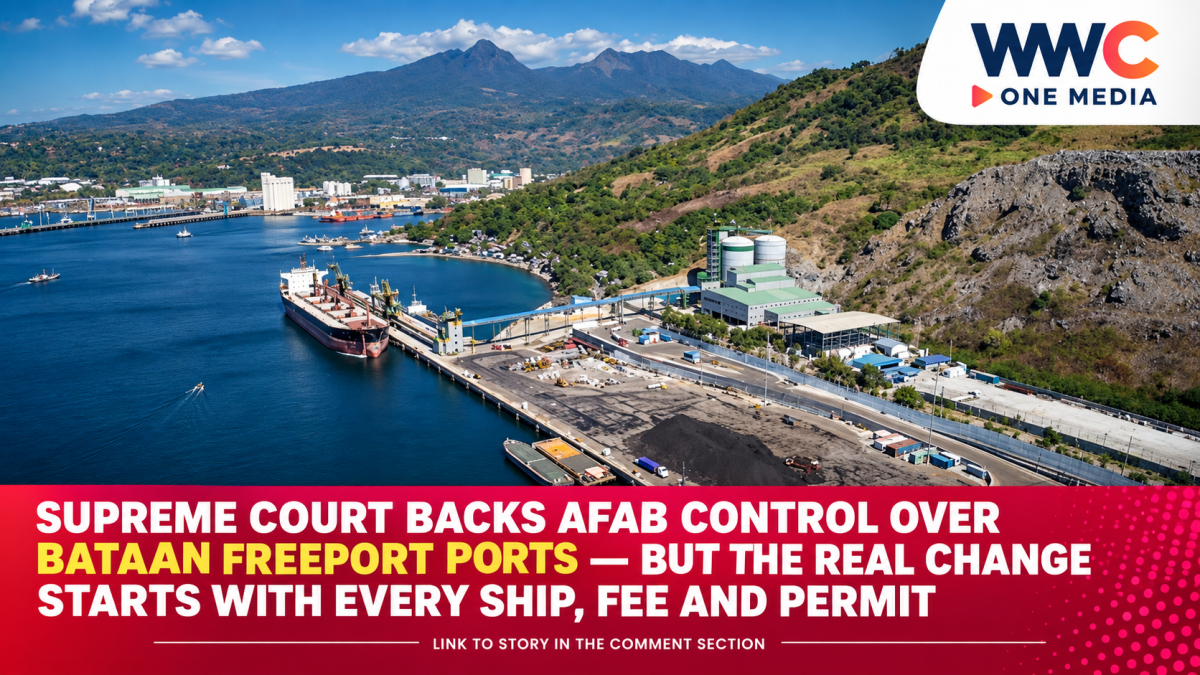
MARIVELES, Bataan — The Authority of the Freeport Area of Bataan says a Supreme Court ruling has settled a years-long dispute over who controls port activity inside the Freeport, strengthening AFAB’s hand over private terminals, maritime transactions, permits, charges and other port-related operations at a time when vessel traffic is accelerating.
The ruling was issued in February 2026, according to AFAB, and affirmed the agency’s regulatory and administrative authority over port operations within the Freeport Area of Bataan and its approved expansion areas.
A writ of execution was issued on June 8, allowing AFAB to begin implementing the decision and coordinating with enterprises and private port operators on the transition to its regulatory framework.
That means the ruling is no longer merely a legal clarification.
It is beginning to affect how companies using Bataan’s private port facilities handle regulatory requirements, administrative processes and collections.
And with maritime traffic rising sharply, the timing matters.
588 vessel calls in seven months
AFAB data cited in current reports show that ports inside the Freeport handled 828 vessel calls in all of 2025.
From January through July 2026, they had already recorded 588 calls—about 71% of the previous year’s full-year total.
If that seven-month pace were sustained through December, 2026 traffic would exceed last year’s level.
AFAB estimates that maintaining the same rate would put vessel calls roughly 21.7% above the 2025 total.
The figures underline why control of port regulation is commercially important.
For manufacturers, energy companies, logistics operators and other industrial locators, maritime access is not a side issue.
Ships carry fuel.
They move imported raw materials.
They deliver machinery.
And they export finished products.
Who licenses, regulates and collects charges on those operations can directly affect the cost and speed of doing business.
The law already gives AFAB sweeping port powers
The Supreme Court development builds on powers Congress explicitly gave AFAB years ago.
Republic Act No. 11453, enacted in 2019, strengthened the Freeport’s charter and expanded AFAB’s authority over infrastructure and services inside its jurisdiction.
The law authorizes AFAB to regulate the establishment, construction, operation and maintenance of infrastructure and services involving:
shipping, barging, stevedoring, cargo handling, hauling, warehousing, cargo storage, port services and concessions, piers, wharves, bulk terminals, mooring areas and related facilities.
It also gives AFAB authority to license port services, impose fees and fix reasonable and competitive charges, while allowing it to establish and maintain infrastructure connected with maritime operations.
RA 11453 goes even further.
It specifically empowers AFAB to establish, operate and maintain facilities and businesses related to shipping and maritime activities, including stevedoring and port terminal services or concessions, while preserving MARINA’s regulatory jurisdiction over areas such as domestic shipping, shipbuilding and ship repair where applicable.
In other words, the legal framework was already broad.
The latest ruling, according to AFAB, resolves uncertainty over how those powers apply in practice to port facilities and transactions inside the Freeport.
Expansion areas matter too
The decision is also significant because the modern Freeport Area of Bataan extends beyond the original Mariveles industrial zone.
RA 11453 defines the FAB main zone as approximately 1,742.48 hectares in Mariveles while allowing additional expansion areas elsewhere in Bataan, subject to statutory requirements.
The law also expressly includes municipal waters along the coastline of the main zone and approved expansion areas within the expanded definition of the Freeport.
That matters for ports.
Industrial estates and power, logistics or manufacturing projects outside the original core area can still depend heavily on coastal access.
If those sites form part of approved FAB expansion zones, AFAB says the Supreme Court ruling confirms its port-regulatory mandate there as well.
What changes for private port operators
The practical effect is likely to be felt first by companies already operating private terminals or using maritime facilities inside the Freeport.
AFAB says affected enterprises will now coordinate with the agency on applicable:
regulatory requirements,
administrative processes,
port-related collections, and
rules governing the operation and use of port facilities.
The authority says it is working with locators and private port operators to move them into the clarified framework while avoiding disruptions to existing business operations.
That transition will be important.
A legal victory that produces duplicated permits, unclear charges or operational delays could undermine the ease-of-doing-business argument behind centralized regulation.
A system in which responsibilities are clearly assigned, on the other hand, could reduce uncertainty for investors.
The real test will therefore be implementation.
AFAB has been seeking clarity since 2021
The current dispute did not begin this year.
According to AFAB’s account, the proceedings were initiated in 2021 to obtain clarity on the extent of the authority’s jurisdiction over port facilities and transactions within the Freeport.
That puts the latest development at the end of a roughly five-year legal process.
The underlying issue is understandable.
Ports can involve overlapping government interests.
There are questions of customs administration, maritime safety, shipping regulation, local government jurisdiction, environmental compliance and the operation of the economic zone itself.
Freeport authorities are created precisely to centralize many business and regulatory functions inside a defined economic territory.
But national agencies retain authority over matters reserved to them by law.
RA 11453 itself reflects that balance by granting AFAB broad authority while preserving coordination with other agencies where statutes require it.
AFAB is a government instrumentality, not an ordinary corporation
The Supreme Court has previously examined AFAB’s legal status in a separate case.
In its 2021 ruling in Authority of the Freeport Area of Bataan v. F.F. Cruz & Co., the Court characterized AFAB as a government instrumentality vested with corporate powers, rather than an ordinary government-owned or controlled corporation.
The Court explained that AFAB forms part of the national government machinery while enjoying operational autonomy under its charter.
That 2021 case was about disputed land and should not be confused with the current port-authority dispute.
In fact, AFAB lost the procedural question in that earlier case because the Supreme Court held that only the Republic, through the Office of the Solicitor General, could bring the relevant reversion action over the disputed public land.
But the earlier decision remains relevant because it explains AFAB’s institutional status and recognizes the Freeport’s connection to port functions and public-domain property.
The Freeport has been a port for decades
Mariveles’ maritime role predates AFAB itself.
Republic Act No. 5490 established Mariveles as a principal port of entry and foreign trade zone in 1969. The area later became the Bataan Economic Zone before Congress converted it into the Freeport Area of Bataan through RA 9728 in 2009.
In an earlier tax case involving the former Bataan Economic Zone, the Supreme Court described the area as a port used for the unloading and introduction of imported goods and recognized the Freeport as property of public dominion.
That history helps explain why maritime infrastructure sits at the center of the Freeport’s commercial model.
Bataan’s industrial economy is built around sectors where moving heavy cargo by sea can be considerably more practical than relying exclusively on road transport.
Why investors care about regulatory certainty
Ports are expensive infrastructure.
Companies making long-term investments in terminals, storage facilities, power plants or manufacturing operations need to know which government body will regulate those investments.
Uncertainty can create several problems:
A company may not know which permits it needs.
Two government entities may impose overlapping requirements.
Fees can become unpredictable.
Project financing may become more complicated if investors are unsure which approvals are legally controlling.
And disputes can delay port expansion or upgrades.
AFAB is presenting the ruling as a way to remove that uncertainty by placing Freeport port operations under a clearer regulatory framework.
For businesses considering multimillion- or billion-peso projects, predictability can matter almost as much as the actual fee charged.
The ruling lands as AFAB pursues more investment
AFAB is simultaneously trying to expand the Freeport’s investor base.
Earlier this month, the authority signed a memorandum of understanding with Tianda Solar as the Chinese company explores potential investment opportunities inside the FAB.
AFAB officials also visited Tianda Copper’s manufacturing operations during the investment mission, highlighting the Freeport’s continuing push toward industrial and manufacturing projects.
For companies producing or moving large quantities of equipment, metals, energy products or industrial materials, port capacity and regulation can directly influence investment decisions.
That makes the Supreme Court development part of a broader investment story rather than an isolated courtroom victory.
But “exclusive authority” needs careful wording
Some current reports describe the ruling as affirming AFAB’s “exclusive” authority over the Freeport’s ports.
That wording should be used carefully.
RA 11453 itself preserves roles for other government agencies in particular areas.
For example, MARINA retains specified responsibilities involving shipbuilding, ship repair and the domestic shipping industry, while customs, environmental and other statutory requirements may still involve national agencies depending on the activity.
The safer formulation is therefore:
The Supreme Court affirmed AFAB’s regulatory and administrative authority over port operations and facilities within the Freeport and its expansion areas, according to AFAB.
That captures the reported ruling without implying that every maritime or national-government regulatory function has been transferred wholesale to AFAB.
The bigger question is how the ruling works at the dock
On paper, the decision resolves a jurisdictional problem.
In practice, its success will be judged very differently.
Will vessels be processed faster?
Will businesses face fewer overlapping requirements?
Will fees become more predictable?
Will private port operators still be able to expand efficiently?
Will AFAB’s one-stop-shop model actually reduce red tape?
And will the authority be able to oversee more port traffic without creating new administrative bottlenecks?
Those questions matter because maritime activity is already rising.
There were 828 vessel calls in 2025.
There were already 588 in the first seven months of 2026.
The Supreme Court fight may have been about legal authority.
But from this point forward, the story is about execution.
AFAB has secured clearer control over Bataan Freeport port regulation. Now it has to prove that clearer control produces a faster, more predictable and more competitive port system.



Leave a Reply