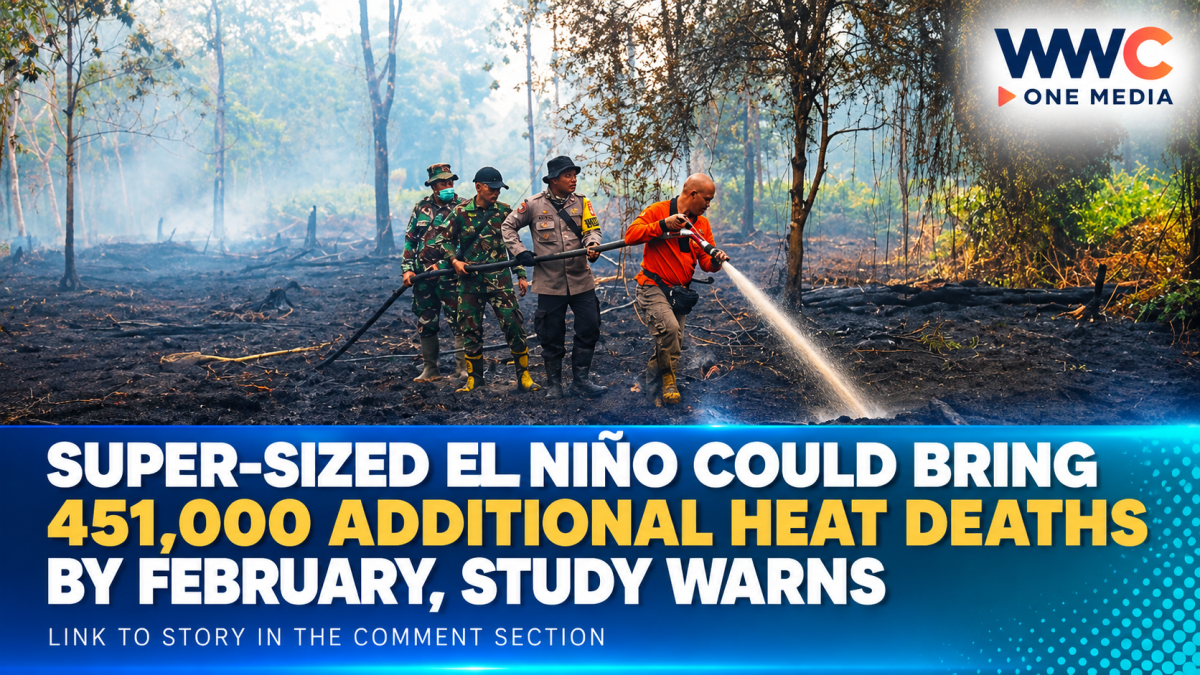
A powerful El Niño event and the extreme heat accompanying it could be linked to as many as 451,000 additional heat-related deaths worldwide by February 2027, according to a new analysis from the University of Chicago-based Climate Impact Lab.
The estimate covers the period from June 2026 through February 2027 and represents deaths above the number researchers would expect during a typical year. The researchers say the danger is being amplified by a combination of El Niño and the planet’s already elevated temperatures caused by long-term global warming.
The warning comes as scientists monitor an unusually strong El Niño that is driving temperatures higher across large parts of the world while also contributing to drought, wildfires and pressure on water supplies.
Nearly half a million additional deaths projected
The Climate Impact Lab estimated the potential death toll by combining seasonal temperature forecasts with previously established relationships between temperature and mortality across more than 24,000 regions worldwide.
Researchers compared projected deaths during the current El Niño period with deaths expected under temperatures resembling those experienced during the previous three decades.
Their model produced an estimate of 451,000 excess heat-related deaths between June 2026 and February 2027.
However, the figure should not be interpreted as a confirmed prediction that 451,000 people will die.
The analysis has not yet undergone peer review. A University of Warwick researcher quoted by Scripps News said the estimate was plausible as a modelling exercise but should not be regarded as a definitive forecast.
The researchers said they released their findings before peer review because the El Niño event is already developing and governments still have an opportunity to implement measures intended to reduce heat-related deaths.
Poorer and hotter regions face the greatest risk
The projected burden is expected to fall disproportionately on countries that are already hot and have fewer resources to protect residents from extreme temperatures.
The Climate Impact Lab’s analysis identifies the Sahel region of Africa as one of the areas facing the largest projected impact, with roughly 66,800 additional heat-related deaths estimated across the region.
South and Southeast Asia and parts of Latin America are also identified as major areas of concern. The analysis estimates approximately:
- 19,400 additional deaths across the Philippines, Vietnam, Thailand and Cambodia
- 19,300 in Indonesia
- 15,800 in India
- 13,300 in Brazil
The distribution reflects the heightened danger of extreme heat in regions where populations may have less access to air conditioning, reliable water supplies and well-resourced health systems.
Other reporting on the study identified Nigeria, Indonesia, Sudan, India and Brazil among the countries projected to experience particularly large numbers of additional heat-related deaths. The United States was also included among the 20 countries with the highest projected totals, with an estimate of about 3,500 additional deaths.
Why El Niño can make extreme heat worse
El Niño is a naturally occurring climate pattern involving changes in ocean temperatures and atmospheric circulation, particularly across the tropical Pacific.
Its effects can extend far beyond the Pacific, altering weather patterns around the globe.
The current event is occurring against a backdrop of long-term global warming. According to the Climate Impact Lab analysis, El Niño could push global land temperatures about 1.2°C (2.1°F) above normal in the coming months.
The study estimates that this could produce 44% more days of extreme heat than would normally be expected.
Scientists involved in the research argue that the event offers a glimpse of the type of heat that climate change could make increasingly common in the future.
The heat threat may continue after El Niño fades
One of the concerns highlighted by researchers is that the health consequences may not immediately disappear when El Niño itself weakens.
Michael Greenstone, a co-founder of the Climate Impact Lab and one of the report’s authors, said the heat danger could persist beyond February, potentially extending into the following summer.
That means the period covered by the current estimate may not capture all of the health consequences associated with the broader weather pattern.
The researchers also stressed that the 451,000 figure concerns heat-related deaths. Other hazards associated with El Niño — including floods, droughts and wildfires — could create additional health and mortality impacts that are not included in that number.
Experts caution against treating the number as certain
The headline figure has attracted attention because of its scale, but experts have emphasized the uncertainty surrounding any long-range mortality model.
Al Jazeera reported that some climate and health experts questioned aspects of the regional estimates, while acknowledging that the coming months could bring substantial health consequences from extreme heat.
The fact that the analysis has not yet been peer-reviewed is another reason the 451,000 figure should be treated as a modelled estimate rather than a confirmed forecast.
Nevertheless, researchers say the potential scale of the threat justifies early preparation.
Governments can take steps to reduce deaths
The Climate Impact Lab says governments do not have to simply wait for extreme heat to arrive.
Measures recommended in the report include:
- Early heat-warning systems
- Cooling centres
- Hydration stations
- Greater protection for outdoor workers
- Increased hospital capacity
- Targeted assistance for older people and other vulnerable groups
- Emergency funding that can be deployed before dangerous heat peaks
Researchers argue that advance preparation could prevent some heat-related deaths during the current El Niño cycle.
For countries across tropical and subtropical Asia, the warning is particularly significant. Several nations in the region are already identified in the study as facing substantial additional heat-related mortality.
A warning, not a confirmed death toll
The 451,000 figure is best understood as a projection of potential excess heat-related deaths under the researchers’ model, not a prediction that a specific number of people will definitely die.
But the report highlights a broader concern: an unusually strong El Niño is arriving at a time when global temperatures are already exceptionally high.
Whether the eventual death toll approaches the model’s estimate will depend partly on how the weather develops — and on how quickly governments and communities respond to the heat risk.