
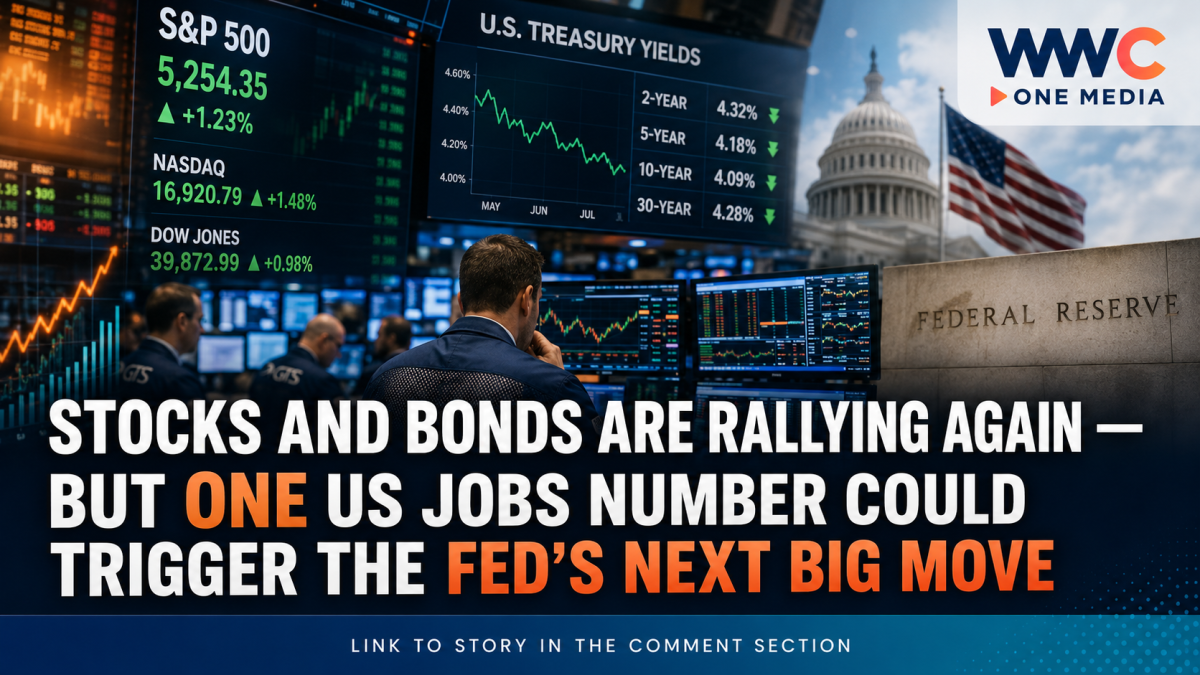
TOKYO — Global financial markets found some relief Thursday, with Asian stocks and government bonds rebounding from a bruising selloff. But underneath the rally, investors are preparing for a potentially decisive few days that could determine whether the US Federal Reserve raises interest rates later this month.
Asian equities moved higher while bond yields retreated from recent peaks, as investors waited for fresh US economic data and comments from Federal Reserve officials.
The MSCI index of Asia-Pacific shares outside Japan gained about 0.5%, following a modest rebound on Wall Street. US stocks had snapped a three-day losing streak Wednesday, with the S&P 500, Dow Jones Industrial Average and Nasdaq all advancing roughly 0.5% to 0.6%.
The rebound offered investors a temporary break after rising oil prices, surging government borrowing costs and renewed Middle East tensions rattled markets at the start of September.
But the biggest question facing traders has not disappeared:
Will the Federal Reserve raise interest rates again?
Fed rate hike odds jump ahead of September meeting
Interest-rate markets have sharply increased expectations that the Fed could tighten monetary policy at its September 15-16 meeting.
According to CME FedWatch data cited by Reuters, traders were assigning roughly a two-in-three probability to a 25-basis-point rate increase, compared with only about 37% a week earlier.
The Federal Reserve’s official calendar confirms that policymakers will meet on September 15 and 16, with the decision and press conference scheduled for September 16. The meeting will also include an updated Summary of Economic Projections, giving markets a fresh look at policymakers’ expectations for inflation, growth and future interest rates.
The Fed’s benchmark rate is currently in a 3.5% to 3.75% target range, according to Reuters.
New York Fed President John Williams said Wednesday that he was still gathering information before reaching a decision. He argued that the recent rise in longer-term borrowing costs appeared to reflect a relatively strong US economy rather than inflation fears alone.
That makes the next round of economic data particularly important.
Weak hiring data complicates the Fed’s decision
The strongest argument against another rate hike may be coming from the labor market.
US private employers added only 38,000 jobs in August, according to the ADP National Employment Report. Economists surveyed by Reuters had expected an increase of 48,000.
Manufacturing employment fell by 17,000 jobs, while professional and business services lost another 16,000 positions. Education and health services remained a major source of hiring, adding 45,000 jobs.
The softer ADP figures immediately raised the stakes for Friday’s official US nonfarm payrolls report.
Economists surveyed by Reuters expect nonfarm payrolls to rebound by about 56,000 jobs after a surprise 23,000 decline in July, while the unemployment rate is forecast to remain at 4.1%.
A weak jobs report could make policymakers more cautious about raising borrowing costs.
A stronger-than-expected report, however, could reinforce the argument that the US economy is resilient enough to withstand tighter monetary policy.
That is the dilemma now confronting the Fed: inflation remains uncomfortable, but parts of the labor market are clearly cooling.
Fed’s own report shows the same economic split
The Federal Reserve’s latest Beige Book reinforces that mixed picture.
Economic activity increased modestly across the United States since early July, with 10 of the Fed’s 12 districts reporting slight-to-moderate growth.
Employment, however, rose only “very slightly” overall. Five districts reported no change in employment, while retail and hospitality businesses reported weakening demand for workers.
Inflation remains harder to dismiss.
Prices increased moderately in eight Federal Reserve districts, while businesses continued to report elevated costs for energy, transportation, metals, petrochemicals, health care and insurance.
Tariffs were also contributing to cost pressures reported by manufacturers and retailers.
The result is an increasingly difficult policy equation: economic growth has not collapsed, employment is slowing and inflationary pressures remain persistent enough to prevent policymakers from declaring victory.
Bond markets finally get some relief
Government bonds rallied Thursday after yields reached levels that had increasingly alarmed investors.
The benchmark US 10-year Treasury yield eased to about 4.78%, while Japan’s 30-year government bond yield dropped roughly 10 basis points to around 4.07% ahead of a major bond auction.
AP reported that the US 10-year yield had been around 4.20% at the beginning of 2026, illustrating how dramatically borrowing costs have risen this year.
Higher Treasury yields matter well beyond Wall Street.
They can filter into mortgage rates, corporate borrowing costs and other loans, while also making bonds more attractive compared with equities.
That means another sustained surge in yields could eventually threaten the stock-market rally.
Oil and the Iran conflict remain another major risk
Markets are also closely watching renewed military confrontation involving the United States and Iran.
The latest escalation has kept crude prices elevated, adding another inflation threat just as the Fed considers whether monetary policy is restrictive enough.
On Thursday, US crude slipped about 0.3% to $90.74 per barrel, while Brent crude eased to roughly $95.21. Gold climbed above $4,400 an ounce, according to Reuters data carried by CNA.
AP reported that rising oil prices and the broader conflict had already contributed to higher gasoline prices and global transportation costs, intensifying investor worries over inflation.
A significant decline in energy prices could reduce some of that pressure.
Another escalation could do the opposite.
Japan adds another interest-rate wildcard
Investors are not only watching the Federal Reserve.
Japan’s services sector expanded at its strongest pace in five months during August, strengthening the argument that the Japanese economy may be capable of absorbing another Bank of Japan rate increase.
The yen strengthened to around 158.6 per US dollar Thursday after rising sharply during the previous session.
Meanwhile, European Central Bank and Bank of Japan policy decisions are also being closely watched as investors assess whether the world’s major central banks are entering another synchronized tightening phase.
Why Friday could become the market’s turning point
For investors, the current rally should not be mistaken for the end of the volatility.
Several powerful forces are pulling markets in opposite directions.
AI-related investment and resilient corporate profits continue to support stocks. Slowing employment growth could reduce pressure on the Fed to tighten aggressively.
But persistent inflation, high oil prices, geopolitical instability and rising government bond yields are pushing policymakers in the opposite direction.
That makes Friday’s US employment report far more than another economic statistic.
A surprisingly strong jobs number could strengthen expectations for a September Fed rate hike and push bond yields higher again. A serious labor-market disappointment could force investors to rethink the entire tightening story.
For now, stocks and bonds are enjoying a relief rally.
The bigger test comes when Washington releases the numbers that could decide whether that relief lasts.
WWC ONE MEDIA MJE




Leave a Reply