
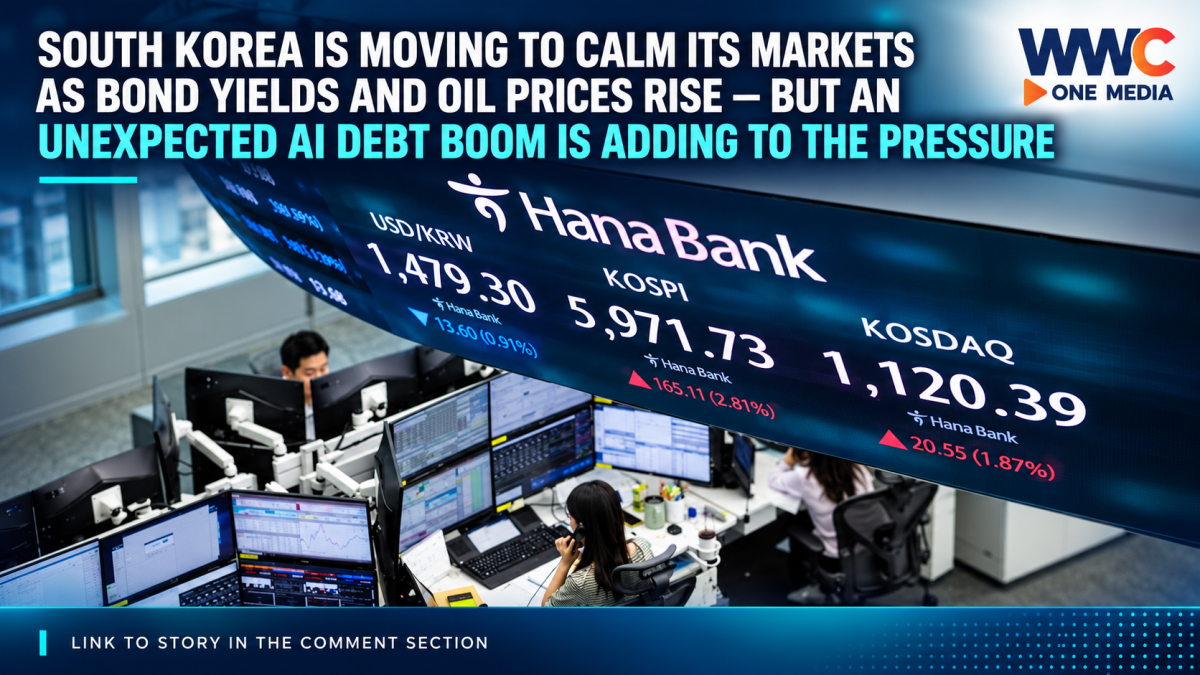
SEOUL — South Korea is stepping up efforts to shield its financial markets from a dangerous mix of rising global interest rates, expensive oil and renewed Middle East tensions — just as another unexpected force, the artificial intelligence investment boom, adds pressure to borrowing costs worldwide.
Finance Minister Koo Yun-cheol convened financial officials on September 4 to review conditions in domestic and global markets and discuss possible stabilization measures as volatility intensifies.
Officials said conditions remained broadly manageable for now. But the government warned that a sharp additional rise in interest rates could put heavier pressure on vulnerable borrowers and increase stress across parts of the financial system.
A Global Bond Shock Is Reaching Korea
The concern in Seoul is being driven partly by a much bigger phenomenon unfolding across global debt markets.
Government bond yields have risen sharply in several major economies as investors confront persistent inflation, enormous government borrowing requirements and growing expectations that interest rates may remain high.
Reuters reported that borrowing costs in the United States, Germany, Britain and Japan recently reached or approached multiyear or multidecade highs.
Japan’s benchmark 10-year government bond yield reached 3% for the first time since 1996, while the U.S. 10-year Treasury yield climbed to around 4.8% during the global selloff.
Higher bond yields matter far beyond financial markets. They can push up borrowing costs for governments, corporations and households, potentially affecting everything from mortgages and business investment to consumer credit and government budgets.
South Korea has not escaped the pressure.
The country’s 10-year Treasury bond yield closed at 4.418% on September 2, up from 4.371% the previous session. It later eased to 4.360% on September 4, illustrating how quickly the market has been moving.
The AI Boom Is Creating an Unusual Bond-Market Problem
One of the more surprising forces behind higher global yields is the enormous amount of money technology companies are borrowing to finance artificial intelligence infrastructure.
Major technology groups are spending aggressively on data centers, chips, cloud infrastructure and increasingly powerful AI models — and much of that expansion is being financed through debt.
Reuters, citing LSEG data, reported that five major AI hyperscalers — Alphabet, Amazon, Meta, Microsoft and Oracle — have issued about $220 billion in debt so far in 2026, more than double their combined issuance last year.
Total global corporate bond issuance has reached roughly $4.9 trillion this year, up about 14% from the same point in 2025.
The flood of new bonds increases the supply investors are being asked to absorb. When supply rises rapidly, borrowers may need to offer higher yields to attract buyers — contributing to upward pressure on borrowing costs throughout financial markets.
That dynamic was specifically highlighted during the Korean government’s market review.
Then There Is Oil
The bond-market problem is being complicated by another inflation threat: crude oil.
Renewed tensions in the Middle East have pushed energy prices sharply higher, raising concerns that expensive fuel could feed back into consumer prices and make it more difficult for major central banks to lower interest rates.
Aju Press reported that West Texas Intermediate crude was at $91.30 a barrel on September 3, compared with $69.50 at the end of June.
Reuters has also linked the latest global bond-market pressure to higher oil prices following renewed U.S.-Iran tensions, with investors concerned that another energy shock could keep inflation elevated and encourage central banks to maintain tighter monetary policy.
For South Korea, one of the world’s major energy importers, sustained high oil prices could create an uncomfortable combination of inflation pressure, higher import costs and more volatile financial markets.
Seoul Is Also Giving Smaller Listed Companies More Time
The government’s September 4 meeting was not limited to bond yields.
Officials also revised part of South Korea’s push to strengthen listing standards on the country’s stock markets.
The government had planned to increase the minimum market capitalization required for companies to remain listed on the tech-heavy KOSDAQ from 20 billion won to 30 billion won beginning in January 2027.
That increase has now been postponed by six months until July 2027, giving companies and investors more time to adjust after recent market turbulence.
The change extends beyond KOSDAQ.
Aju Press reported that the tougher minimum capitalization requirement for KOSPI-listed companies is also being delayed until July 2027. The KOSPI threshold had risen from 20 billion won to 30 billion won in July and was scheduled to increase again to 50 billion won in January.
That next increase will now also be postponed for six months.
A Softer Landing for Companies Facing Delisting
Seoul is also preparing a possible escape route for some companies that no longer meet the main markets’ listing standards.
Qualified companies facing delisting will be allowed to transfer from KOSPI or KOSDAQ to the smaller-company Korea New Exchange, or KONEX, without first going through the normal liquidation trading period.
The measure is designed to reduce the disruption for investors and businesses when companies fall below required listing standards.
Aju Press reported that eligibility will be limited to firms meeting specified financial requirements, including profitability or minimum equity conditions, while companies suffering capital impairment will be excluded.
Why Korea Is Watching So Closely
South Korea’s immediate challenge is that several global risks are now reinforcing one another.
Governments are issuing large amounts of debt. AI companies are borrowing aggressively. Oil prices are elevated. Middle East tensions remain unpredictable. Higher energy prices threaten inflation, while inflation fears can push bond yields even higher.
The result is a financial environment in which borrowing can become more expensive even without a dramatic domestic economic deterioration.
That is particularly important for households and small businesses already carrying significant debt.
Korean officials said the financial condition of vulnerable borrowers remained broadly stable but warned that additional sharp rate increases could increase the strain. The government has pledged to continue support measures while closely watching the bond market and other vulnerable areas of the financial system.
For Seoul, the goal is increasingly clear: prevent a global bond and oil shock from becoming a domestic credit problem.
And with geopolitical tensions, enormous government borrowing and the AI investment boom all pushing on the same part of the financial system, Korea may have little control over what causes the next wave of volatility.
WWC ONE MEDIA M.J.E




Leave a Reply