
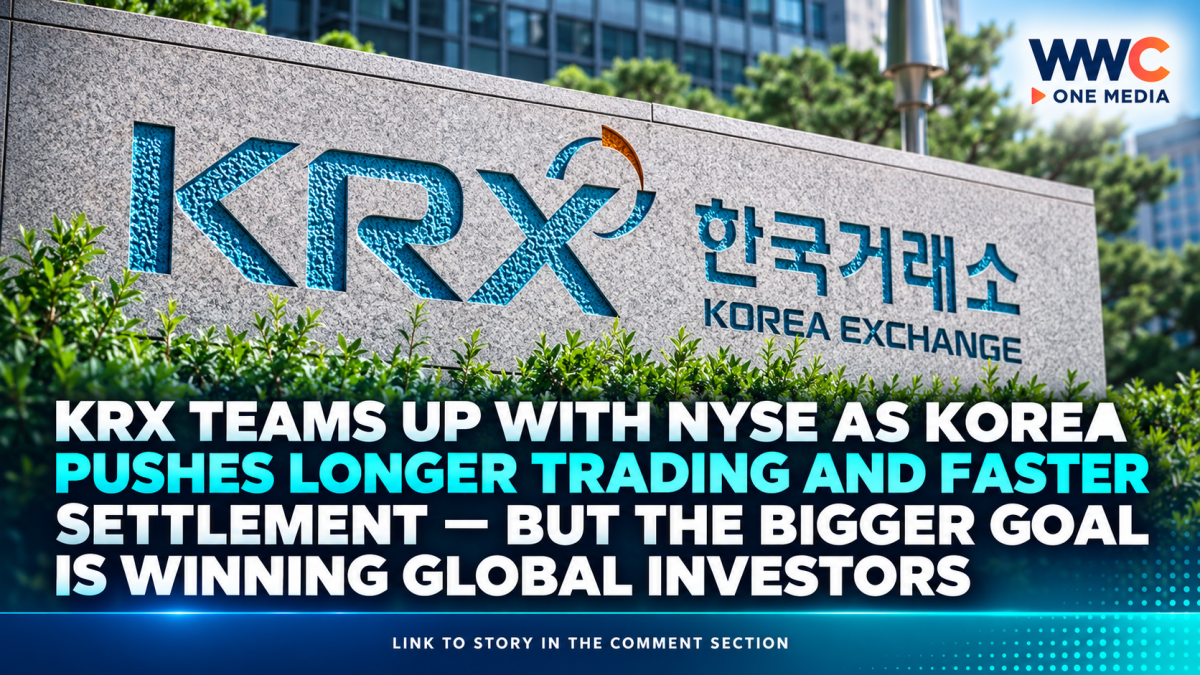
South Korea is taking another major step toward remaking the way its stock market operates — and this time, it is turning to Wall Street for help.
Korea Exchange Chairman Jeong Eun-bo and New York Stock Exchange President Lynn Martin have signed a cooperation agreement aimed at sharing expertise on longer trading hours, faster settlement and the infrastructure needed to run increasingly global capital markets.
On paper, it is a memorandum of understanding.
Strategically, however, it comes at a pivotal moment for Seoul.
KRX is preparing to extend real-time stock trading deeper into the evening, South Korean regulators are studying a shift from T+2 to T+1 settlement, and policymakers are trying to convince some of the world’s largest institutions that investing in Korea should be as straightforward as investing in other major financial markets.
The ultimate prize is bigger than longer trading hours.
South Korea wants more global capital — and eventually, a market structure that international investors treat as genuinely developed.
Wall Street Meeting Comes Just Before Korea Changes Its Trading Day
The agreement was signed in New York on Sept. 3, where KRX also held a global investor roadshow with BofA Securities at Bank of America Tower.
The Korea Herald reported that about 30 major institutional investors attended the meeting, where Jeong presented recent reforms designed to improve foreign investors’ access to South Korea’s capital markets. Other Korean financial outlets reported the same post-event attendance figure.
Jeong then met Martin and signed an MOU covering cooperation in market operations and infrastructure.
Under the agreement, KRX and NYSE plan to exchange knowledge accumulated from changes including:
- extending trading hours;
- shortening securities settlement cycles;
- modernizing exchange infrastructure; and
- potentially creating a joint consultative mechanism for continued cooperation.
But the timing is what makes the agreement especially significant.
Beginning Sept. 14, KRX is scheduled to replace its existing evening single-price auction with a much more substantial real-time aftermarket running from 4 p.m. until 8 p.m.
That is not merely adding a few minutes to the trading day.
It changes how investors can react to news after Seoul’s regular market closes at 3:30 p.m.
Korea’s After-Hours Market Is About to Become Much More Like a Real Market
Under the existing KRX structure, evening trading is relatively limited.
Currently, the regular stock market runs from 9 a.m. to 3:30 p.m., while existing post-market trading includes a system in which transactions are matched periodically rather than functioning like the normal continuous market. KRX’s published rules still reflect that current structure ahead of the Sept. 14 change.
That changes this month.
From Sept. 14, the existing 4 p.m.-to-6 p.m. single-price after-hours market is set to disappear and be replaced by continuous trading from 4 p.m. to 8 p.m.
Instead of waiting for orders to be pooled and matched periodically, buy and sell orders will be able to execute when prices match — much more like trading during the regular session.
For Korean investors, that means major developments arriving after 3:30 p.m. could increasingly be reflected in stock prices the same evening rather than waiting until the next morning.
It also intensifies competition with Nextrade, South Korea’s alternative trading system, which already operates extended sessions.
KRX’s ambitions originally went further.
The exchange had planned to introduce both early-morning and evening sessions, but the premarket portion was postponed after brokerages raised concerns about technology systems, testing and staffing. Current government plans call for the KRX premarket to potentially arrive around the end of 2027.
That distinction matters.
Korea is extending its trading day now — but it has not yet reached the near-12-hour KRX schedule originally envisioned.
Then Comes the Bigger Plumbing Change: T+1
Trading hours are only the visible part of the overhaul.
The more technically important change may be settlement.
South Korean stocks currently generally operate under a T+2 system, meaning trades settle two business days after they are executed. KRX’s own market information confirms that structure.
The government now wants to explore shortening that to T+1 — settlement on the next business day.
South Korea’s Financial Services Commission says it intends to produce a roadmap as early as October 2026, arguing that faster settlement could free up capital and improve market efficiency.
For a simple example:
Buy shares on Monday under T+2, and settlement normally happens Wednesday.
Under T+1, it happens Tuesday.
That sounds minor.
For a financial system processing billions of dollars every day, it is not.
A shorter settlement period reduces the amount of time money and securities remain exposed between trade execution and final settlement, potentially lowering counterparty and liquidity risks.
But it also forces brokerages, custodians and global investors to move cash, securities and foreign currency faster.
That is one reason some Korean securities firms have urged regulators to proceed carefully with T+1.
Why Korea Is Looking at America
The United States already made this transition.
U.S. securities markets shifted from T+2 to T+1 on May 28, 2024, after the Securities and Exchange Commission concluded that shortening settlement could reduce credit, market and liquidity risks.
That gives the NYSE ecosystem practical experience Korea can study.
And the learning flows both ways when it comes to extended-hours trading.
NYSE itself is pushing toward much longer access.
NYSE Arca, the group’s fully electronic market, is working toward greatly expanded trading in U.S.-listed stocks and ETFs. NYSE’s current plan divides the day into overnight, early, core and late sessions, potentially stretching access from 9 p.m. through 8 p.m. the following day, with infrastructure work aimed at a 2026 launch.
That means the KRX-NYSE discussions are occurring while both markets are confronting the same fundamental question:
Should a stock exchange built around traditional daytime business hours still work that way when investors and news operate globally around the clock?
The Real Competition Is for International Money
Longer hours alone will not transform Korea’s capital market.
KRX knows that.
The New York roadshow was explicitly aimed at global institutions, with Jeong presenting reforms intended to make South Korean stocks easier for overseas investors to buy and manage.
South Korea has already removed several longstanding barriers.
For example, regulators abolished the country’s roughly three-decade-old foreign investor registration certificate requirement in December 2023. Corporate investors can instead use legal entity identifiers when opening investment accounts.
Authorities have also expanded English-language corporate disclosures and loosened rules affecting foreign investors’ use of omnibus accounts.
These may sound like administrative changes.
For a pension fund or asset manager handling billions of dollars across dozens of countries, they can determine whether a market is easy enough to invest in at scale.
And MSCI Is Still Watching
That brings the story to one of Seoul’s longest-running financial ambitions.
South Korea remains classified by MSCI as an emerging market rather than a developed market.
In its June 2026 review, MSCI acknowledged Korea’s reforms but said international investors still saw unresolved accessibility problems.
Among the issues cited were limited offshore convertibility of the Korean won, liquidity during extended foreign-exchange trading hours, settlement-related burdens, restricted practical use of omnibus accounts and operational complications surrounding short selling.
MSCI therefore did not put South Korea on its developed-market watchlist in its latest review.
That provides important context for KRX’s New York push.
Longer stock-market hours and T+1 settlement will not automatically deliver an MSCI upgrade.
But they address part of the larger problem Seoul is trying to solve: making the Korean market function in ways global institutional investors already expect in other major markets.
There Is Also a Risk to Trading Longer
More trading is not automatically better trading.
Extended hours can give investors greater flexibility, but thinner liquidity outside peak hours can also produce wider bid-ask spreads and sharper price movements.
Brokerages must maintain technology and staffing for longer periods.
Risk controls must remain effective after the traditional close.
And investors may face a market in which a stock’s official closing price is no longer the last price they see that day.
That is particularly relevant in Korea.
Even after KRX’s new aftermarket launches, the official daily closing price will continue to be determined by the regular session, rather than by the final trade at 8 p.m., according to reporting on the exchange’s preparations.
The distinction could matter for index calculations, valuation references and investors accustomed to thinking of “the closing price” as the last traded price of the day.
The NYSE Deal Is Really About Korea’s Next Market
The KRX-NYSE agreement should therefore not be mistaken for a merger, a cross-listing deal or the creation of a common Korea-U.S. trading venue.
It is a cooperation agreement centered on knowledge, market operations and infrastructure.
But the direction is unmistakable.
KRX wants longer trading.
Regulators want faster settlement.
The government wants fewer barriers for foreigners.
And South Korea wants international institutions to see its capital market as increasingly global rather than domestically constrained.
The next important milestone arrives almost immediately, when the new KRX aftermarket is scheduled to open on Sept. 14.
After that comes the T+1 roadmap.
And farther ahead sits a much more difficult question:
Can all of these reforms finally convince global investors — and eventually index providers such as MSCI — that Korea’s market infrastructure has caught up with the scale and sophistication of the companies listed on it?
That is the real test of the Wall Street partnership.
WWC ONE MEDIA M.J.E




Leave a Reply