
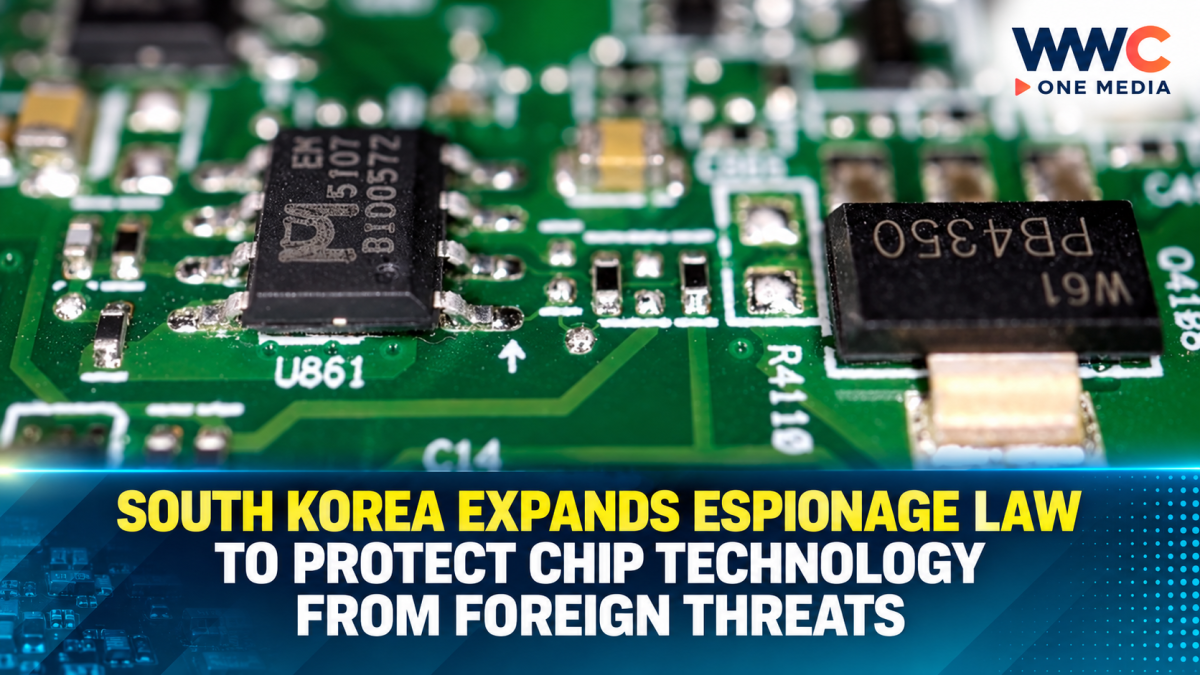
South Korea has expanded its espionage law to cover sensitive technology stolen or transferred to any foreign country, closing a major legal loophole as Seoul steps up efforts to protect its semiconductor industry from industrial espionage.
The revised law took effect on Sept. 13, replacing a framework that had largely limited espionage offences to activities benefiting North Korea. Under the new rules, passing sensitive information to a foreign country or an equivalent organisation can constitute espionage, carrying a minimum prison sentence of three years.
The change is significant for South Korea’s technology sector, particularly its semiconductor industry. The country is home to global chipmakers Samsung Electronics and SK Hynix, whose memory technologies have become increasingly important to the global artificial intelligence boom.
For decades, South Korea’s espionage provisions were criticised for being too narrow because prosecutors generally had to establish that information had been provided to North Korea. When suspected technology theft involved other countries or foreign companies, authorities often had to rely on separate laws covering industrial technology or trade secrets, which could carry different and sometimes lighter penalties.
The revised law is intended to address that gap by treating espionage benefiting foreign countries more broadly as a national-security offence.
The move comes amid growing concern in Seoul over the loss of advanced semiconductor technology to overseas competitors. South Korean authorities have reported a rise in cases involving the leakage of strategic technologies, including semiconductors, displays, batteries and artificial intelligence-related technology.
China is a major focus of those concerns, although the amended law does not specifically name Beijing. Reuters reported that Chinese companies have increasingly been competing with South Korean chipmakers, while cases involving suspected technology transfers to China have intensified scrutiny of the country’s industrial-security protections.
One high-profile case involved former Samsung Electronics employees accused of leaking DRAM technology to Chinese memory-chip maker CXMT. The allegations have highlighted concerns that valuable production know-how could accelerate the development of overseas competitors. The companies did not comment on the case when Reuters reported on the legislation.
The threat is particularly important because semiconductors are central to South Korea’s economy and its position in global technology supply chains. Samsung and SK Hynix are among the world’s largest memory-chip producers, while Chinese companies such as CXMT have been steadily increasing their presence in the DRAM market.
The law’s expansion also reflects a wider global race to protect advanced technology. Governments in the United States, Europe and Asia have increasingly tightened controls around semiconductor technology as competition over artificial intelligence, advanced computing and chip manufacturing intensifies.
South Korea is simultaneously investing heavily in maintaining its technological lead. The government has announced plans for a massive semiconductor hub and is seeking to strengthen the country’s position in advanced chip manufacturing as competition from China grows.
However, tougher legislation does not automatically make technology theft easier to prosecute. Legal experts have noted that prosecutors may still have to establish a connection between the stolen information and a foreign state or organisation, potentially leaving room for sophisticated espionage operations to operate through intermediaries or private companies.
China has not been explicitly singled out by the new law. Chinese Foreign Ministry spokesperson Mao Ning said Beijing expects countries to protect normal investment and business activities and provide a fair and non-discriminatory environment for companies operating internationally.
For South Korea, the legislation represents a broader shift in how the country views technology protection. Advanced chips are no longer treated solely as commercial assets but increasingly as strategic resources tied to national security, economic competitiveness and geopolitical influence.
As demand for AI chips and advanced memory continues to grow, Seoul is making clear that protecting the technology behind those products will be treated as a matter of national security.




Leave a Reply