
MANILA, Philippines — A seemingly simple question over what qualifies as an “alias” has reopened one of the most controversial issues in Vice President Sara Duterte’s impeachment trial: Were the unusual names appearing on confidential-fund acknowledgment receipts connected to real people — or were some of them merely fictitious identities?
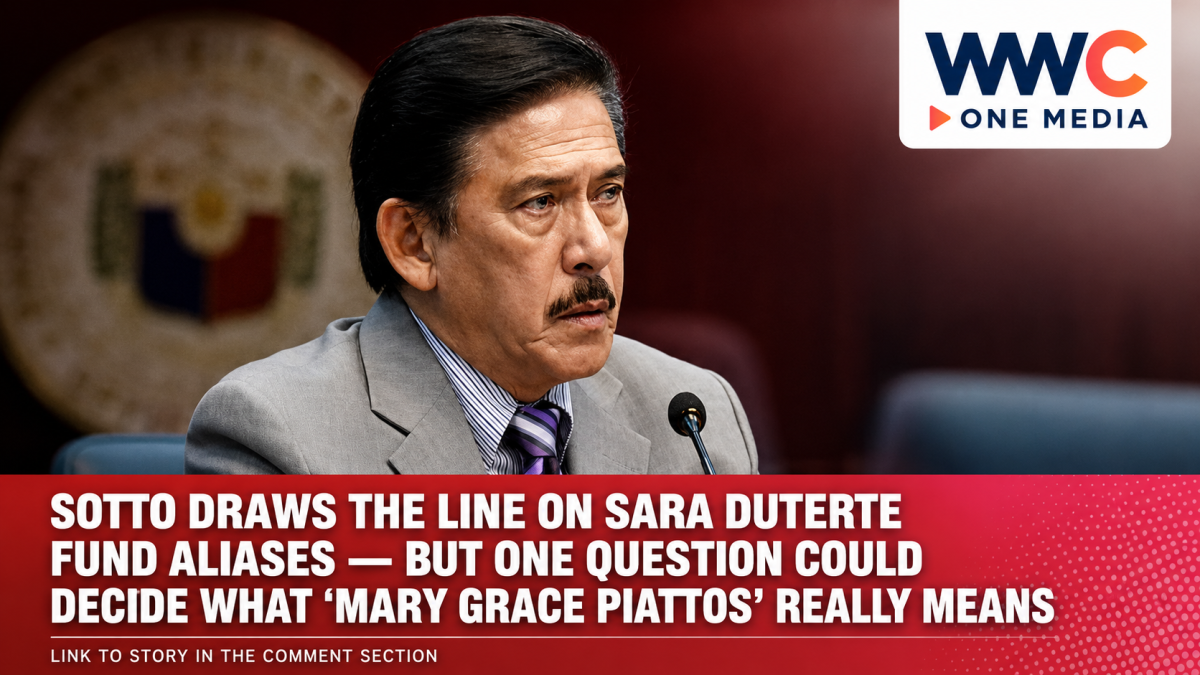
Senator-judge Vicente “Tito” Sotto III raised that distinction before the Senate impeachment court on September 1, saying that an alias presupposes the existence of an actual person using another name.
“If there is a person behind the alias, then it is an alias. If there is no person behind the name, it is a fictitious name or a fake name,” Sotto said during a manifestation, according to the Philippine Daily Inquirer.
The remark may sound technical, but it strikes directly at a question prosecutors have repeatedly raised as they scrutinize the liquidation of hundreds of millions of pesos in confidential funds handled by the Office of the Vice President and, separately, the Department of Education during Duterte’s tenure as education secretary.
From ‘Mary Grace Piattos’ to a growing list of unusual names
At the center of the controversy are acknowledgment receipts containing names such as Mary Grace Piattos, Andy Lim, Miggy Mango and Kristine Applegate Estrada, among numerous others presented or discussed during proceedings.
Some names resemble snack brands, food items, public personalities or combinations of recognizable surnames, prompting questions from lawmakers, prosecutors and senator-judges about who actually received the money represented by the documents.
The name “Mary Grace Piattos” has become the most recognizable example.
GMA News reported that the Philippine Statistics Authority previously told a House inquiry that it could find no birth, death or other identification record corresponding to a person named Mary Grace Piattos. The House prosecution team later even listed “Mary Grace Piattos” in its pre-trial witness list in connection with the alleged receipt of confidential funds.
That absence of a PSA record, however, does not by itself resolve every legal or evidentiary issue surrounding the name. The Senate impeachment court must still determine what the documents establish, who was actually behind the transactions and how much evidentiary weight should be given to the receipts and accompanying testimony.
What Philippine law actually says about aliases
Sotto pointed to Republic Act No. 6085, a 1969 law amending Commonwealth Act No. 142 on the use of aliases.
The statute generally prohibits a person from using a name different from the one registered at birth, first baptism or — for an alien — immigration registration, unless another name has been authorized by a competent court. The law contains limited exceptions for pseudonyms used for literary, cinema, television, radio, entertainment or certain athletic purposes.
It also provides a process for obtaining judicial authority to use an alias and requires authorized aliases to be recorded with the proper civil registry.
But Sotto’s intervention highlighted an even more basic point: before debating whether a person may legally use an alias, the court may first have to determine whether an identifiable person actually exists behind the name.
That distinction could become increasingly important as the impeachment court evaluates the paper trail surrounding confidential-fund expenditures.
Former OVP disbursing officer says names were aliases
The issue gained additional weight following the testimony of former OVP special disbursing officer Gina Acosta.
According to Philstar’s account of her August 24 testimony, Acosta acknowledged that recipient names appearing on OVP acknowledgment receipts were aliases rather than the recipients’ real names.
She also testified that she released confidential-fund cash to then-Vice Presidential Security and Protection Group chief Col. Raymund Dante Lachica, who was tasked with implementing confidential operations, and that she could not personally verify the identities of the ultimate recipients.
Those statements have made the identity question increasingly central to the prosecution’s case.
Article I of Duterte’s impeachment case concerns allegations involving the alleged misuse and irregular liquidation of ₱612.5 million in confidential funds allocated to the OVP and DepEd.
Duterte and her defense team dispute the prosecution’s accusations and have maintained that the allegations against her must be established through competent evidence rather than political rhetoric or speculation.
Defense has pushed back on the alias argument
There is also an important qualification to the prosecution’s theory.
During earlier testimony, state auditor Roderick Wamil told the impeachment court that the joint circular governing confidential and intelligence funds neither expressly allows nor expressly prohibits the use of codenames or aliases for recipients.
Defense lawyers have also pointed out that the controversial aliases themselves were not specifically cited in certain Commission on Audit notices of disallowance concerning the confidential funds.
Duterte’s camp previously said it was prepared to explain the use of names such as “Mary Grace Piattos.”
That means the presence of an unusual name on a document is not, standing alone, proof that money was stolen, that a recipient did not exist or that Duterte personally committed an impeachable offense. Those conclusions would have to be supported by evidence accepted by the impeachment court.
Duterte has repeatedly argued that the case against her is weak and politically driven. In an August 26 statement, she said allegations should be proven through evidence rather than “insults, speculations, or political theatrics.”
Padilla’s comparison with Philippine heroes triggered another debate
The alias issue became politically charged days earlier when Senator-judge Robin Padilla pointed to historical figures who used pseudonyms, including opposition leader Benigno “Ninoy” Aquino Jr., who used “Marcial Bonifacio” when he returned to the Philippines from exile in 1983.
Senator-judge Bam Aquino responded that while his uncle used an alias, Ninoy Aquino was not dealing with confidential-fund acknowledgment receipts.
House prosecution spokesperson Zia Alonto Adiong also criticized the comparison, arguing that aliases used by historical figures should not automatically be equated with the identities being scrutinized in the Duterte fund case.
Sotto’s latest manifestation effectively narrowed that debate.
The central issue is no longer simply whether aliases can ever be legitimate.
The bigger question is whether the names appearing in government liquidation documents can ultimately be linked to real, identifiable recipients who actually received money or provided information or services corresponding to those payments.
Why the distinction could matter
Confidential funds are, by design, subject to secrecy because they may finance intelligence gathering and sensitive operations. But secrecy does not necessarily eliminate accountability requirements.
That tension is emerging as one of the defining questions of Duterte’s impeachment trial: How can government protect legitimate confidential sources while still proving that public money went where officials claim it went?
The prosecution is attempting to show that irregular documentation, disputed recipient identities and other alleged deficiencies form part of a broader pattern of improper liquidation.
The defense, meanwhile, is challenging the prosecution to prove that those irregularities establish wrongdoing by Duterte herself.
And that is why Sotto’s distinction could become more significant than the names that first attracted public attention.
“Mary Grace Piattos,” “Miggy Mango” and the other unusual entries may dominate the headlines.
But for the impeachment court, the decisive question could ultimately be much simpler:
Who — if anyone — was actually behind each name, and can the government trace the public money to that person?



Leave a Reply