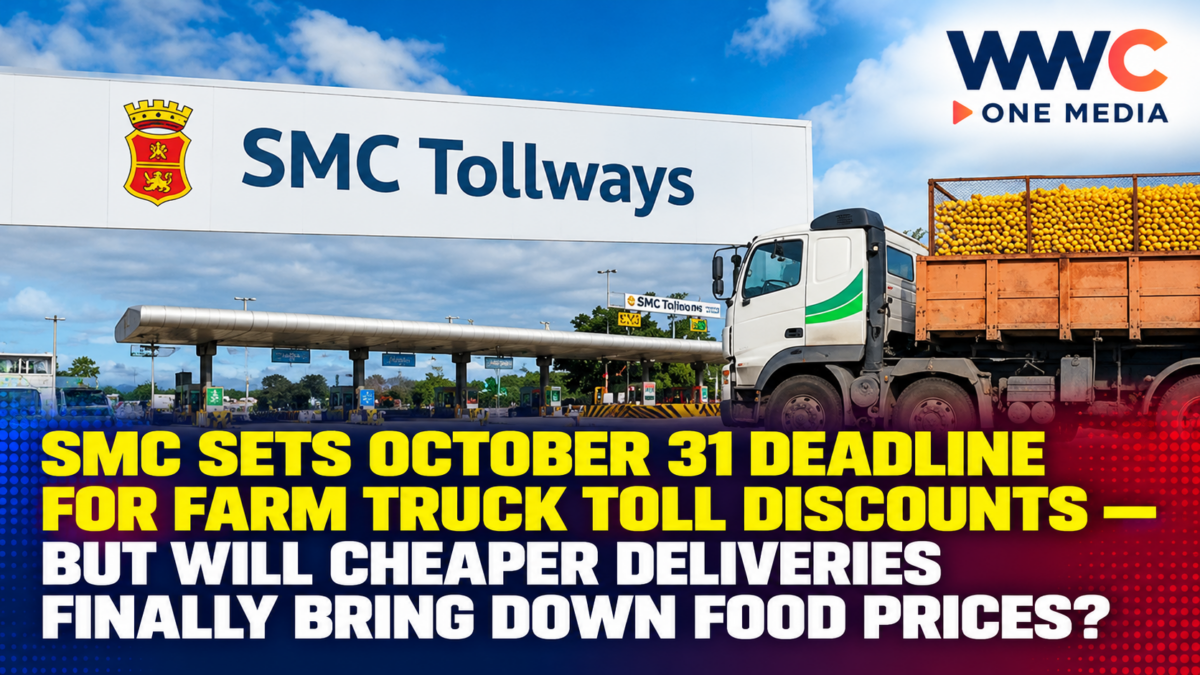
MANILA, PHILIPPINES — Agricultural truck operators across Luzon have only until October 31 to enroll in a government-backed toll discount program that could help ease the cost of delivering food from farms to markets.
San Miguel Corporation’s tollway unit, SMC Tollways, has confirmed that qualified vehicles transporting agricultural products can receive a 5% toll discount on five major expressways from November 1 to November 30, 2026.
The initiative, backed by the Department of Transportation (DOTr) and Toll Regulatory Board (TRB), aims to reduce agricultural logistics expenses at a time when elevated fuel prices continue to put pressure on transport operators and food supply chains.
But there is a catch: not every truck automatically qualifies.
Operators must have valid Department of Agriculture (DA) accreditation and be enrolled in the program before the October 31 cutoff.
SMC Tollways has warned that applications will not be accepted after the deadline.
The move raises a question that matters beyond the trucking industry: Could lower delivery expenses eventually translate into more affordable vegetables, rice, fruits and other food products for Filipino families?
FIVE MAJOR EXPRESSWAYS COVERED BY THE DISCOUNT
The 5% reduction will apply to qualified agricultural vehicles using the following SMC-operated tollways:
- Skyway System — A major elevated expressway network serving Metro Manila and connecting with southern Luzon routes.
- NAIA Expressway (NAIAX) — An important connection between the airport area and the surrounding expressway network.
- South Luzon Expressway (SLEX) — A major freight corridor connecting Metro Manila with agricultural and industrial areas to the south.
- STAR Tollway — A key expressway serving Batangas and southern Luzon.
- Tarlac–Pangasinan–La Union Expressway (TPLEX) — A major northern Luzon corridor supporting movements between agricultural provinces and distribution markets.
These expressways carry a wide range of commercial vehicles, including trucks transporting agricultural commodities.
Reducing toll charges may help participating operators lower part of their operating expenses.
However, the discount applies only to eligible and properly enrolled agricultural transport vehicles.
It is not a general 5% toll reduction for private motorists, buses or all delivery trucks.
OCTOBER 31 IS THE FINAL ENROLLMENT DEADLINE
SMC Tollways has emphasized that agricultural truck operators must complete enrollment no later than October 31, 2026.
The discount becomes effective on November 1 and continues until November 30.
This creates a limited window for operators who have not yet registered.
Missing the deadline means new applicants will not qualify through late enrollment under the announced November program.
For businesses operating multiple agricultural delivery vehicles, each vehicle’s eligibility and enrollment documents should be checked in advance.
The company is urging qualified operators not to delay their applications.
HOW AGRICULTURAL TRUCK OPERATORS CAN APPLY
New applicants need to prepare the required vehicle and accreditation documents before visiting an Autosweep RFID Customer Service Center.
The requirements are:
- Vehicle Official Receipt and Certificate of Registration (OR/CR) — Proof of the vehicle’s registration.
- Valid Department of Agriculture Accreditation Certificate — Confirmation that the vehicle or operator meets the relevant agricultural transport accreditation requirements.
- Copy of the Autosweep RFID card — The account number must be visible so the eligible vehicle can be associated with its RFID account.
Documents can be submitted at any Autosweep Customer Service Center.
Truck operators should ensure that their registration information, accreditation and RFID details are correct and consistent.
Incomplete or expired documents could prevent successful enrollment.
For assistance, SMC Tollways has provided the Autosweep customer service hotline:
(02) 5318-8655
PREVIOUSLY REGISTERED TRUCKERS MAY NOT NEED TO APPLY AGAIN
There is good news for agricultural haulers who already participated in the program.
SMC Tollways said previously enrolled truck operators will automatically qualify for the November discount if their DA accreditation remains valid.
They do not need to submit a completely new application merely because the November discount period is beginning.
However, operators whose DA accreditation has expired must re-enroll.
This requirement is important because previous registration does not override the need for current accreditation.
For existing participants, checking the validity of their documents before October 31 could help prevent interruptions in eligibility.
WHY THE GOVERNMENT IS REDUCING AGRICULTURAL TOLL CHARGES
The discount is part of a wider government effort to reduce the cost of moving agricultural goods.
Farm products often travel through several stages before reaching consumers.
These may include collection at farms, consolidation at trading centers, trucking to wholesale markets and delivery to retailers.
At each stage, businesses incur expenses.
Fuel, driver wages, vehicle maintenance, tolls, storage and handling can all contribute to the final cost of delivering produce.
When fuel prices rise, transport operators face additional pressure.
Those costs may eventually be passed along to food distributors, wholesalers, retailers and consumers.
The DOTr and TRB initiative is intended to provide some relief by reducing an eligible truck’s toll expense.
While a 5% discount may appear modest, the savings can accumulate for operators making frequent deliveries.
Still, the total benefit depends on the route, vehicle class, frequency of trips and the share of tolls in overall operating costs.
HOW MUCH CAN A TRUCK ACTUALLY SAVE?
The program reduces the toll charge by 5% on eligible transactions.
For illustration, the savings would work as follows:
- A hypothetical ₱500 toll charge would be reduced by ₱25.
- A hypothetical ₱1,000 toll charge would be reduced by ₱50.
- A hypothetical ₱2,000 toll charge would be reduced by ₱100.
These are simple examples, not published toll quotations for any particular expressway journey.
A truck operator making multiple eligible trips could accumulate additional savings during November.
For instance, 20 trips that would otherwise cost ₱1,000 each would generate ₱1,000 in total savings under a straightforward 5% discount calculation.
However, the actual savings would depend on the published toll rates and qualifying transactions.
Importantly, a 5% toll discount is not the same as a 5% reduction in total freight costs.
If toll fees account for only a small portion of a delivery company’s expenses, the reduction in overall transport costs will be smaller.
WILL THIS HELP LOWER FOOD PRICES?
The government’s broader objective is to ease pressure on agricultural distribution costs.
Lower logistics expenses can potentially help food producers, traders and retailers manage their prices.
For fresh vegetables, fruits, fish and other perishable commodities, efficient transportation can be particularly important.
Delays may increase spoilage, while high transport expenses can reduce the margins available to farmers and traders.
However, the direct effect on retail prices is uncertain.
Food prices are influenced by many other factors, including harvest volumes, weather, imports, supply shortages, electricity costs, fuel prices and market competition.
Even if a truck operator receives a toll discount, there is no guarantee that the full savings will be transferred to the next buyer.
Some savings may be absorbed by higher expenses elsewhere in the supply chain.
The discount should therefore be viewed as a targeted logistics intervention rather than a guaranteed nationwide reduction in food inflation.
AGRICULTURAL TRANSPORT REMAINS A MAJOR NATIONAL CHALLENGE
The Philippines depends on road transportation to move agricultural products between rural production areas and urban markets.
Luzon’s expressway network connects major farming regions with distribution centers, food processors, supermarkets and other commercial destinations.
Trucks may travel long distances before goods reach consumers.
Poor road conditions, traffic congestion, fuel costs and multiple handling requirements can increase expenses.
For smaller agricultural businesses, such costs may represent a significant operational burden.
The toll discount provides one form of assistance, but broader solutions may require improvements in farm-to-market roads, cold storage, logistics facilities and market access.
Reducing unnecessary transport delays can be as important as lowering direct toll charges.
ANOTHER TOLLWAY PROGRAM OFFERS DIFFERENT REBATES
The SMC announcement also comes alongside a separate initiative involving other expressway operators.
In October, the Department of Agriculture reported that Metro Pacific Tollways-related operators had resumed an agricultural truck toll rebate program.
According to the DA, the arrangement provides an estimated 7% to 8% rebate for qualifying transactions.
Eligible vehicles initially pay the regular toll, after which the rebate is credited back to their RFID accounts.
The program covers participating tollways operated by companies including NLEX Corporation, Cavitex Infrastructure Corporation and MPCALA Holdings Inc.
The DA said the program took effect on October 1 and would continue through November 30, 2026.
This is a separate arrangement from SMC Tollways’ announced 5% November discount.
Truck operators should not assume that the same percentage, application procedure or crediting mechanism applies to every expressway.
Participating operators and authorities should be consulted for the exact terms governing each route.
WHY DISCOUNT AND REBATE MECHANISMS MATTER
Although both programs are designed to reduce eligible transport costs, their implementation can differ.
An immediate toll discount reduces the amount charged at the transaction point or through the applicable tolling system.
A rebate arrangement may require the vehicle to pay the regular toll first and receive a subsequent account credit.
For companies managing cash flow, the timing of the savings can matter.
An immediate reduction may lower the cash or RFID balance required for a trip.
A delayed rebate may provide relief only after the amount is credited.
The DA’s October announcement specifically describes the Metro Pacific-related initiative as a rebate program.
The SMC reporting confirms a 5% discount but does not independently detail every technical aspect of how the reduction will be reflected in the Autosweep account.
Operators should verify the transaction process through official Autosweep customer service channels.
WHAT OTHER NEWS OUTLETS CONFIRM
The Philippine News Agency reported on October 26 that SMC Tollways had set October 31 as the enrollment deadline and identified the five participating expressways.
BusinessMirror independently reported the same announcement on October 27, including the DA accreditation and Autosweep requirements.
Specialized logistics publication PortCalls Asia also covered the deadline and the November 1–30 discount period.
Context.ph highlighted the potential impact on agricultural transportation expenses and consumer food prices.
Meanwhile, the Department of Agriculture’s official announcement provides additional context about the separate toll rebate arrangements being implemented by other expressway companies.
Together, these reports confirm that the SMC discount is real, time-limited and subject to specific eligibility requirements.
However, none of the reviewed reports establishes how much total money the SMC discount will save the agricultural industry or how much retail food prices will decline as a result.
Those outcomes will need to be assessed after implementation.
WHAT FARMERS AND FOOD DISTRIBUTORS SHOULD KNOW
The initiative could be relevant to farmers who depend on contracted truck operators to move produce.
However, farmers themselves do not automatically receive a toll discount unless the vehicle transporting the goods satisfies the program’s accreditation and enrollment requirements.
Agricultural traders and distributors should coordinate with their transport providers to confirm eligibility.
Businesses operating their own trucks should review the requirements and complete enrollment on time.
The program may also help transporters maintain more predictable delivery expenses during November.
But the savings should be considered alongside fuel, wages, maintenance, loading and other logistics costs.
WHAT HAPPENS AFTER NOVEMBER 30?
The announced SMC discount runs only through November 30, 2026.
As of October 29, SMC Tollways has not confirmed an extension beyond that date in the reporting reviewed.
Any future renewal would require a separate announcement or policy decision.
This creates another issue for agricultural transporters.
Businesses may benefit from temporary toll relief in November but still face higher expenses afterward if fuel prices remain elevated.
A longer-term program would need to consider the effectiveness of the discount, the number of eligible operators enrolled and the financial implications for tollway operations.
For policymakers, the results could help determine whether temporary relief should be extended, revised or replaced with other transport-support measures.
THE BIGGER QUESTION: CAN SMALL TOLL SAVINGS MAKE A REAL DIFFERENCE?
SMC Tollways’ November discount comes at a time when agricultural distribution costs remain an important concern for both businesses and households.
The policy offers eligible truck operators a straightforward opportunity to reduce certain toll expenses.
It covers five major Luzon expressways and is supported by the government’s broader effort to make food transportation more affordable.
But the window for new enrollment is closing.
Operators must secure valid DA accreditation and submit their requirements no later than October 31.
For farmers, traders and consumers, the larger issue is whether these targeted savings can eventually contribute to lower distribution expenses.
A 5% toll discount cannot solve every problem affecting food prices, but it could provide some relief to operators transporting agricultural goods across Luzon.
And as the November implementation approaches, one important question remains:
Will the government’s toll discount initiative finally help ease the cost of delivering food to Filipino markets — or will rising fuel prices and other logistics expenses wipe out much of the potential savings?