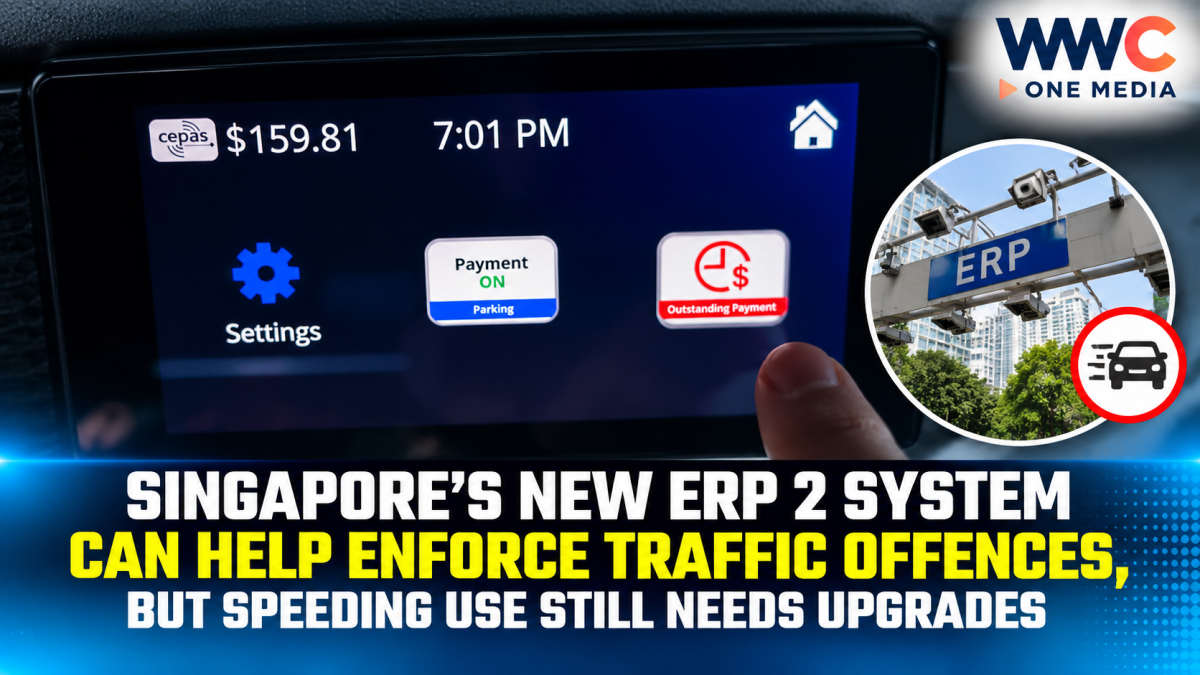
Singapore’s new ERP 2 system is being introduced primarily to replace the country’s ageing electronic road-pricing infrastructure, but its satellite-based technology could also give authorities new ways to detect and enforce certain traffic offences.
Unlike the existing ERP system, which relies on physical gantries and radio-frequency technology, ERP 2 uses Global Navigation Satellite System technology through an in-vehicle On-Board Unit. The system can determine when a vehicle passes a charging location and calculate the applicable road-use charge.
The new technology has raised questions among motorists about whether authorities could use the vehicle-location data to identify offences such as speeding.
The Land Transport Authority has confirmed that ERP 2 can potentially be used for speeding enforcement, but said further enhancements are required before that capability can be implemented. Transport Minister Jeffrey Siow gave a similar position in Parliament earlier this year.
For now, however, ERP 2 is already being used for certain enforcement purposes involving vehicles.
One example is the detection of illegal cross-border taxi services. Foreign cross-border taxis licensed to operate between Singapore and neighbouring countries are required to have the ERP 2 On-Board Unit installed. Authorities can use the system to identify suspicious movements that may indicate a vehicle is providing prohibited domestic trips within Singapore.
Between May and July 2026, the LTA said ERP 2 data helped detect 60 instances of suspicious behaviour involving 31 unique foreign vehicles. Drivers were contacted and reminded about the relevant offences, while formal enforcement against foreign cross-border taxis providing illegal ride-hailing trips in Singapore began in September.
The system can also build on enforcement capabilities that already exist under ERP 1. The LTA said records from existing ERP gantries have been used to identify vehicles that should not be operating on Singapore roads, including deregistered vehicles.
This means ERP 2 is not simply a replacement for the country’s current tolling infrastructure. Its satellite-based architecture gives authorities a more flexible way to understand where vehicles are travelling and, for specific authorised purposes, investigate possible violations.
However, that does not mean every movement recorded by the OBU will automatically become evidence of a traffic offence.
The LTA has stressed that ERP 2 is primarily designed for road-use charging and traffic management. Vehicle-specific information will be collected for payment, charging and authorised enforcement purposes, while information used for broader traffic planning and management will generally be aggregated and anonymised.
Data access is also subject to safeguards governing collection, use and security. The LTA says these measures are intended to prevent unauthorised access to personal information collected through the system.
The distinction will become increasingly important as Singapore completes the transition to ERP 2. From Jan. 1, 2027, ERP 2 On-Board Units will be mandatory for all Singapore-registered motor vehicles travelling on public roads, while the existing ERP 1 system will be decommissioned.
The transition is taking place alongside wider changes to traffic enforcement. Singapore has already deployed Traffic Violation Enforcement Cameras using video analytics and automatic number-plate recognition to detect selected offences including red-light running, illegal U-turns and crossing double white lines.
New legislation has also expanded the use of technology in enforcement. A provision passed by Parliament allows computer programs to assess whether there is sufficient evidence of a traffic offence and automatically issue notices requiring vehicle owners to provide driver particulars. Authorities said such systems will be tested and audited, with procedures allowing affected motorists to seek a review if they believe a vehicle was wrongly identified or an offence did not occur.
The combination of ERP 2, traffic cameras, automatic number-plate recognition and video analytics therefore points toward a more technology-driven traffic enforcement system.
But speeding remains a separate question. Although ERP 2 has the technical potential to contribute to speeding enforcement, authorities have not said that the system will immediately become a nationwide speed-monitoring network. Further technical enhancements would be needed before such use could be introduced.
For motorists, the immediate change is therefore the transition to satellite-based road pricing rather than a new automatic speeding system.
The bigger development is that the same technology being introduced to calculate road charges could eventually give Singapore authorities another tool for enforcing traffic rules, provided the necessary technical capabilities, legal framework and data safeguards are put in place.