
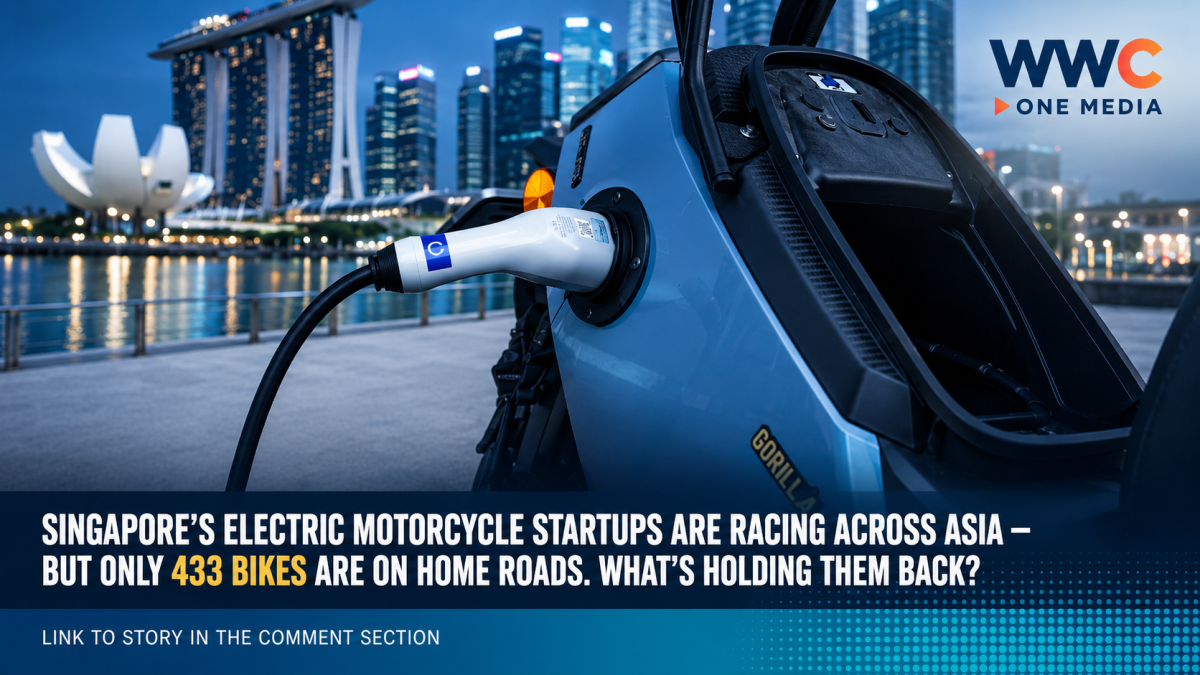
SINGAPORE — Singapore is producing electric-motorcycle companies with ambitions stretching from Indonesia to Thailand, Malaysia, Vietnam, the Philippines and even Africa. Yet their toughest market may be the one right outside their own headquarters.
Despite years of government efforts to electrify transport and experiments with battery-swapping technology, only 433 electric motorcycles were registered on Singapore roads as of July 2026, representing about 0.2% of the country’s motorcycle population, according to figures reported by CNA.
That is a striking contrast with electric cars. Singapore now has more than 69,000 electric cars, representing more than 10% of the car population.
And that gap is helping explain why several Singapore-founded electric motorcycle businesses are looking beyond the city-state for scale.
Singapore Companies Are Going Where the Motorcycles Are
Indonesia has emerged as one of the most important proving grounds.
Singapore-based electric two-wheeler company Kilats has been operating there since 2024 and, according to CNA, has almost 700 motorcycles rented to Grab riders in Bali and Bandung, backed by 44 battery-swapping stations.
The company is planning further expansion in Indonesia, followed by Thailand, with Vietnam and the Philippines targeted for 2027. Its founders increasingly view Singapore less as the company’s main motorcycle market and more as a headquarters, financing and regional management base.
That strategy reflects the enormous difference in market size. Indonesia has well over 100 million motorcycles by commonly cited estimates, making two-wheelers a fundamental part of everyday transport rather than a relatively small vehicle category.
Another Singapore company, Charged Asia, is also heavily exposed to Indonesia. CNA reported that the company currently derives its revenue there and has deployed more than 5,000 motorcycles, while management is targeting a much larger regional fleet over the coming years.
Its ambitions are becoming more visible at the product level as well.
Charged launched its higher-performance Ndara electric motorcycle in Indonesia in June 2026. Industry coverage reported an 11kW peak output, a claimed top speed of 125kmh and Type 2 charging—the connector technology commonly associated with electric cars. The company has indicated that a version is also intended for Singapore.
That charging choice could prove particularly important.
Singapore May Be Moving Away From the Battery-Swap Model
Battery swapping once looked like one of the most promising solutions for electric motorcycles.
Singapore launched regulatory trials involving electric motorcycles and battery swap-and-charge stations in 2022. The concept was straightforward: instead of waiting for a motorcycle battery to recharge, riders could replace a depleted battery with a charged one and quickly get back on the road.
But Singapore’s road environment presents a different challenge from dense neighbourhood-based delivery markets.
Motorcycles travelling regularly on expressways require more power and range, while larger batteries become heavier and harder to swap manually. At the same time, an expensive swapping network becomes difficult to justify when there are only a few hundred electric motorcycles using it.
That is pushing some companies toward a different solution: plugging motorcycles directly into Singapore’s existing EV-charging network.
The Land Transport Authority confirmed to CNA that electric motorcycles are allowed to use EV charging points around Singapore.
Singapore has also continued updating its regulatory infrastructure. From April 2026, the country’s national EV charging standard was elevated to SS 722, with provisions covering electric-motorcycle battery swapping as well as newer charging technologies.
The broader strategy remains ambitious. Singapore’s government continues to target 100% cleaner-energy vehicles by 2040, with electrification expected to play a central role in the transition.
But motorcycles remain one of the difficult pieces of that transition.
Price Is Only Part of the Problem
Electric motorcycles face several obstacles simultaneously: purchase price, battery capacity, charging availability, range anxiety and questions about long-term battery life and resale value.
Those issues matter even more in the motorcycle segment because buyers can be highly price-sensitive.
Interestingly, the government does not currently believe an electric-motorcycle purchase subsidy is necessarily the answer.
In a March 5, 2026 parliamentary reply, Acting Transport Minister Jeffrey Siow said Singapore had no plans to introduce purchase incentives specifically for electric motorcycles, noting that some models were already comparable in price with mass-market internal-combustion motorcycles.
The government instead pointed to shorter driving ranges and the lack of an adequate fast-charging or battery charging-and-swap network as possible reasons adoption remained at just 0.2%.
That creates a chicken-and-egg problem.
Companies may hesitate to invest heavily in motorcycle-specific charging infrastructure until there are enough riders. Riders, meanwhile, may hesitate to switch until there is enough infrastructure.
Yet 2026 Is Showing Signs of a Breakthrough
Singapore’s electric motorcycle market is not standing completely still.
Home-grown manufacturer Scorpio Electric received conditional LTA vehicle-type approval for its Lambda Scorpii in June 2026. The following month, the motorcycle became road-legal in Singapore, opening the door to a phased commercial rollout.
That followed European Union whole-vehicle type approval for the model in 2025, giving the Singapore-developed motorcycle regulatory clearance for wider international ambitions.
Other home-grown brands have also been building their businesses internationally.
ION Mobility, another Singapore-founded electric motorcycle company, has focused heavily on Indonesia. Its M1-S is marketed with a claimed range of up to 150km per charge and a top speed of 105kmh, illustrating how companies are trying to close the performance gap between electric two-wheelers and conventional motorcycles.
Meanwhile, Zion Mobility previously announced plans to bring electric motorcycles to Singapore, Indonesia and the Philippines after entering Thailand, reinforcing the broader trend of Singapore-based firms treating Southeast Asia as one interconnected two-wheeler market rather than building exclusively for their home country.
Corporate Fleets Could Come Before Everyday Riders
The breakthrough may therefore not begin with private motorcycle owners.
Commercial fleets—delivery services, logistics companies, government-linked organisations and other businesses with vehicles travelling predictable distances every day—could provide electric motorcycles with their first meaningful scale.
For these operators, fuel and maintenance savings accumulate faster because vehicles are used far more intensively than the average privately owned motorcycle.
Businesses also have stronger incentives to measure emissions and meet sustainability targets.
Once riders begin seeing electric motorcycles used daily by couriers and fleet operators, the technology becomes more familiar. That visibility could eventually reduce consumer concerns about reliability, charging and range.
In other words, the road to mass adoption may run through businesses first.
The Bigger Irony
Singapore has many of the ingredients needed to become an electric-mobility innovation hub: financing, engineering talent, strong regulation, charging infrastructure and access to the huge Southeast Asian market.
What it does not have is a huge domestic motorcycle market.
That explains why companies founded in Singapore are increasingly designing products, raising capital and managing their businesses from the city-state while deploying thousands of vehicles elsewhere.
Indonesia provides the volume. Thailand, Vietnam and the Philippines offer additional motorcycle-heavy markets. Singapore provides the corporate and technological base.
But the story may now be coming full circle.
With locally developed motorcycles becoming road-legal, companies adopting charging systems compatible with existing EV infrastructure and commercial fleets potentially creating the first meaningful pool of users, Singapore’s electric-motorcycle market has another chance to shift out of low gear.
The question is whether better technology and easier charging can finally persuade ordinary riders—or whether Singapore’s electric-motorcycle champions will continue finding their biggest successes everywhere except home.




Leave a Reply