
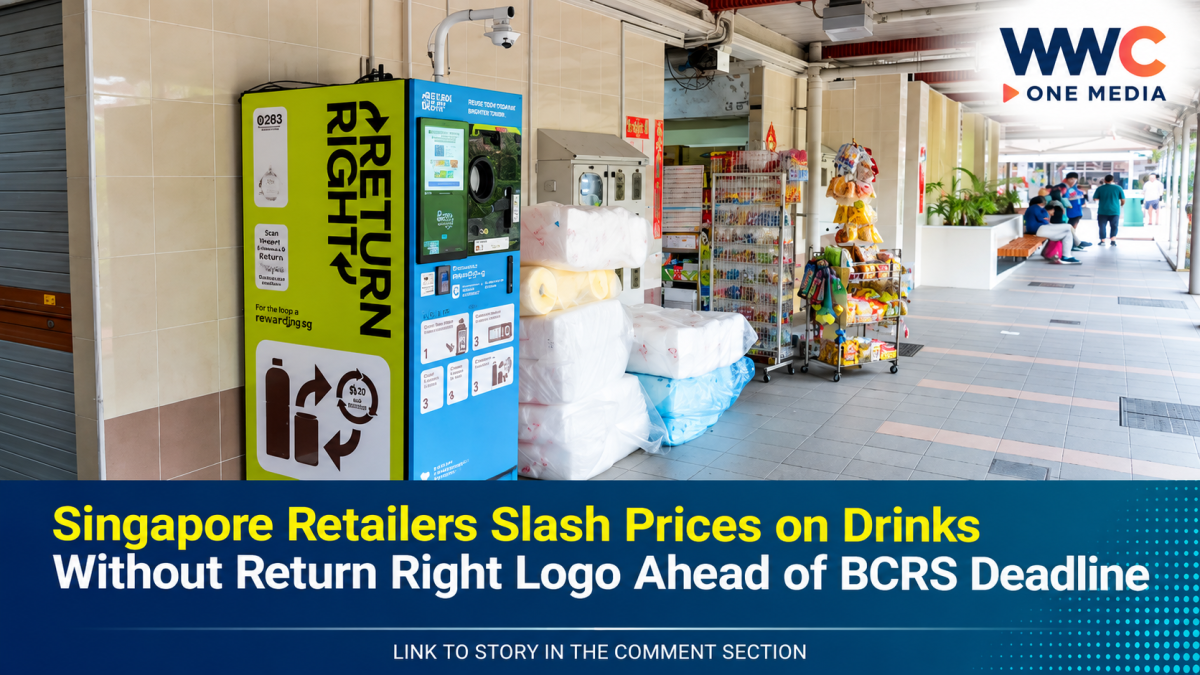
Some Singapore retailers are cutting prices by as much as 50 per cent on canned and bottled drinks that do not carry the required Return Right logo, as businesses race to clear remaining stock before stricter rules under the Beverage Container Return Scheme take effect.
The discounts come just weeks before the next major phase of Singapore’s beverage recycling scheme, which requires eligible drinks sold in the country to carry the appropriate deposit marking.
Under the Beverage Container Return Scheme (BCRS), eligible plastic bottles and metal cans between 150ml and 3 litres are subject to a 10-cent refundable deposit. Consumers can recover the deposit by returning eligible empty containers through the scheme’s designated return points.
The scheme officially began on April 1, 2026, but retailers were given a transition period to clear beverage stock that had entered the market before the new requirements took effect.
That transition period is now nearing its end.
Drinks without the logo being sold at steep discounts
According to recent reports, some retailers and distributors have begun heavily discounting beverages that do not carry the required Return Right marking.
Some products have been reduced by around 20 per cent, while others have been offered at discounts of up to 50 per cent.
The discounted stock includes products such as beer, tea and other bottled or canned beverages.
For shoppers, the price cuts can make the older stock considerably cheaper than drinks sold under the new system.
But there is an important catch.
Containers without the required deposit marking are not eligible for the 10-cent BCRS refund.
Why retailers are clearing the old stock
The discounts are largely linked to Singapore’s transition to the nationwide beverage container return system.
From Oct 1, 2026, eligible beverage containers sold at retail outlets must carry the required deposit marking. Products without the marking will no longer be permitted to be sold.
The National Environment Agency has confirmed that the BCRS began on April 1 and is designed to encourage consumers to return used beverage containers for recycling.
The scheme covers eligible plastic bottles and metal cans containing beverages, with a 10-cent deposit collected when the drink is purchased.
That deposit is then refunded when the empty container is returned through the BCRS system.
What happens to drinks without the Return Right logo?
Consumers buying older stock should not expect to receive the 10-cent refund when they return those containers.
The purpose of the transition period was to allow retailers and producers to sell through beverage products that were already in the market before the scheme’s full requirements took effect.
With the deadline approaching, some businesses appear to be choosing to reduce prices rather than risk being left with unsold inventory.
That has created an unusual situation in Singapore supermarkets and other retail outlets: shoppers may find identical or similar drinks being sold at significantly different prices depending on whether the container carries the BCRS marking.
The 10-cent deposit will not simply be an extra cost
For drinks carrying the required marking, shoppers will pay an additional 10 cents per eligible container at the point of purchase.
However, that money is refundable.
Consumers can return qualifying bottles and cans at designated BCRS return points and receive the deposit back.
FairPrice, one of Singapore’s major supermarket operators, has also published guidance explaining that the 10-cent deposit applies to eligible beverages under the scheme.
This means the final cost to consumers depends partly on whether they return their empty containers.
People who do not return the containers effectively forgo the refundable deposit.
Drink prices had already been a concern
The arrival of the BCRS has generated concerns among beverage importers, producers and smaller retailers about additional costs.
Earlier reports found that some businesses expected the new scheme to increase beverage prices, with estimates of possible increases ranging from 25 cents to 60 cents for some products.
Importers and smaller retailers warned that the additional costs associated with complying with the scheme could eventually be passed on to consumers.
The current discounts on non-BCRS stock therefore represent the other side of the transition: instead of increasing prices, some retailers are cutting them sharply to move older products before the sales deadline.
Singaporeans have already encountered problems with the new system
The BCRS rollout has not been entirely straightforward.
When the scheme began in April, some consumers reported difficulty finding eligible bottles and cans in stores because retailers were still selling older inventory.
There have also been reports of consumers encountering problems when using return machines.
One recent case involved a consumer who said a BCRS machine rejected a container and it took about two weeks for the 10-cent deposit to be refunded.
The early rollout also prompted confusion over which containers qualify and how refunds are processed.
The Straits Times previously reported that eligible bottles and cans were initially difficult to find in some stores because retailers were still clearing products that had been manufactured or imported before the scheme began.
Some people are already making money from discarded bottles and cans
The refundable deposits have also created an unexpected incentive for people to collect discarded beverage containers.
A 53-year-old man recently told 8world that he had collected bottles and cans left behind by others for nearly two months and accumulated more than S$1,000 in refunds.
He said he typically collected around S$10 to S$20 worth of containers a day, with the refunds credited to his EZ-Link card.
Other people have also been seen collecting discarded bottles and cans around food centres and returning them through BCRS machines.
The development illustrates one of the intended effects of a deposit-return system: giving discarded containers a direct monetary value.
What shoppers should check before buying
For consumers looking for the current discounts, the key difference is the marking on the container.
A drink without the required Return Right logo may be cheaper because it belongs to the older stock being cleared before the October deadline.
A qualifying drink carrying the BCRS marking comes with a 10-cent refundable deposit.
So shoppers may want to check the label and final price before assuming that two apparently identical drinks cost the same.
The transition is also likely to become less visible once older stock disappears from retailers’ shelves and the BCRS becomes the standard system for eligible drinks across Singapore.
For now, however, bargain hunters may find some unusually cheap beer, tea and other beverages as retailers race against the clock to clear their remaining non-BCRS inventory.




Leave a Reply