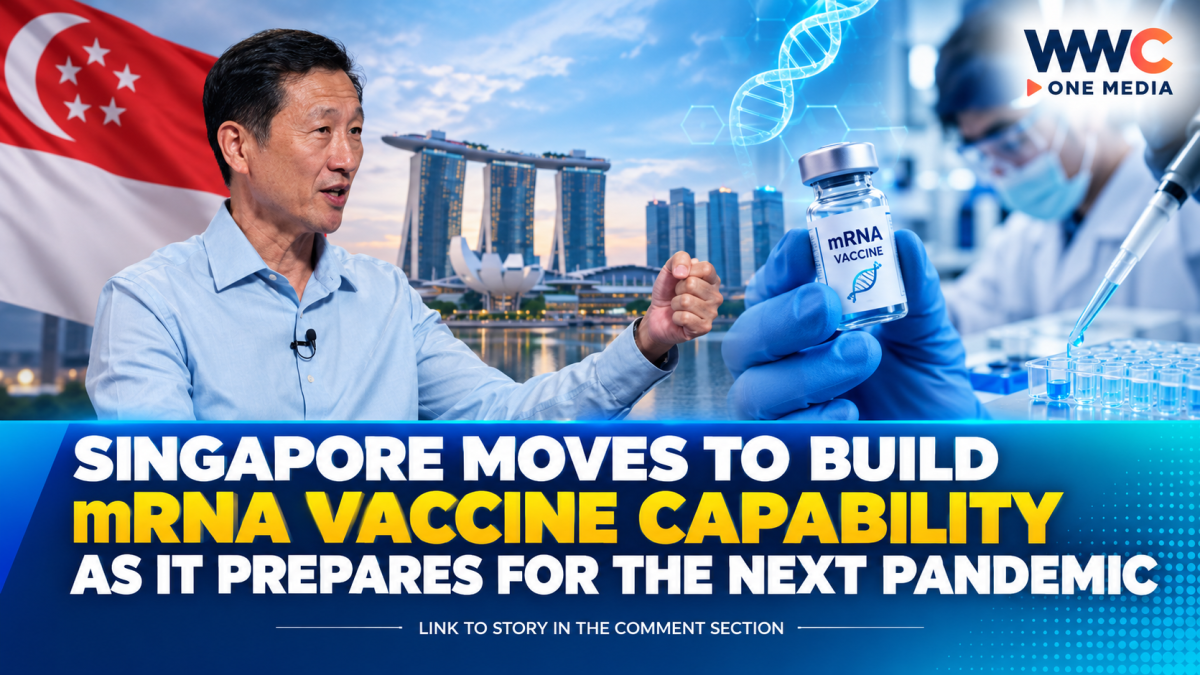
SINGAPORE — Singapore is stepping up preparations for the next major pandemic by supporting the development and local production of mRNA influenza vaccines, using the technology to strengthen its ability to respond rapidly if a new infectious disease emerges.
Health Minister Ong Ye Kung said the initiative would help Singapore build practical vaccine-development and manufacturing expertise while serving an immediate “peacetime” need.
The strategy is part of a broader effort to ensure that Singapore can move more quickly from identifying a dangerous pathogen to developing, producing and deploying a vaccine.
Ong said Singapore is not fully prepared for another pandemic yet, estimating its preparedness at around 50 per cent, with substantial work still needed.
Why Singapore Is Betting on mRNA
mRNA vaccine technology became widely known during the COVID-19 pandemic and allows scientists to design vaccine candidates without relying on the same production approach used for many traditional vaccines.
Ong said mRNA could offer significant flexibility when confronting a previously unknown pathogen because the platform can potentially be adapted quickly.
That makes the technology particularly relevant to preparations for “Disease X” — a term used for an unknown pathogen that could cause a future epidemic or pandemic.
Singapore’s approach, however, is not based on waiting for such a pathogen to appear.
Instead, authorities want to maintain facilities, expertise and partnerships during normal times so that the country does not have to build those capabilities from scratch during an emergency.
Hilleman Facility Could Produce Millions of Doses
Singapore-based Hilleman Laboratories is expected to play a major role in the initiative.
Its facility will produce materials for early clinical trials, with the first batch of a separate Bundibugyo ebolavirus vaccine candidate expected by the end of 2026.
For that vaccine candidate, Hilleman’s Singapore facility could have domestic capacity equivalent to 50 million to 60 million doses of drug substance, or about 12 million doses of drug product annually, according to Singapore’s Ministry of Health. Technology could also be transferred to a larger manufacturer in the region if required.
The facility’s existing capabilities could therefore provide a practical foundation for expanding Singapore’s vaccine manufacturing expertise.
Singapore Wants a Faster Response When the Next Outbreak Comes
The country’s pandemic strategy extends beyond simply producing vaccines.
Singapore is also working with pharmaceutical and manufacturing companies including Sanofi, GSK, Moderna and Thermo Fisher Scientific, while exploring the development of an RNA Readiness and Response global biofoundry.
The proposed model would separate vaccine design and development from large-scale production, similar in concept to the way semiconductor companies specialize in chip design and manufacturing.
The aim is to reduce production bottlenecks and make it possible to scale RNA vaccine manufacturing much more rapidly during a global emergency.
The 100-Day Race Against a New Pandemic
Singapore is also supporting the Coalition for Epidemic Preparedness Innovations (CEPI) and its goal of developing vaccines for newly identified pandemic threats within 100 days.
That means preparedness cannot begin after an outbreak has already spread.
Prototype vaccine research, laboratory networks, clinical-trial systems, manufacturing facilities and regulatory capabilities all need to be established beforehand.
CNA reported that Singapore’s mRNA influenza vaccine initiative is intended to serve a normal, peacetime purpose while simultaneously building adaptable capabilities for future outbreaks.
Vaccine Approval Is Another Piece of the Puzzle
Singapore is also seeking a stronger role in the international regulatory system.
Ong said the country’s Health Sciences Authority (HSA) will work toward achieving the World Health Organization’s corresponding benchmarking and listing for vaccine regulation.
The objective is to strengthen the ability of regulators to evaluate and authorize vaccines quickly during emergencies without compromising safety or quality.
Singapore is also contributing to pathogen surveillance through international genomic-data sharing networks, which can help scientists identify emerging threats earlier.
The Bigger Message Behind Singapore’s Strategy
Singapore’s preparations highlight a lesson from COVID-19: pandemic readiness is not only about having a vaccine formula.
It also requires manufacturing capacity, trained scientists, clinical-trial networks, regulatory systems, international cooperation and the ability to scale production quickly.
And there is an important limitation.
Ong cautioned that no country can be 100 per cent prepared for an unknown future pathogen. The identity and characteristics of a future “Disease X” remain unknown, meaning preparedness must focus on flexible systems rather than a single predicted threat.
Singapore’s mRNA influenza initiative is therefore more than a vaccine project. It is an attempt to keep the machinery of pandemic response running before the next crisis arrives.
Because when the next unknown virus appears, the biggest question may not be whether scientists can invent a vaccine — but whether the world can produce and deliver it fast enough.
WWC ONE MEDIA G,A