
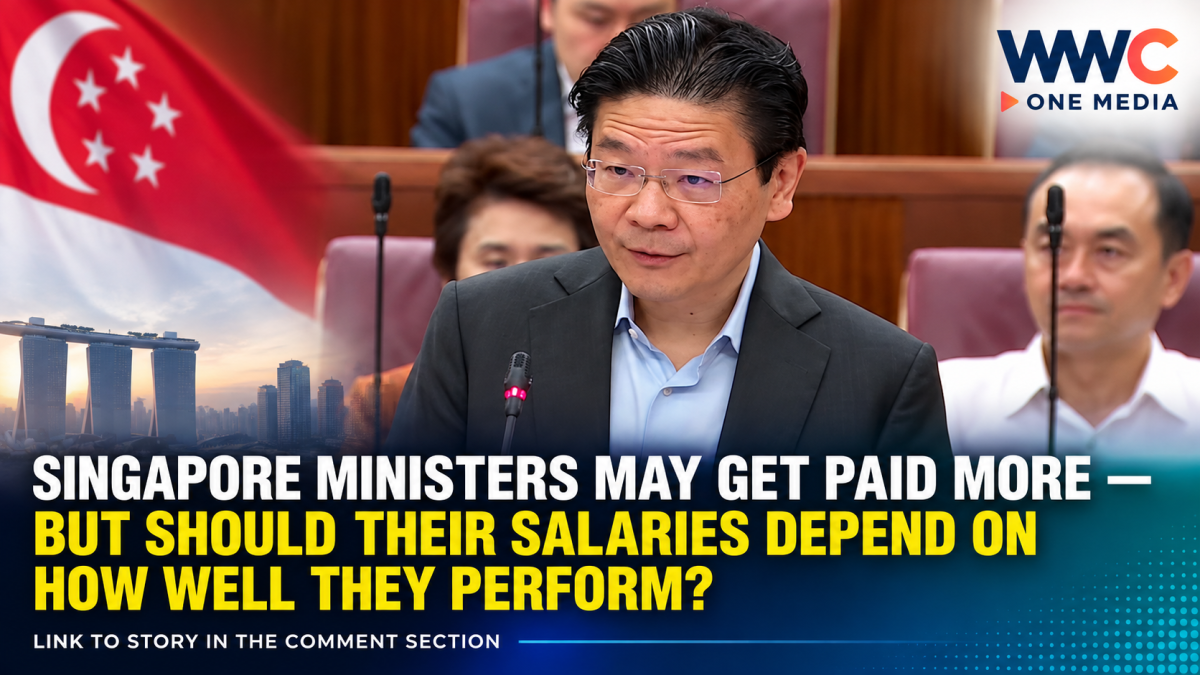
SINGAPORE — The debate over Singapore ministers’ salaries is once again making headlines, but a new question is emerging at the heart of the controversy: If political leaders are paid more, should the public be able to see clearer proof that they are delivering better results?
Singapore’s government has announced changes to the political salary framework, with serving political office holders set to receive a one-off salary adjustment of up to 9 per cent from Oct 15, 2026. The move has reignited a decades-old national debate over whether Singapore’s already highly paid political leaders should receive more — and whether their compensation should be tied more directly to performance.
Veteran newspaper editor and senior fellow Han Fook Kwang argued in a new commentary that Singapore may have reached a point where simply paying ministers more is no longer enough. Instead, he said, higher political salaries should come with stronger, more transparent and meaningful measures of performance.
A Debate That Has Lasted More Than 30 Years
Singapore’s political salary debate is nothing new.
The issue has been discussed for more than three decades, dating back to a 1994 White Paper on ministerial pay. Supporters have consistently argued that competitive salaries are necessary to attract talented people into government and reduce the risk of corruption.
Critics, however, have repeatedly asked whether million-dollar salaries are really necessary for public service — and whether higher pay actually guarantees better political leadership.
Those same questions remain largely unresolved today.
But according to Han, Singapore now has something it did not have decades ago: more than 30 years of experience with the policy itself.
That experience, he argued, should allow Singaporeans to ask a more important question than simply whether ministers deserve higher salaries:
Has the system actually delivered the leadership talent it was designed to attract?
Singapore Is Facing a Leadership Recruitment Challenge
The latest salary review comes at a time when Singapore’s government has openly acknowledged difficulties in attracting people from the private sector and senior levels of the public service into politics.
Prime Minister Lawrence Wong told Parliament that he had approached several chief executives and senior business leaders who could have made significant contributions to government but were unwilling to enter politics. He also said senior permanent secretaries had declined similar approaches.
That raises an uncomfortable question for Singapore:
If ministers are already among the highest-paid political leaders in the world, why is recruiting top talent still proving difficult?
The answer may be that money is only one part of the equation.
Entering politics can also mean losing privacy, facing constant public scrutiny, dealing with intense criticism and placing family life under the spotlight. Wong has stressed that competitive political salaries are not meant to lure people into politics for money, but to ensure that capable individuals do not have to make excessive financial sacrifices when they choose to serve.
The S$1.8 Million Figure Is Not What Ministers Will Immediately Receive
One of the biggest misunderstandings surrounding the salary review concerns the widely reported S$1.8 million benchmark for an MR4 minister.
That figure is a revised reference benchmark — not an automatic salary that every junior minister will immediately receive.
Under the government’s implementation plan, serving political office holders will receive a one-off adjustment of up to 9 per cent beginning Oct 15, depending on factors including individual performance and when their salaries were last adjusted.
For a minister currently earning around S$1.1 million at the MR4 reference salary, the maximum immediate adjustment would bring the figure to about S$1.2 million.
After that, future salary movements will depend on individual performance and responsibilities. The government expects most ministers who remain at MR4 to be at the lower end of the revised range, around S$1.35 million, by the end of the current term rather than automatically reaching S$1.8 million.
The revised framework therefore puts even greater focus on a crucial word:
Performance.
Should Ministers Be Paid Like CEOs — And Judged Like Them Too?
Singapore already includes performance-related elements in political remuneration.
Current indicators used in determining national performance include economic growth, unemployment and income growth for middle-income and lower-income Singaporeans.
But critics and lawmakers have questioned whether those measures go far enough.
During the parliamentary debate, Nominated Member of Parliament Haresh Singaraju raised the possibility of using broader quality-of-life indicators that reflect how Singaporeans are actually living.
NMP Kenneth Goh suggested longer-term measures involving issues such as demographic sustainability, social mobility, climate adaptation and social cohesion, potentially assessed over three to five years.
These ideas could fundamentally reshape the political salary debate.
Instead of asking only:
“How much should a minister earn?”
Singaporeans could increasingly ask:
“What results did the minister deliver?”
The Call for More Transparency
The debate has also raised questions about how transparent Singapore’s political salary system should be.
Workers’ Party chief Pritam Singh supported the government’s decision to limit the immediate increase for political office holders to up to 9 per cent but questioned the longer-term formula used to benchmark ministerial salaries. He also called for greater transparency regarding ministers’ actual remuneration.
Prime Minister Wong said he would consider whether more information could be disclosed about where ministers sit within salary ranges and their variable payouts, although he warned against turning ministerial assessments into a public popularity contest or annual ranking exercise.
That may be the political balancing act Singapore now faces.
The public wants accountability.
The government wants to maintain a system that evaluates ministers rigorously without reducing Cabinet performance to social media popularity or simplistic rankings.
Opposition Parties Question Whether Higher Pay Is the Answer
The government’s argument that competitive salaries are necessary to attract capable leaders has also been challenged by opposition parties.
The Progress Singapore Party, Singapore Democratic Party and Red Dot United have questioned whether high salaries are truly necessary to attract talented people into politics, arguing that public service should not be driven primarily by financial rewards.
At the same time, the Workers’ Party has taken a more nuanced position, supporting some immediate adjustments while questioning the formula used for ministerial salaries.
The result is a debate that is no longer simply about whether salaries should go up or down.
It is increasingly about:
- How Singapore measures good leadership
- How much transparency the public deserves
- Whether ministers should be rewarded for long-term results
- Whether quality of life should matter as much as economic growth
- And whether performance-based pay can strengthen public trust
Why the Debate Matters Beyond the Salary Figures
The Singapore government argues that political salaries must remain competitive because the country cannot afford to have a weak pool of potential leaders.
The Public Service Division has said that the existing benchmark — based on the median income of Singapore’s top 1,000 citizen earners with a discount for public service — is intended to reflect the calibre of talent needed for government while recognising the ethos of serving the public.
International coverage has also highlighted the political sensitivity of the issue. Reuters reported that the salary changes have generated online criticism and renewed attention to the gap between political pay and ordinary wages, while the government has argued that competitive remuneration is important for attracting capable leaders and maintaining integrity.
The Associated Press likewise noted that ministers will not immediately move to the new benchmark and that future salary progression will depend on performance and responsibilities.
This is why the debate is unlikely to disappear anytime soon.
Singapore is not simply deciding how much to pay its politicians.
It is confronting a much bigger question:
What should the public expect in return?
The Bigger Test: Can Higher Pay Deliver Better Leadership?
Han’s central argument is simple but potentially powerful.
If Singapore eventually decides to make a more decisive move toward higher political salaries, those increases should be accompanied by an equally serious effort to link compensation to challenging, transparent and meaningful performance targets.
That could mean a larger portion of political pay being tied to variable bonuses based on outcomes that Singaporeans can understand and evaluate.
The challenge will be designing measures that go beyond short-term economic numbers.
A minister may oversee policies whose results take years to emerge. Some of the most important outcomes — stronger social cohesion, improved housing security, better public trust or climate resilience — are also difficult to measure with a single number.
But that difficulty may be exactly why the next phase of Singapore’s political salary system matters.
The public may be willing to accept higher pay. But increasingly, Singaporeans may want to know what performance justifies it.
And that could turn a 30-year-old argument over salaries into a much more consequential debate over accountability, leadership and public trust.
Because in the end, the real question may not be whether Singapore ministers are paid too much.
It may be whether Singapore has built the right system to show that they are worth every dollar.




Leave a Reply