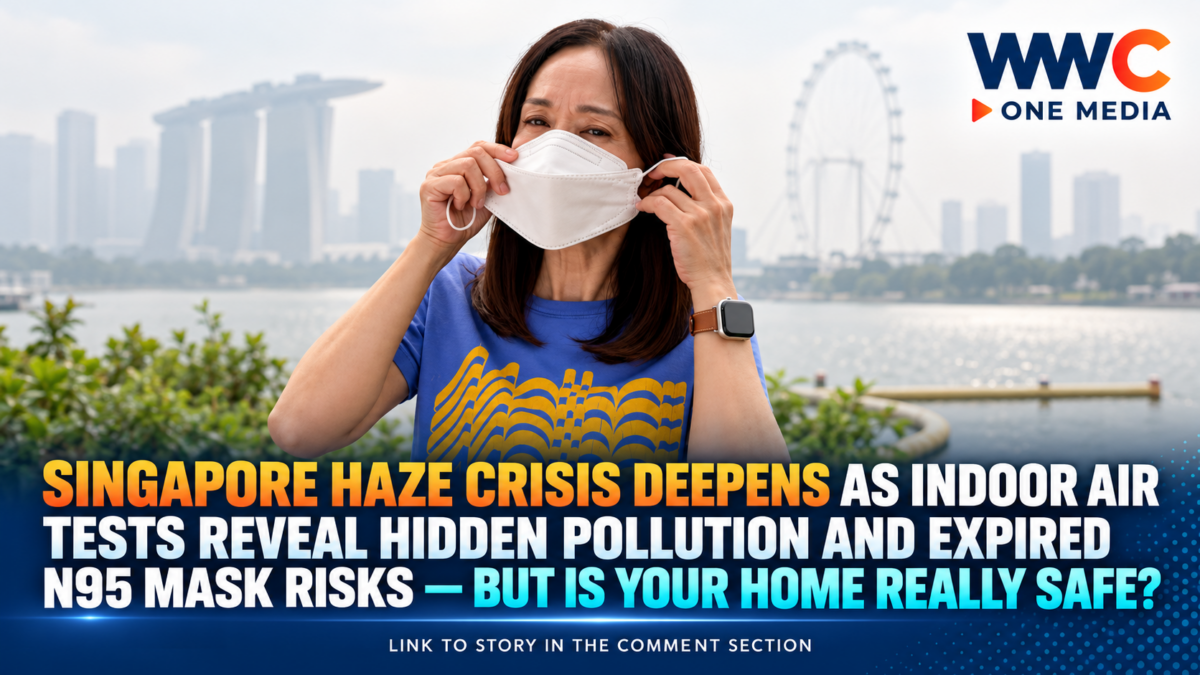
SINGAPORE — As Southeast Asia battles one of its most persistent haze emergencies in years, a troubling discovery is challenging how millions of people protect themselves from dangerous air pollution: Staying inside with windows closed does not always guarantee cleaner air.
An investigation by Channel NewsAsia’s Talking Point found that indoor air pollution in a Singapore apartment was actually higher than outdoors, while laboratory tests showed that some expired N95 masks continued to filter fine particles effectively and others had fallen below the required standard.
The findings come as Singapore endures its most prolonged haze episode since 2015, with unhealthy air quality affecting residents, businesses and outdoor activities.
And the warning goes beyond Singapore. With wildfire smoke continuing to travel across national borders, the crisis raises an urgent question for households throughout Southeast Asia: Are the everyday precautions people rely on actually protecting their health?
The alarming discovery: Indoor air can be worse than outside
In one of the most striking findings, researchers tested the air inside a fifth-floor Singapore apartment after its windows had been shut for approximately one hour.
The results revealed a PM2.5 concentration of 187 micrograms per cubic metre indoors, compared with 169 micrograms per cubic metre outdoors.
The discovery undermines the assumption that simply closing windows automatically creates a safe indoor environment.
Nanyang Technological University assistant professor Leonard Ng explained that polluted outdoor air may have entered the apartment earlier, before the windows were closed.
Consequently, shutting the windows could have trapped that pollution indoors.
In another apartment on the 15th floor of the same building, the indoor reading initially stood at 149 micrograms per cubic metre. When the windows were opened during worsening outdoor conditions, the reading jumped to 301.
The experiments demonstrate how quickly haze particles can move into residential spaces, particularly when outdoor pollution is severe.
However, the findings came from specific homes under changing conditions. They do not establish that indoor air is generally more polluted than outdoor air during haze episodes.
The larger lesson is that indoor air quality depends on ventilation, pollution sources, outdoor conditions and filtration.
Air-conditioning versus air purifiers: A major difference
Many households depend on air-conditioning to remain comfortable while keeping their windows closed during the haze.
But can an ordinary air-conditioning unit remove enough dangerous particles?
The investigation found that running an air-conditioner for 10 minutes reduced one bedroom’s PM2.5 reading from 131.6 to 109.8 micrograms per cubic metre.
Although an improvement, the pollution level remained elevated.
A separate test involving an air purifier produced a more substantial reduction, bringing a living room’s PM2.5 reading down to 40.7 after one hour of operation.
Because the two tests were conducted under different conditions and durations, they cannot be interpreted as a direct comparison of removal efficiency.
Nevertheless, they illustrate why an air-conditioner should not automatically be treated as a substitute for a properly sized air purifier.
Experts recommend considering the purifier’s Clean Air Delivery Rate, or CADR, which indicates how much filtered air the device can provide.
An appropriately sized purifier, maintained with suitable filters and operated with doors and windows closed during severe haze, can help reduce indoor particle exposure.
Expired N95 masks: A surprising 99% result, but also a warning
Another revelation involved N95 masks that had passed their expiration dates.
During testing at an ST Engineering facility, N95 masks that expired in 2017 achieved 99% filtration efficiency.
That exceeded the 95% filtration requirement associated with N95 respirators.
However, another N95 mask that expired in 2022 achieved only 93%, falling below that requirement.
The findings highlight an important distinction: Some expired respirators can retain strong filtering performance, but their protective effectiveness cannot be guaranteed.
Storage temperature, humidity, material deterioration and damage to straps or nosepieces can affect their condition.
Jerome Lee, ST Engineering’s head of respiratory protection, cautioned against depending on expired masks because deterioration is not necessarily visible.
The investigation also found filtration efficiencies of approximately 67% for a surgical mask, 95% for a KF94 and 98% for a new N95 mask in the particular laboratory tests.
These results should not be treated as universal performance ratings for every mask of those types.
Crucially, filtration material is only one part of respiratory protection.
A poorly fitted N95 can allow contaminated air to enter through gaps around the nose, cheeks or chin.
For people who need respiratory protection during hazardous outdoor conditions, a properly fitting, undamaged and unexpired respirator remains the more reliable choice.
Why dangerous PM2.5 particles deserve attention
The primary health concern during severe haze is PM2.5, microscopic airborne particles measuring 2.5 micrometres or less in diameter.
Because of their small size, these particles can penetrate deep into the respiratory system.
Exposure is associated with respiratory irritation, worsening asthma, cardiovascular problems and other health risks.
Long-term exposure to fine particulate pollution is linked to serious conditions including heart disease, stroke and lung cancer.
Children, older adults, pregnant women and people with existing heart or respiratory conditions can be especially vulnerable.
The health effects of haze also depend on the duration and intensity of exposure.
A single elevated reading does not establish that a particular person will develop a serious illness, but repeated or prolonged exposure increases concern.
Outdoor exercise could significantly increase pollution exposure
For fitness enthusiasts, Singapore’s haze crisis presents another challenge.
The harder someone exercises, the more air they generally breathe.
In a cardiopulmonary exercise test featured by Talking Point, presenter Diana Ser’s breathing volume increased to approximately three times her resting level during moderate exertion and six times during maximal effort.
Medical experts explained that intense exercise can substantially increase the amount of polluted air inhaled.
This means jogging, cycling and other strenuous outdoor activities may increase exposure when fine-particle concentrations are high.
Doctors advised checking updated air quality readings, reducing exercise intensity and duration, and considering indoor alternatives when pollution worsens.
Exercising inside is not automatically risk-free, however, particularly when indoor air is poorly filtered or contaminated.
Why different air pollution websites display different numbers
Residents monitoring the haze may notice that Singapore’s National Environment Agency reports different figures from international air-quality websites.
The reason is not necessarily a measurement failure.
Some websites combine official monitoring data with information from privately operated or lower-cost sensors, while others transform pollution concentrations into index values using different formulas.
These readings may reflect different locations, time periods or calculation methods.
Singapore’s one-hour PM2.5 concentration provides a more immediate indication of fine-particle pollution.
Its 24-hour Pollutant Standards Index, or PSI, is designed to support broader health advisories and activity planning.
Residents should therefore avoid treating a PM2.5 concentration expressed in micrograms per cubic metre as numerically interchangeable with an Air Quality Index score.
For local decisions, the NEA’s official air quality readings and health advisories provide an important reference.
Regional haze crisis: Indonesian wildfires continue to threaten Southeast Asia
Singapore’s deteriorating air quality is part of a much larger regional environmental emergency.
Reuters reported on October 15 that widespread forest and peatland fires in Indonesia had generated severe smoke pollution across parts of Southeast Asia.
Exceptionally dry conditions associated with El Niño have made vegetation and peatlands more vulnerable to ignition and difficult to extinguish.
Smoke from fires in Sumatra and Borneo has contributed to deteriorating air quality across neighboring territories.
By October 22, Reuters reported that Indonesia had recorded a decline in detected fire hotspots, but insufficient rainfall meant significant fire risks remained.
More than 69,000 personnel had been deployed to firefighting operations, alongside aircraft and other fire-suppression measures.
The crisis has also disrupted education, outdoor activities and travel in affected countries.
The Straits Times reported on October 24 that Singapore tourism businesses experienced booking disruptions and cancellations, with some operators reporting substantial reductions.
These developments show that haze is not merely an environmental inconvenience. It carries public-health, economic and regional consequences.
When will the haze end?
Climate researchers interviewed by CNA suggested that Singapore could experience more sustained relief around mid-November as the northeast monsoon changes prevailing wind patterns.
However, the timetable is an outlook rather than a guarantee.
Air quality can improve temporarily with rainfall and favorable winds, then deteriorate again if fires remain active and smoke moves toward populated areas.
On October 25, The Straits Times reported that hourly PM2.5 concentrations had returned to the normal category in three Singapore regions in the morning, even as 24-hour PSI readings remained unhealthy across the island.
The contrasting readings underline how quickly short-term air conditions can change during a prolonged regional pollution episode.
Researchers also warn that increasingly dry and hot conditions associated with climate variability and climate change could intensify future fire risks.
Singapore has taken enforcement steps under its Transboundary Haze Pollution Act, including issuing notices to companies connected to inquiries into the ongoing haze.
Meanwhile, ASEAN continues to pursue its ambition of achieving a haze-free region by 2030.
Whether those efforts succeed will depend on effective fire prevention, land management, enforcement and regional cooperation.
Seven practical ways families can reduce haze exposure
Health and environmental authorities recommend combining several precautions rather than relying on a single protective measure.
- Close windows and doors when outdoor pollution rises, but ventilate the home when air quality improves.
- Use an appropriately sized air purifier with a filter designed to capture fine particles, and maintain or replace the filter as recommended.
- Do not rely solely on ordinary air-conditioning to remove dangerous PM2.5 pollution.
- Use properly fitting, unexpired respirators when appropriate, particularly for necessary prolonged outdoor exposure under severe conditions.
- Reduce strenuous outdoor activity when pollution reaches unhealthy levels, especially for vulnerable individuals.
- Avoid generating additional indoor pollution from smoking, candles and other sources of airborne particles.
- Monitor official air quality updates and seek medical advice when needed, particularly for persistent breathing difficulties, worsening asthma or other concerning symptoms.
The bigger question: Can Southeast Asia stop the next haze emergency?
The latest findings challenge the familiar belief that shutting windows, switching on the air-conditioner and putting on a mask automatically eliminate the risks of severe haze.
Indoor air can remain contaminated. Respirators can deteriorate. Outdoor activity can increase exposure. And short-term improvements in pollution readings do not necessarily mean the regional fires are over.
For Singapore and its neighbors, improving household protection is essential, but preventing the pollution at its source remains the longer-term challenge.
As Southeast Asia confronts recurring wildfires, increasingly volatile weather and the human cost of polluted air, the most urgent question may no longer be how families can hide from the haze.
It is whether governments and industries can prevent another crisis before the region is forced to breathe through one again.