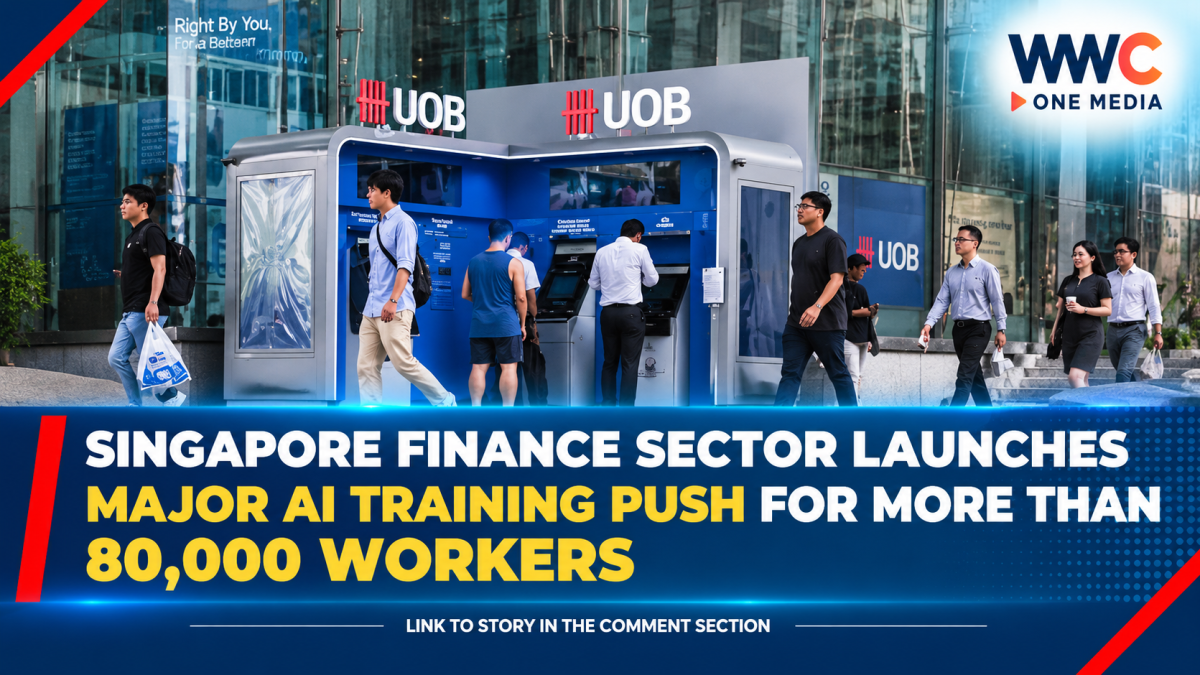
SINGAPORE — More than 80,000 financial-sector employees in Singapore are set to receive critical artificial intelligence training by 2028 as banks, insurers and asset managers accelerate efforts to reshape jobs for an AI-driven economy.
The initiative brings together 23 financial institutions under a new IBF AI Workforce Co-Lab, launched by the Institute of Banking and Finance (IBF). The participating institutions have committed to train their entire Singapore-based workforce through IBF-recognised programmes. More than half of those employees have already received training.
The institutions represent about 40% of Singapore’s financial-sector workforce, making the programme one of the country’s larger coordinated efforts to prepare finance professionals for changes brought by AI.
AI Is Already Changing Finance Jobs
The programme comes as AI moves beyond experimentation and into everyday financial operations.
Singapore Deputy Prime Minister and Minister for Trade and Industry Gan Kim Yong said AI is already changing areas including customer service, financial advisory, credit underwriting, fraud detection, market analysis and software development.
The government’s approach is not simply to teach workers how to use AI tools.
Officials and industry groups are also looking at how individual jobs themselves may change as AI takes over or assists with routine tasks.
That distinction is central to the new Co-Lab.
Rather than treating AI adoption solely as a technology upgrade, participating institutions will examine how responsibilities are evolving and test approaches for training, reskilling and job redesign. Findings will subsequently be shared with the wider financial sector.
Three New AI Career Pathways
The IBF initiative begins with three specialised pathways covering different parts of the financial workforce.
1. Leaders
The Co-Lab@Leaders programme is designed to help executives identify useful AI applications, establish appropriate governance and lead workforce transformation.
The goal is to encourage leaders to consider not only where AI can improve productivity, but also which jobs could change and how employees can prepare for those changes.
2. Wealth Managers
The Co-Lab@Wealth Managers pathway focuses on combining AI capabilities with human advisory skills.
AI can help relationship managers process information more quickly, analyse portfolios and prepare for client meetings. But the programme emphasises that professional judgment and client relationships remain important parts of wealth management.
Ten private-banking employers have committed to upskill relationship managers through the initiative.
3. Operations Staff
The third pathway, Co-Lab@Operations, focuses on employees whose work is being reshaped by automation and AI.
Workers may need new capabilities in areas such as process improvement, exception handling, risk oversight and checking AI-generated output.
For some employees, that could mean taking on higher responsibilities within an existing role. For others, it could involve moving into related jobs or newly created AI-enabled positions.
The Message: AI Training Is Not Just About Technology
Singapore’s financial-sector strategy reflects a broader concern facing employers worldwide: AI adoption can change tasks faster than traditional job descriptions can keep up.
MAS Managing Director and IBF chairman Chia Der Jiun said that giving workers new technical skills is only part of the challenge. Employees also need support as their jobs and responsibilities evolve.
That is why the initiative includes more than conventional training.
IBF is also launching a Job Redesign Playbook for Financial Services, developed with the Skills and Workforce Development Agency and the Institute for Human Resource Professionals. The playbook is intended to give business leaders and HR professionals practical guidance as companies redesign roles around AI.
Banks Are Already Training Their Employees
Some major financial institutions have already begun building AI capabilities among their workforces.
DBS, for example, has worked with IBF to equip around 14,800 Singapore-based employees with foundational AI capabilities, according to the government’s announcement.
OCBC said almost all of its Singapore employees had already attended AI-, digital- or data-related programmes, while UOB said it had been building foundational AI capabilities among its staff and was now focusing more heavily on how roles and skills would evolve.
The emphasis is increasingly shifting from basic AI familiarity to practical workplace application.
A Separate Push for Young Finance Talent
The transformation plan also looks beyond current employees.
The government and IBF are developing programmes to prepare younger workers for a financial sector in which AI is expected to be a standard part of many jobs.
IBF’s pilot Young Talent Programme for AI in Finance combines AI and finance education with industry exposure. Its first cohort has completed masterclasses and is moving toward project work with industry mentors, with some participants expected to undertake work attachments at financial institutions.
The strategy reflects a recognition that future finance professionals may need both traditional expertise and the ability to work effectively with AI systems.
Singapore Wants AI to Create New Career Paths, Too
The initiative does not frame AI solely as a source of workplace disruption.
Officials have highlighted the possibility of new responsibilities and career paths emerging as routine tasks become increasingly automated.
Gan said financial institutions should plan for their people at the same time they plan for AI—identifying how jobs will change, preparing employees early and helping them take advantage of emerging opportunities.
That could mean expanding an existing role, moving workers into adjacent positions or creating entirely new AI-related responsibilities.
In operations, for example, employees who previously handled frontline or routine work may increasingly participate in monitoring AI systems, improving workflows or checking whether automated outputs are appropriate.
The Bigger Picture for Singapore’s Financial Hub
The programme comes as Singapore continues to position itself as a major international financial centre while financial institutions rapidly adopt AI.
The enhanced partnership between IBF, the NTUC Financial and Professional Services Cluster of Unions and seven industry associations will broaden industry outreach and access to training and career support. Together, those associations represent more than 800 financial institutions and FinTech firms, accounting for more than 70% of the sector’s workforce.
The immediate target is therefore the 80,000-plus workers covered by the 23 pioneer institutions—but the wider ambition is to create a framework that can be adopted across Singapore’s financial ecosystem.
The challenge will be ensuring that training keeps pace with the technology itself.
AI tools are evolving rapidly, meaning a one-time course is unlikely to be enough. Workers may need continuing education as responsibilities, systems and regulatory expectations change.
The AI Workforce Shift Is Already Underway
Singapore’s finance sector is now moving toward a model in which AI skills become part of mainstream professional development rather than a specialist capability reserved for technology teams.
By 2028, more than 80,000 workers are expected to have received critical AI training through the participating institutions.
But the bigger experiment will be what happens after the training: whether AI simply automates parts of existing jobs, or whether it leads to redesigned roles in which human judgment and AI capabilities work together.
For Singapore’s financial industry, the next phase of the AI race may therefore be less about acquiring the newest technology—and more about preparing the people who will use it.
WWC ONE MEDIA G,A