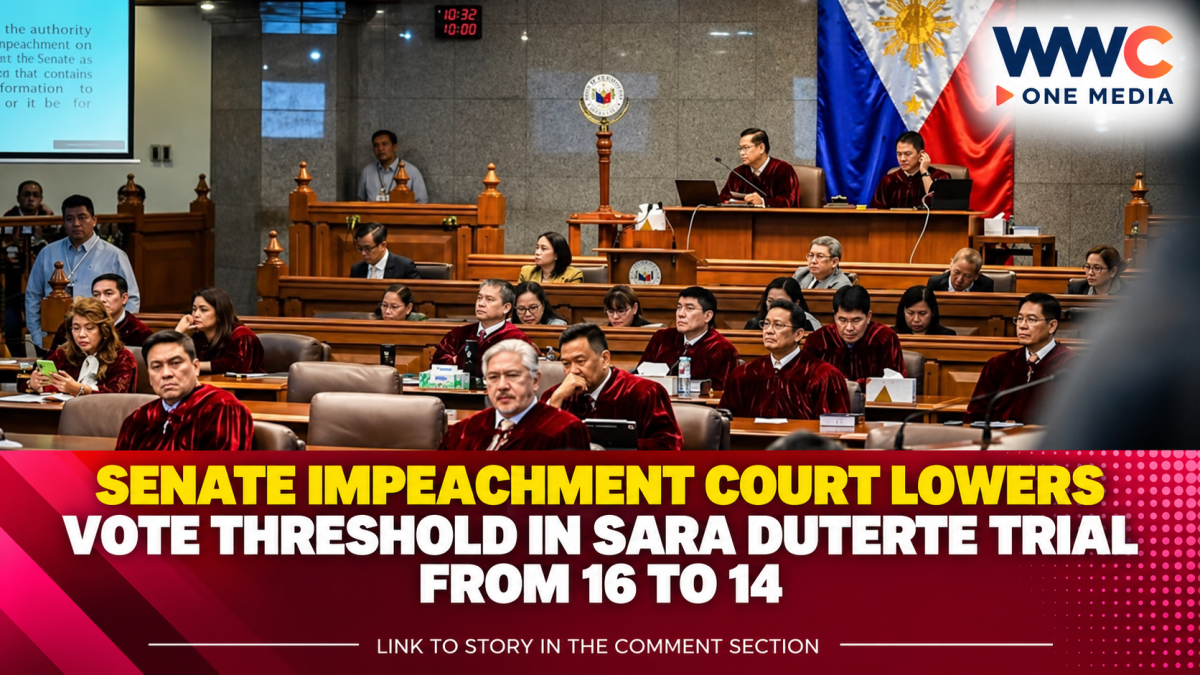
The Senate impeachment court has changed the voting formula for convicting Vice President Sara Duterte, replacing the earlier 16-vote threshold with a system that counts only senator-judges who are legally and factually capable of participating in the proceedings.
The decision was reached on September 23, when 13 senator-judges voted to approve Senator Erwin Tulfo’s motion to revisit the earlier interpretation, while one voted against it and six did not participate.
Under the new ruling, the Constitution’s requirement of a two-thirds vote will be calculated using the number of senator-judges who are eligible and able to participate when the judgment is rendered. The ruling excludes senators who are detained, suspended or otherwise legally restrained from performing their functions, those whose whereabouts are unknown and are being sought by authorities, those who are physically or medically incapacitated, and those beyond the Senate’s coercive processes.
With 20 senator-judges currently considered capable of participating, two-thirds works out to 13.33 votes, which the court said must be rounded up. That means 14 votes would be required under the present composition. The numerical threshold could change again if the number of legally and factually capable senator-judges changes before the final vote.
The new formula reverses the July 6 interpretation by Senate President and impeachment court presiding officer Francis “Chiz” Escudero, who had ruled that two-thirds of all 24 senators, or 16 votes, was required to convict an impeached official.
Escudero voted against changing the earlier interpretation. He said he continued to believe that all 24 members should be counted but would implement the impeachment court’s decision.
The dispute centers on the wording of Article XI, Section 3 of the 1987 Constitution, which requires a vote of two-thirds of all the members of the Senate for conviction in an impeachment case. The prosecution argued that senators who cannot legally or factually participate should not be included in the denominator, while Duterte’s defense maintained that detention, absence or non-participation does not remove a senator from Senate membership.
The impeachment court’s decision followed two weeks of review that included presentations from former Supreme Court justices and constitutional experts, as well as oral arguments from the prosecution and defense.
Senator Alan Peter Cayetano argued that the constitutional question should ultimately be addressed by the Supreme Court rather than being resolved by the impeachment court itself. He also warned that changing the denominator during the trial could have consequences for the validity of the proceedings.
Duterte’s defense has indicated that it may pursue legal remedies, while lawyer Israelito Torreon said he was preparing a possible Supreme Court petition challenging the revised threshold. The proposed challenge would argue that the Constitution refers to all members of the Senate, rather than only those participating in the trial.
The ruling does not itself determine the outcome of Duterte’s impeachment case. Senator-judges will still have to evaluate the articles of impeachment and evidence presented during the trial before casting their eventual judgment.
For now, the immediate change is procedural: the number of votes required for conviction is no longer fixed at 16 and will instead depend on the number of senator-judges legally and factually capable of participating when the final vote is taken.