
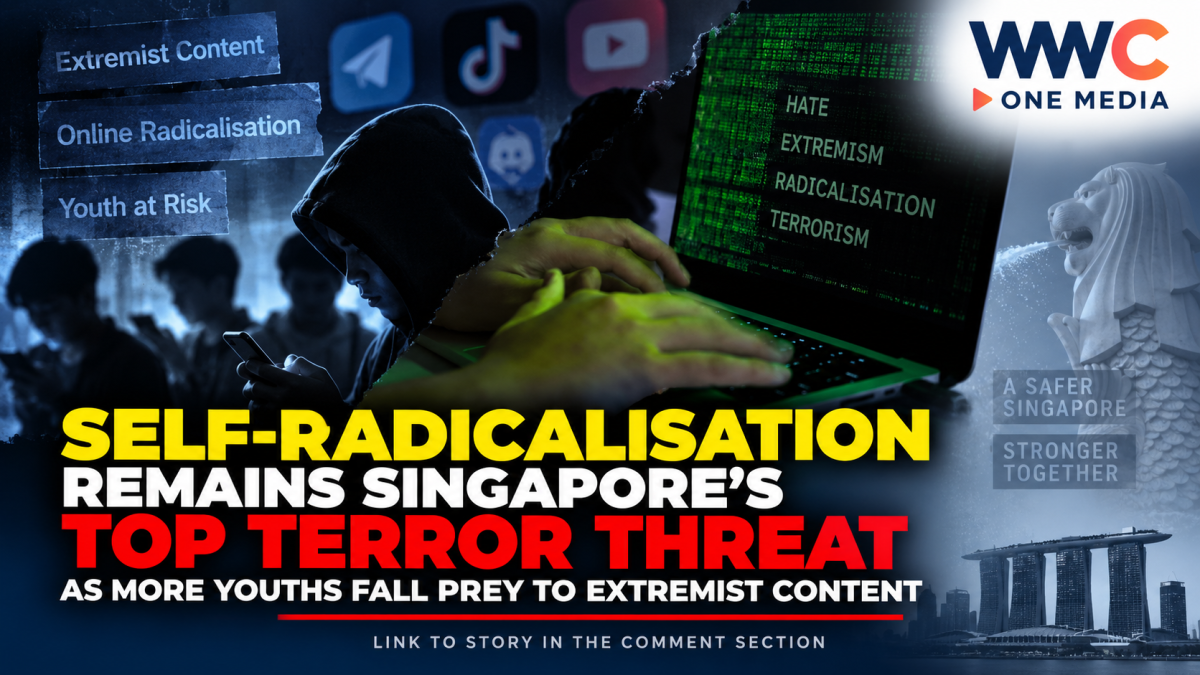
SINGAPORE — Self-radicalisation remains Singapore’s main domestic terrorism threat, with a growing number of young people being drawn towards extremist ideologies online, the Internal Security Department (ISD) has warned.
In its latest Singapore Terrorism Threat Assessment Report, released on Sept. 10, the ISD said seven out of eight Singaporeans dealt with under the Internal Security Act (ISA) between July 2025 and 2026 were self-radicalised.
More alarmingly, most of the recent cases involved young people.
Six of the eight Singaporeans issued ISA orders during the period were youths, including three 14-year-olds, a 15-year-old and two 19-year-olds.
Youth Radicalisation Is Rising
The number of youth ISA cases has increased sharply in recent years.
Between 2017 and 2021, Singapore recorded four youth cases. That number rose to 15 cases between 2022 and 2026, according to the ISD.
Since 2015, Singapore has dealt with 23 youth terrorism-related cases under the ISA. Of those, 12 had plans to carry out attacks in Singapore, highlighting the serious danger posed even by very young individuals who become radicalised.
The ISD said individuals are also becoming radicalised at younger ages, raising fresh concerns among parents, schools and the wider community.
ISIS Propaganda Remains a Major Influence
The ISD said most self-radicalised individuals in Singapore continue to subscribe to Islamist extremist ideologies.
ISIS propaganda remains widely accessible online and continues to be a significant influence in local radicalisation cases.
Of the Singaporeans dealt with under the ISA during the past year, five youths supported ISIS. Three of them had sought to carry out ISIS-inspired attacks in Singapore, according to the report.
The agency also flagged extremist narratives surrounding the Israeli-Palestinian conflict, warning that terrorist and extremist groups continue to exploit global conflicts to spread propaganda and recruit supporters.
A New and Growing Threat: ‘Composite Violent Extremism’
Singapore is also seeing more individuals influenced by what authorities call Composite Violent Extremism, or CoVE.
The term refers to individuals who embrace multiple extremist ideologies, even when those beliefs appear contradictory.
All three CoVE cases detected in Singapore over the past year involved people under the age of 20.
One of the most alarming cases involved a 14-year-old boy who was arrested in May after allegedly becoming radicalised by multiple extremist ideologies.
According to the ISD, the boy was arrested a month before he planned to carry out an attack at his school and pledge allegiance to ISIS.
The agency warned that young people who spend significant amounts of time online may encounter and absorb ideas from different extremist movements without fully understanding their contradictions or consequences.
Gaming Platforms and Social Media Under Scrutiny
Online platforms continue to feature prominently in youth radicalisation cases.
The ISD specifically noted the role of online and gaming environments, where young people may encounter extremist communities and harmful propaganda.
Young people are particularly vulnerable because their critical thinking and cognitive skills are still developing, the agency said.
The concern is not unique to Singapore. Counterterrorism officials elsewhere have also warned that online environments are increasingly exposing minors to extremist content and helping drive a shift towards younger, self-initiated individuals involved in extremist violence.
Singapore authorities have repeatedly stressed the importance of helping young people critically evaluate what they encounter online rather than accepting extremist propaganda at face value.
Terror Threat Level Remains High
Overall, the ISD assessed Singapore’s terrorism threat level as remaining high.
The agency said ongoing conflicts in the Middle East have heightened terrorism threats globally, with extremist groups seeking to exploit international developments to advance their agendas.
While there is currently no specific intelligence of an imminent terrorist attack against Singapore, the ISD warned that attacks overseas could inspire copycat attacks closer to home.
Singapore remains an attractive target for terrorist groups because of its international profile, economic importance and close links with countries that extremist organisations frequently target.
Singapore Named in Extremist Propaganda
The ISD pointed to a propaganda magazine published by the Islamic State Khorasan Province on March 9 that listed Singapore among countries it described as “Lands of Disbelief.”
The agency also warned about the emergence of new threats and extremist networks operating internationally.
Among them is a group known as Harakat Ashab al-Yamin al-Islamiya (HAYI), which has reportedly claimed responsibility for attacks and attempted attacks in Europe, Canada and the United States.
The ISD said some HAYI-linked attacks involved a method described as “gig terrorism,” in which individuals or organised criminal groups with no apparent ideological motives are recruited to carry out acts of violence in exchange for money.
Concerns Over Southeast Asia
The ISD also flagged an increased presence of Hamas-linked operatives and networks in Southeast Asia.
According to the agency, this could increase the risk of the region being used for recruitment, facilitation, operational planning or attacks.
Singapore’s security agencies are working with foreign intelligence and security partners to exchange information and disrupt potential threats before they develop further.
More Than 150 Singaporeans Issued ISA Orders Since 2022
Since 2022, a total of 156 Singaporeans have been issued ISA orders, according to the ISD.
Of these:
- 106 were issued detention orders
- 50 were issued restriction orders
- 87 of those detained have since been released
- 40 restriction orders have since lapsed
The figures highlight the continued effort by authorities to identify and intervene in radicalisation cases before violence occurs.
Authorities Urge Public to Report Signs of Radicalisation
The ISD has urged members of the public to remain vigilant and report suspected terrorism threats or signs of radicalisation early.
Authorities say early intervention can give security agencies and community partners an opportunity to help individuals before they become a danger to themselves or others.
Singapore leaders have also cautioned against allowing the actions of a small number of radicalised individuals to fuel prejudice or distrust against entire communities.
Senior Minister K. Shanmugam recently stressed that Singapore must not allow a small extremist minority to damage the trust built between communities.
The Bottom Line
Singapore’s biggest terrorism threat is increasingly coming from individuals who radicalise themselves online — and many of them are getting younger.
Seven of the eight Singaporeans dealt with under the ISA between July 2025 and 2026 were self-radicalised, while six of the eight were youths.
ISIS propaganda remains a major influence, but authorities are now facing another emerging challenge: young people mixing multiple and sometimes contradictory extremist ideologies into what the ISD calls Composite Violent Extremism.
The threat remains high, even though Singapore has no specific intelligence of an imminent attack.
For authorities, parents, schools and communities, the warning is clear:
Extremism is no longer just something that develops in distant conflict zones. Increasingly, it can begin with a young person sitting alone in front of a screen.
WWC ONE MEDIA J.M.D




Leave a Reply