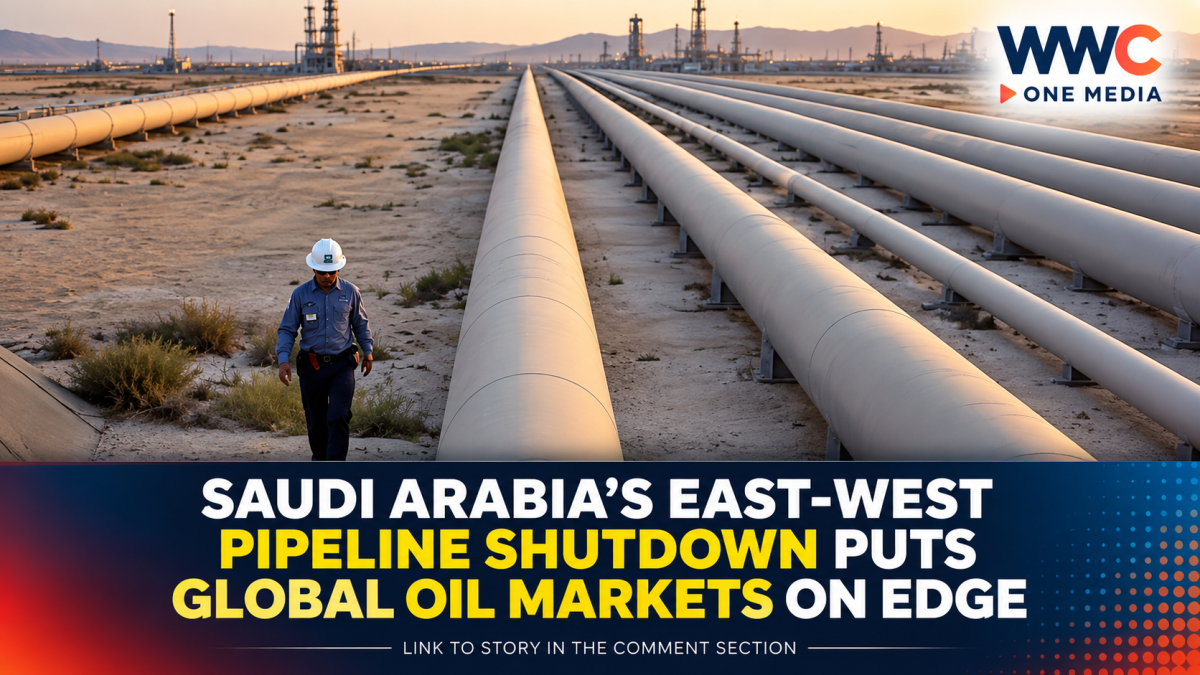
Saudi Arabia’s shutdown of its critical East-West oil pipeline has turned one of the world’s most important energy bypass routes into the latest pressure point for an already fragile global oil market.
The roughly 1,200-kilometer pipeline, operated by Saudi Aramco, normally moves crude from the kingdom’s oil-producing region in the east to the Red Sea port of Yanbu, allowing Saudi Arabia to export oil without sending all of it through the Strait of Hormuz.
That alternative route has become especially important since the disruption of Hormuz during the wider Middle East conflict.
Now, after drone attacks damaged the pipeline network, Saudi Arabia has been forced to suspend operations while repairs are carried out — raising fresh questions over how much crude the kingdom can continue delivering to international buyers.
Why the pipeline matters so much
The East-West Pipeline, sometimes called Petroline, stretches across the Arabian Peninsula from the country’s eastern oil fields toward Yanbu on the Red Sea.
Before the latest shutdown, it was carrying roughly 4 million to 5 million barrels of crude per day, according to Reuters and other reporting — equivalent to roughly 4% to 5% of global oil supply.
Its strategic importance is even greater than those numbers suggest.
The pipeline provides Saudi Arabia with a way to move crude toward the Red Sea without relying exclusively on the Strait of Hormuz, one of the world’s most important oil chokepoints.
With shipping through Hormuz already heavily disrupted, the pipeline had become a crucial alternative route for the world’s largest crude exporter.
That is why the latest outage has unnerved traders.
Three pumping stations were reportedly damaged
The extent of the damage has also become clearer.
Reuters reported that three pumping stations serving the East-West Pipeline were damaged in the attack — one more station than previously assessed — based on satellite imagery and industry sources.
Saudi Arabia initially shut the pipeline as a precaution after drone attacks originating from Iraq struck areas in the Riyadh and Madinah regions.
The Saudi Energy Ministry said the attacks caused damage and injuries and that the pipeline was shut down while emergency and technical teams assessed the infrastructure.
Saudi authorities have attributed the attacks to drones originating from Iraq, but responsibility for the attacks has been reported amid a broader regional conflict, and details surrounding the perpetrators remain contested.
The biggest problem is timing
The critical question for oil traders is no longer simply whether the pipeline was damaged.
It is how quickly Saudi Arabia can restore enough capacity to keep exports moving.
Reuters reported that Saudi oil buyers and traders estimated Saudi export stocks at the Red Sea could sustain shipments for only around five to seven days without the pipeline resuming operations.
Other reports have cited longer repair estimates.
Associated Press reporting indicated that repairs to a major pumping facility could take three to five weeks, while industry sources cited by Reuters have offered varying estimates, including the possibility of partial operations returning before full repairs are completed.
That uncertainty is one of the reasons the market has remained on edge.
Aramco is already changing where its oil goes
The disruption is already affecting physical oil deliveries.
Bloomberg reported that Saudi Aramco has told at least two European refining customers they will receive no Saudi crude in October following the pipeline attack. Reuters separately confirmed the Bloomberg report.
The affected European buyers normally receive Saudi crude under long-term supply arrangements.
The decision indicates that the pipeline shutdown is not merely a technical problem. It is beginning to affect actual international crude allocations.
Saudi Arabia is simultaneously redirecting more crude toward alternative channels.
Reuters reported that Aramco has sold as much as 60 million barrels of crude for September and October loadings from the Persian Gulf, with some cargoes expected to be moved through ship-to-ship transfers outside the Strait of Hormuz.
That strategy could help soften the immediate supply shock, although it cannot necessarily replace the pipeline’s full capacity.
Saudi Arabia has fewer easy alternatives
Under normal circumstances, Saudi Arabia has several ways to move crude to customers.
But the current geopolitical environment has narrowed those options.
The Strait of Hormuz remains heavily disrupted, while the East-West Pipeline was specifically designed to provide an alternative path from the Gulf to the Red Sea.
The closure therefore hits at a particularly sensitive moment.
The Red Sea and Yanbu route is important because it allows Saudi crude to reach international markets without crossing the Hormuz chokepoint.
With both routes under pressure, the kingdom faces a logistical problem that goes beyond simply repairing one piece of infrastructure.
The oil market is already dealing with multiple disruptions
The pipeline shutdown is happening while the global energy market is dealing with several simultaneous supply threats.
Oil shipments through the Strait of Hormuz have been disrupted, attacks have affected Saudi energy infrastructure, and security risks have increased around other regional shipping routes.
Reuters reported that oil prices rose by about $3 on Sept. 15 after crude loadings at Yanbu were suspended and Saudi Arabia canceled some cargoes for European customers.
By Sept. 18, however, oil prices had pulled back somewhat after China asked Iran to limit attacks by Houthi forces on Saudi oil infrastructure.
Brent settled at $104.87 per barrel, down 95 cents on the day, while U.S. West Texas Intermediate settled at $100.30, down $1.61.
The price movement illustrates the market’s current dilemma: traders are reacting not only to actual barrels lost, but also to changing expectations about whether disruptions will worsen or ease.
The pipeline normally acts as Saudi Arabia’s insurance policy
The East-West Pipeline has strategic importance precisely because it gives Saudi Arabia an alternative to Hormuz.
That role became dramatically more important after the Strait of Hormuz was disrupted.
The pipeline runs from the eastern part of Saudi Arabia toward Yanbu, where crude can be loaded onto tankers for markets in Europe and elsewhere.
Al Jazeera reported that the route can transport approximately 4 million to 5 million barrels per day, making it a crucial piece of Saudi Arabia’s export infrastructure.
With the pipeline operating normally, Saudi Arabia has greater flexibility in deciding where to send its crude.
With it offline, that flexibility shrinks.
The damage could therefore affect more than crude prices
The immediate concern is crude supply, but the consequences can spread through the entire energy system.
Higher crude prices can raise costs for:
- gasoline and diesel
- aviation fuel
- petrochemicals
- shipping
- manufacturing
- electricity generation in oil-dependent markets
- transportation and logistics
The impact depends heavily on how long the disruption lasts.
A short outage that is followed by a rapid partial restart could be absorbed by inventories and alternative shipping arrangements.
A prolonged outage, combined with continued Hormuz disruptions, would create a much more serious supply problem.
Saudi Arabia is trying to buy time
The kingdom has several ways to cushion the disruption.
It can draw on inventories, redirect crude to different ports, alter customer allocations and use ship-to-ship transfers to move oil around logistical bottlenecks.
The latest reports indicate that some of those measures are already being used.
But these workarounds have limits.
Reuters reported that Saudi Arabia is shifting additional crude loadings toward routes that can avoid Hormuz, while traders say the kingdom has been adjusting export plans to manage the disruption.
That means the market is not facing a simple question of “pipeline closed or pipeline open.”
Instead, traders are calculating how much crude Saudi Arabia can continue delivering through a combination of pipelines, inventories, alternative ports and shipping routes.
The six-week repair scenario is the number traders fear
Bloomberg reported that Saudi Aramco was working to bypass a damaged section and restore approximately half of the pipeline’s capacity within days, with full restoration targeted in roughly six weeks, according to a person familiar with the matter.
If achieved, that would significantly reduce the immediate supply risk.
A partial restart would mean Saudi Arabia could begin moving substantial volumes again while repairs continued.
But if repairs take longer than expected — or if additional attacks damage the infrastructure again — the market could face another round of supply concerns.
That is why the repair timeline has become almost as important to oil traders as the original attack.
The market is watching Yanbu
The Red Sea port of Yanbu is now one of the key indicators of whether Saudi Arabia can maintain exports.
If Yanbu shipments begin recovering, traders could interpret that as evidence that Saudi Arabia is successfully managing the disruption.
If loadings remain severely restricted, pressure could build on global crude supplies.
Reuters reported that Yanbu crude loadings were suspended after the pipeline disruption, while Saudi Arabia subsequently adjusted export arrangements to compensate.
The next several weeks could therefore reveal whether the kingdom’s alternative logistics are sufficient to bridge the gap until the pipeline is repaired.
Global oil markets are balancing on a narrow margin
The pipeline outage does not automatically mean that the world will lose the full 4 million to 5 million barrels per day previously transported through it.
Saudi Arabia can use inventories and alternative routes.
Nor does every barrel normally carried by the pipeline represent additional global production; some can potentially be redirected through other export channels.
But the outage removes a major piece of infrastructure at precisely the moment when the global oil market is already dealing with severe geopolitical disruption.
That makes the loss of flexibility almost as important as the immediate loss of pipeline capacity.
The bigger risk is a second shock
The most dangerous scenario for oil markets would be multiple disruptions occurring simultaneously.
If the East-West Pipeline remains impaired while Hormuz traffic stays depressed and attacks continue threatening Saudi infrastructure, spare logistical capacity could become increasingly difficult to find.
That could force Saudi Arabia to prioritize some customers over others and could put additional upward pressure on crude and refined-product prices.
Recent reports that European customers will receive no Saudi crude allocations in October demonstrate how quickly those pressures can reach international refiners.
For now, Saudi Arabia is attempting to keep barrels moving.
But the margin for error has narrowed.
The East-West Pipeline was supposed to give Saudi Arabia a way around the world’s biggest oil chokepoint. Now that bypass is damaged too — leaving traders to watch one crucial question: how fast can Riyadh get the oil flowing again?
What the latest reporting shows
| Development | What it means |
|---|---|
| East-West Pipeline shut | Saudi Arabia temporarily lost a major Red Sea export route |
| Three pumping stations damaged | The damage appears broader than initially assessed |
| Pipeline normally carries ~4–5 million bpd | Equivalent to roughly 4–5% of global oil supply |
| European October allocations canceled for some buyers | Pipeline disruption is already affecting physical deliveries |
| Up to 60 million barrels being redirected through alternative arrangements | Saudi Arabia is trying to keep exports moving despite the outage |
| Partial restart targeted | Bloomberg-reported plans call for roughly half capacity to return within days, with full restoration targeted in about six weeks |