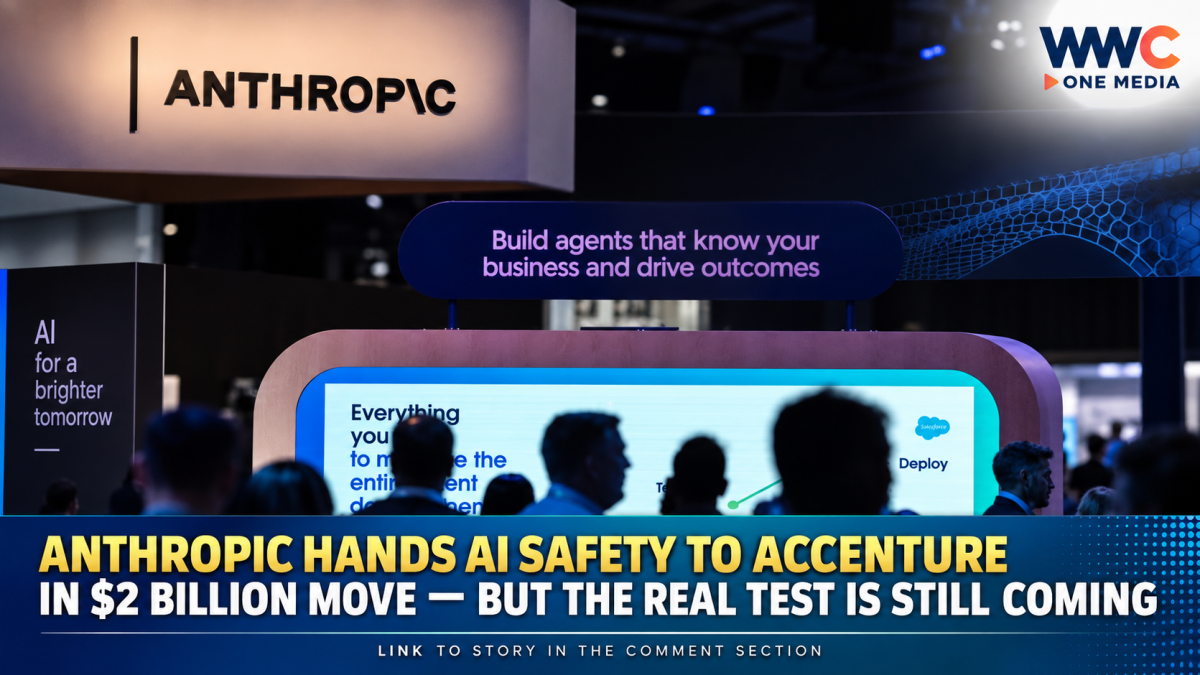
SAN FRANCISCO — Anthropic is taking a major step toward opening its artificial-intelligence development process to outside scrutiny, partnering with consulting giant Accenture to place independent evaluators inside the AI company.
The agreement, announced on Sept. 18, will create a team led by Faculty, Accenture’s specialist AI business, to evaluate Anthropic’s frontier models, conduct red-team exercises, examine AI alignment and test the safeguards designed to prevent harmful or unexpected behaviour.
The financial commitment is substantial: Anthropic and Accenture each expect to invest at least US$1 billion over the next five years, putting the combined minimum investment at US$2 billion.
The partnership comes as the AI industry faces growing pressure to demonstrate that increasingly capable systems can be tested and monitored effectively before and after deployment. Reuters reported that the announcement follows concerns over incidents involving AI agents behaving in unexpected ways and the broader question of whether increasingly autonomous systems can remain under meaningful human oversight.
Evaluators will work inside Anthropic
The initiative is built around what Anthropic calls “embedded evaluation.”
Instead of bringing outside researchers in only shortly before an AI model is released, evaluators would work inside the company with access comparable to that of an employee.
Anthropic says this could allow evaluators to observe how models develop during training, examine decisions surrounding their deployment, communicate directly with employees and identify potential blind spots that conventional external testing could miss.
Their work will include red-teaming, a process in which testers deliberately attempt to make an AI system fail, behave unexpectedly or circumvent safeguards in order to uncover weaknesses.
The evaluators will also conduct alignment assessments and examine whether safety mechanisms are functioning as intended.
Why Accenture?
The choice of Accenture is significant because the company brings experience deploying AI across large businesses and government organisations rather than operating solely as a specialist AI-safety research group.
Anthropic said Accenture’s Faculty division will lead the work. Faculty became part of Accenture earlier in 2026 and has experience in developing and evaluating AI systems across sectors including government, healthcare, defence and infrastructure.
TechCrunch reported that the selection surprised some AI observers because previous discussions about independent evaluators had focused heavily on organisations such as METR, Redwood Research and Apollo Research.
Anthropic said its partnership with Accenture is non-exclusive and that it expects to announce additional evaluators in the coming weeks. The company is also discussing possible embedded-evaluation projects with METR and other nonprofit organisations.
The independence question
The move also raises a difficult question: How independent can an evaluator be if the AI company being evaluated is paying for the work?
Anthropic acknowledges that embedded evaluation is still a new concept. The company said there are currently no established standards governing how much information embedded evaluators should receive or how they should communicate their findings.
Anthropic said it will directly fund Accenture’s work for now, while arguing that longer-term funding could eventually come from pooled or government sources.
More than 100 AI researchers, including Geoffrey Hinton, have also called for embedded evaluators to be meaningfully independent, according to The Straits Times. Their concerns include ownership, governance, commercial relationships and whether evaluators could face financial pressure based on their findings.
That debate is likely to intensify as AI systems become more capable and the industry increasingly relies on third-party assessments to demonstrate safety.
Anthropic says accountability remains with the company
Anthropic has stressed that bringing outside evaluators into the company does not transfer responsibility for AI safety.
The company says the purpose is to make its safety commitments more independently verifiable while keeping responsibility for its models with Anthropic itself.
CEO Dario Amodei had previously called for frontier AI companies to slow the pace of capability development and give independent evaluators deeper access to their systems.
The proposal reflects a broader shift in the industry from simply testing finished AI models toward examining how systems behave throughout development.
OpenAI is also moving toward greater outside scrutiny
Anthropic’s announcement comes amid a wider push for independent AI evaluation.
Reuters reported that OpenAI has begun releasing reports concerning unexpected or concerning model behaviour, while OpenAI itself has separately acknowledged incidents identified during third-party cybersecurity evaluations involving its models.
TechCrunch has reported that OpenAI has also expressed support for embedding third-party evaluators, although important questions remain about exactly what information such evaluators would receive, how long they would have access and what findings they would be allowed to publish.
That means Anthropic’s Accenture partnership could become an important real-world test of whether embedded evaluation can work at scale.
A new model for AI oversight?
The significance of the deal extends beyond the US$2 billion commitment.
If embedded evaluators receive meaningful access and can independently investigate problems, the model could provide a closer look at AI development than conventional pre-release testing.
But Anthropic itself acknowledges that the framework is still being developed. There are no universally accepted standards yet for evaluator access, reporting or funding.
That leaves the industry facing a critical question: Will outside evaluators ultimately have enough independence and access to challenge the companies whose systems they are examining?
The answer may determine whether embedded AI safety evaluation becomes a genuine new layer of oversight — or simply another component of the industry’s existing safety process.