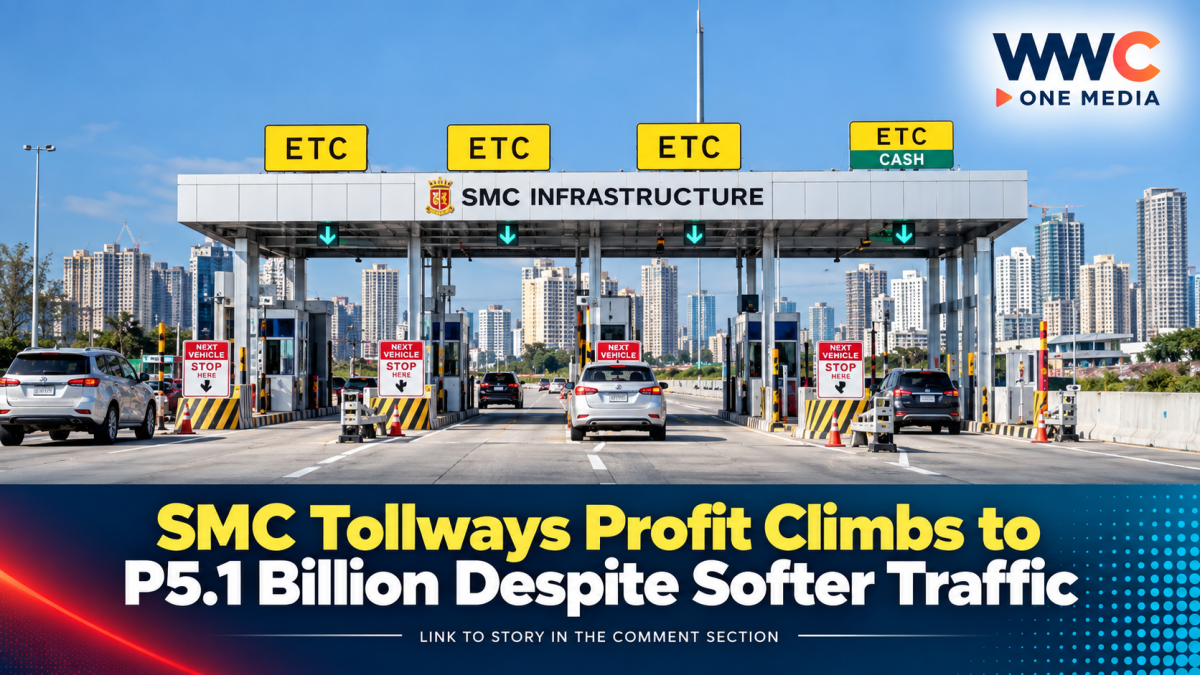
San Miguel Corp.’s tollway business continued to deliver stronger earnings in the first half of 2026 even as traffic volumes softened, highlighting how higher toll revenues, operational efficiency and cost controls are helping cushion the impact of weaker road traffic.
SMC Tollways posted P5.1 billion in net income for the first half of 2026, representing a roughly 4% increase from the same period a year earlier, according to recent company financial disclosures reported by Philippine business media.
The result comes despite a slight decline in traffic across the company’s operating toll roads, as higher fuel prices and broader economic pressures affected motorists’ travel patterns.
The earnings performance underscores an increasingly important feature of SMC’s infrastructure portfolio: the business does not depend solely on traffic growth to expand profits.
Traffic slipped, but toll revenues held up
SMC Infrastructure’s operating toll roads recorded slightly lower traffic during the first half.
Company management said average daily traffic across its operating toll roads declined by about 1% to 1.07 million vehicles, reflecting, among other factors, the impact of higher fuel prices that began affecting motorists in March amid the Middle East conflict.
Despite the softer traffic, the infrastructure group’s revenue increased.
SMC’s first-half earnings presentation showed infrastructure revenue rising 3% to P20.5 billion, while operating income remained broadly steady at P11.1 billion. EBITDA increased 8% to P17 billion, while net income rose 29% to P8.8 billion at the broader SMC Infrastructure level.
This distinction is important: the P5.1-billion figure refers to SMC Tollways, while SMC’s broader Infrastructure segment includes additional businesses and projects and reported a higher consolidated net-income figure.
Why profits increased even with fewer vehicles
The numbers suggest that SMC’s tollway operations have been able to offset softer traffic through pricing and operating efficiency.
Toll-road revenue is influenced not only by the number of vehicles using a road but also by toll rates, vehicle mix and the routes being used.
A decline in traffic therefore does not necessarily translate into a similar decline in revenue.
SMC has also emphasized cost management as an important contributor to its infrastructure performance. Its official first-half results showed infrastructure EBITDA rising 8% and operating income increasing 13% under the group’s earlier segment reporting.
SMC’s toll-road network remains a major infrastructure asset
San Miguel’s infrastructure portfolio includes some of the Philippines’ most important expressways and transport projects.
Its toll-road operations are associated with major corridors including Skyway, South Luzon Expressway (SLEX), NAIA Expressway (NAIAx) and the STAR Tollway, among others.
These routes serve major residential, commercial, industrial and airport corridors around Metro Manila and Southern Luzon.
The company’s tollway network therefore plays an important role in the movement of commuters, freight and private vehicles.
SLEX and STAR expansion remain underway
The earnings performance comes while SMC continues to spend heavily on expanding its infrastructure network.
During its first-half analyst briefing, SMC said construction was progressing on several priority toll-road projects.
The SLEX Toll Road 4 project, for example, had reached approximately 50% completion at the time of the briefing.
The company also reported continuing work on widening and expansion projects involving STAR, SLEX, NAIAx and Skyway.
Those investments are intended to increase capacity and improve connectivity along some of the country’s busiest transport corridors.
MRT-7 and airport projects add to the infrastructure pipeline
SMC’s infrastructure strategy extends beyond toll roads.
The company said MRT-7 had reached approximately 84.42% overall completion during its first-half update, with civil works and site development continuing.
SMC is also involved in the development and operation of New Manila International Airport, while continuing improvements connected to the Ninoy Aquino International Airport concession.
At NAIA, passenger volume reached approximately 26.9 million in the first half, up about 1% from the comparable period, according to the company’s earnings presentation.
That gives the infrastructure business several potential sources of long-term growth beyond traditional toll collection.
Fuel prices became a new headwind
The traffic decline is particularly notable because motorists faced higher fuel costs during the period.
SMC management specifically linked the 1% decline in average daily traffic to the partial impact of higher fuel prices that began in March amid the Middle East conflict.
Higher gasoline and diesel prices can influence driving behavior, particularly for discretionary trips and commercial operators whose transportation costs are sensitive to fuel prices.
For toll-road operators, however, the effect can vary depending on whether traffic consists primarily of commuters, freight vehicles or longer-distance travelers.
Toll-road earnings show resilience
The first-half performance provides an example of how infrastructure businesses can remain profitable even when volume growth slows.
SMC Infrastructure recorded:
- P20.5 billion in first-half revenue
- P11.1 billion in operating income
- P17 billion in EBITDA
- P8.8 billion in net income
- 1.07 million average daily traffic
- Approximately 1% year-on-year traffic decline
The figures were presented by SMC during its first-half 2026 earnings briefing.
The broader infrastructure business therefore generated higher earnings despite the traffic setback.
The performance fits into SMC’s broader earnings picture
The tollway result comes as San Miguel reported substantial growth in its overall first-half core earnings.
SMC reported P54.2 billion in core net income, up 48% year-on-year, while consolidated revenue rose 34% to P964.1 billion.
Reported consolidated net income, however, declined 44% to P37.7 billion, primarily because the previous year’s results included significant one-time gains and the current period was affected by foreign-exchange-related items.
The distinction between reported and core earnings is important when assessing the conglomerate’s underlying operating performance.
Infrastructure helped diversify SMC’s earnings
San Miguel’s business portfolio spans food and beverage, fuel, power, cement and infrastructure.
That diversification has become particularly relevant as different parts of the economy face different pressures.
Petron, for example, has been exposed to movements in crude prices, freight costs and geopolitical disruptions, while consumer businesses have faced cautious spending.
Infrastructure, meanwhile, benefits from long-term concessions and large-scale projects whose earnings are less directly tied to short-term consumer demand.
SMC’s first-half results showed infrastructure among the businesses contributing to the group’s operating performance.
What happens to traffic next?
The biggest near-term question for SMC’s tollway business is whether traffic can recover as fuel-price pressures ease and economic activity improves.
A sustained decline in traffic would place greater importance on toll-rate adjustments, cost efficiency and the completion of new capacity.
A recovery in vehicle volumes, meanwhile, could provide an additional boost to revenues as newly expanded road sections become operational.
The company is continuing to invest in capacity, meaning its long-term earnings potential will depend partly on whether additional infrastructure generates enough traffic to justify the capital committed to these projects.
The bigger story is not just the P5.1 billion
The headline figure is impressive, but the more important signal may be the combination of softer traffic and higher profitability.
That suggests SMC’s tollway operations have some ability to absorb short-term fluctuations in road usage.
At the same time, the traffic decline serves as a reminder that infrastructure businesses are not completely insulated from broader economic conditions.
Fuel prices, inflation, employment, consumer spending and economic growth can all influence how frequently Filipinos use toll roads.
For SMC, the strategy appears to be built around expanding the network while improving the efficiency of existing assets.
And with billions of pesos being invested in SLEX, STAR, Skyway, NAIAx and other major infrastructure projects, the next test will be whether today’s resilient tollway earnings can translate into even larger cash flows as the expanded network comes online.