
MANILA, Philippines — The Senate impeachment trial of Vice President Sara Duterte is heading into another potentially crucial phase, with two former special disbursing officers (SDOs) expected to take the witness stand as prosecutors dig deeper into how hundreds of millions of pesos in confidential funds were withdrawn and accounted for.
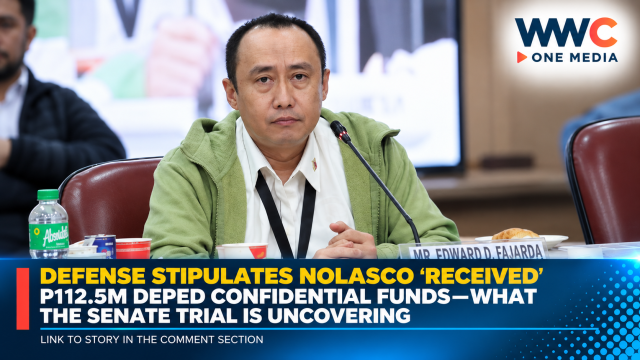
Former Office of the Vice President (OVP) SDO Gina Acosta and former Department of Education (DepEd) SDO Edward Fajarda have been summoned to testify before the Senate Impeachment Court. Their testimony could become particularly significant because both officials previously appeared before House investigators examining the handling of confidential funds during Duterte’s tenure as vice president and education secretary.
The two were initially expected to testify earlier in the trial, but the Senate impeachment court later issued fresh subpoenas after the original summons covered only the August 10–12 trial dates. The new subpoenas extend their appearance to the next scheduled proceedings.
Why Acosta and Fajarda matter
Acosta and Fajarda are not peripheral figures in the confidential-fund controversy.
During previous congressional hearings, Acosta testified that she encashed confidential-fund allocations for the OVP and turned the money over to a security official, saying she did so on Duterte’s instructions. Fajarda similarly testified that funds withdrawn from the DepEd confidential-fund allocation were turned over to a security officer designated to handle the money.
House investigators had previously cited the manner in which the money was transferred as a potential violation of government rules governing confidential and intelligence funds.
According to records cited during the congressional inquiry, Acosta encashed P125 million per quarter for the OVP confidential funds during portions of 2022 and 2023, while Fajarda handled P37.5 million per quarter in DepEd confidential funds in 2023.
Those earlier admissions are now being revisited in the impeachment trial, where prosecutors are attempting to establish what happened to the money after it was withdrawn.
The P612.5-million question
The confidential-fund allegations form part of one of the most closely watched components of Duterte’s impeachment case.
The House impeachment proceedings have focused on P612.5 million in confidential funds attributed to the OVP and DepEd during Duterte’s tenure. The House panel previously recommended criminal charges involving technical malversation, falsification, use of falsified documents, perjury, bribery, corruption and plunder in connection with its findings.
Importantly, those recommendations and allegations remain matters at issue in legal proceedings; they are not convictions.
The prosecution’s case has centered partly on whether the funds were actually used for legitimate confidential activities and whether the documents submitted to justify the expenditures accurately reflected what happened to the money.
COA testimony has already raised new questions
The expected testimony of Acosta and Fajarda follows several days of evidence from Commission on Audit witnesses.
COA supervising auditor Xylene Mae del Campo testified that the OVP’s transfer of confidential-fund disbursements to a security official violated a provision of the government’s joint circular governing confidential and intelligence funds.
Del Campo also testified about questionable recipient names appearing in acknowledgment receipts and said the audit found no corresponding accomplishments for some of the reported expenditures. Reports from the trial have highlighted unusual names appearing among the alleged recipients, adding another layer to the prosecution’s challenge to the liquidation documents.
At the same time, Del Campo testified that the P75 million in DepEd confidential funds spent during the first half of 2023 was, based on the audit reviewed at that point, found in order. That distinction is important because the trial evidence is not uniformly negative toward every expenditure questioned by prosecutors.
Defense pushes back
Duterte’s defense team has challenged aspects of the COA testimony and questioned the rules used to assess confidential-fund expenditures.
The defense has also disputed portions of the prosecution’s interpretation of government auditing rules, meaning the eventual significance of Acosta’s and Fajarda’s testimony will likely depend not only on what they say but also on how their statements fit with the documentary evidence and the applicable COA rules.
That is where the next stage of the trial could become consequential.
The prosecution wants the SDOs’ testimony to help establish the chain of custody and disbursement of the funds. The defense, meanwhile, has an opportunity to challenge their recollections, interpretations and previous statements.
What could come next
The testimony of Acosta and Fajarda could place renewed attention on several questions:
- Who actually received the cash after it was withdrawn?
- Who was authorized to handle the confidential funds?
- What instructions were allegedly given to the SDOs?
- Were the funds used for activities that qualified as confidential expenditures?
- Do the acknowledgment receipts accurately identify actual recipients?
- Can the liquidation documents be independently supported?
- And ultimately, who bore responsibility for the use of the funds?
The questions are especially significant because the House prosecution has previously argued that Acosta and Fajarda themselves testified that they did not personally know how the money was ultimately spent after it was turned over to other individuals.
A trial entering a critical phase
The upcoming testimony comes after the Senate impeachment court heard extensive evidence from COA auditors regarding Duterte’s confidential-fund spending.
The prosecution has portrayed the audit findings and testimony as evidence of serious irregularities. The defense has challenged the prosecution’s interpretation and the application of auditing rules.
That makes the former SDOs’ appearance particularly important.
They were among the officials directly involved in the initial withdrawal and handling of the funds. Their testimony could therefore help the impeachment court connect the documentary trail to the actual movement of cash.
But whether their testimony strengthens or weakens the prosecution’s case will ultimately depend on the evidence presented, cross-examination and the Senate Impeachment Court’s assessment.
For now, one thing is clear: the spotlight is moving from the audit documents to the people who physically handled the money.
And with P612.5 million at the center of the allegations, the next testimony could become one of the most closely scrutinized moments in Duterte’s impeachment trial.

Leave a Reply