
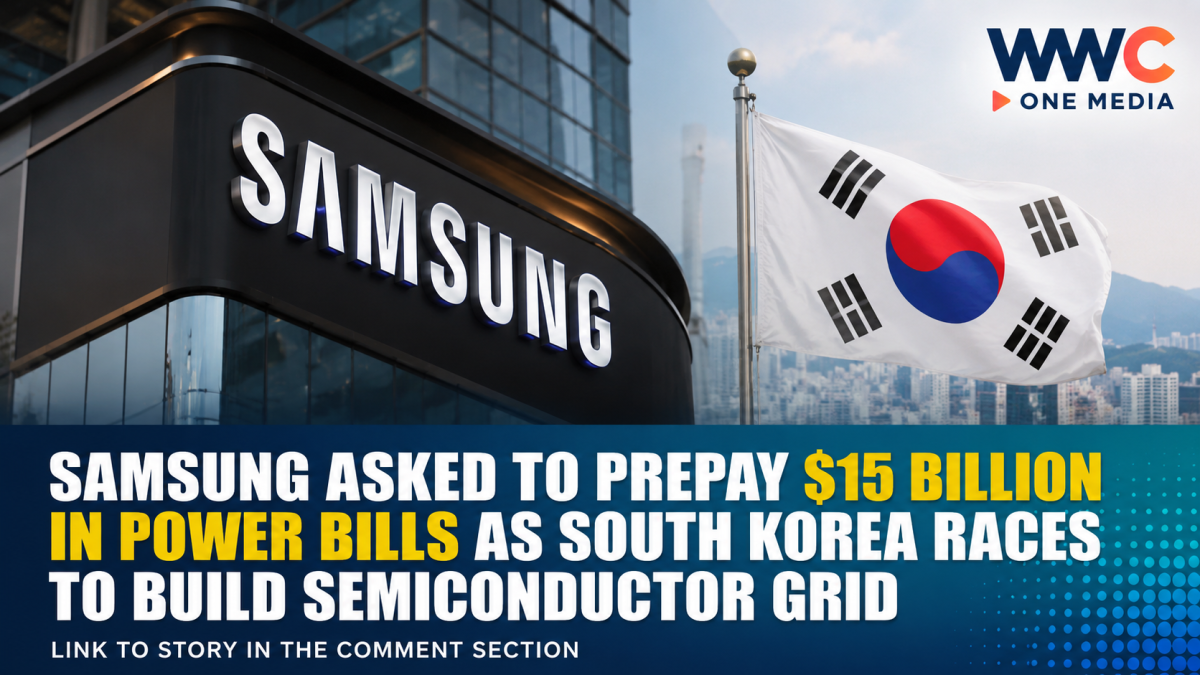
SEOUL — South Korea’s state-run electricity giant is seeking a massive upfront payment from Samsung Electronics as the country scrambles to finance the power infrastructure needed for its expanding semiconductor and artificial-intelligence industries.
Korea Electric Power Corp. (KEPCO) has proposed that Samsung Electronics prepay about 20 trillion won — roughly US$15 billion — for electricity through 2031, according to a report cited by Channel News Asia and South Korean media.
KEPCO has also proposed that SK hynix prepay another 5 trillion won, bringing the potential combined advance payment to 25 trillion won, or about US$18.1 billion.
The proposal would effectively bring forward electricity revenue that KEPCO would otherwise collect over several years. The utility intends to use the money to help finance transmission lines and substations serving major semiconductor clusters, including projects in Yongin and the Honam region.
Why does KEPCO want the money upfront?
South Korea is facing an increasingly difficult infrastructure challenge: its semiconductor ambitions require enormous amounts of reliable electricity.
Samsung and SK hynix are expanding advanced chip manufacturing, while the rapid growth of AI and data-center infrastructure is adding another layer of demand for electricity.
KEPCO says an advance-payment arrangement could help accelerate grid investment while giving major industrial customers greater certainty that electricity infrastructure will be available when their new facilities come online.
The proposal could also reduce KEPCO’s reliance on issuing additional debt to finance the required infrastructure.
South Korean reports say KEPCO’s debt has already exceeded 210 trillion won, making alternative sources of investment funding particularly important.
Samsung and SK hynix could receive interest
This is not simply a request for companies to hand over billions of dollars with no financial return.
Under the proposal reported by South Korean media, KEPCO would pay interest on the advance payments, with the rate reportedly positioned above the yield on two-year South Korean government bonds but below KEPCO’s own two-year bond yield.
The interest would reportedly be handled through deductions from future electricity bills rather than necessarily being returned as a conventional cash payment.
However, the final interest rate, payment amounts, duration and participation have not been finalized.
KEPCO itself said the proposal remains under discussion, meaning the reported 20 trillion won and 5 trillion won figures should not be interpreted as finalized payments.
A bigger problem hiding behind the proposal
The move highlights a growing strategic issue for South Korea: chips and AI may be advancing faster than the country’s power infrastructure can keep up.
Semiconductor fabs consume huge quantities of electricity and require exceptionally stable power supplies. Delays in transmission infrastructure can therefore become a bottleneck for factory construction and production schedules.
That makes electricity availability increasingly important to South Korea’s strategy to remain one of the world’s leading semiconductor manufacturing hubs.
The issue is particularly significant around the planned semiconductor clusters, where massive new industrial facilities will require new transmission networks and substations.
Samsung has not yet agreed
Despite the size of the proposal, there is no indication that Samsung has already committed to the arrangement.
CNA reported that Samsung did not immediately comment, while SK hynix also did not immediately respond to a request for comment. KEPCO said the proposal’s major conditions were still being negotiated.
For now, the plan represents a proposed financing mechanism rather than a finalized deal.
But if accepted, it could mark an unusual shift in how South Korea finances critical electricity infrastructure — effectively asking the country’s biggest industrial power users to help fund the grid they will depend on for their next generation of factories.
And with AI driving demand for both advanced chips and data centers, the question facing South Korea is becoming increasingly urgent:
Can the country’s power grid expand fast enough to keep up with its semiconductor ambitions?
WWC ONE MEDIA MJE




Leave a Reply