
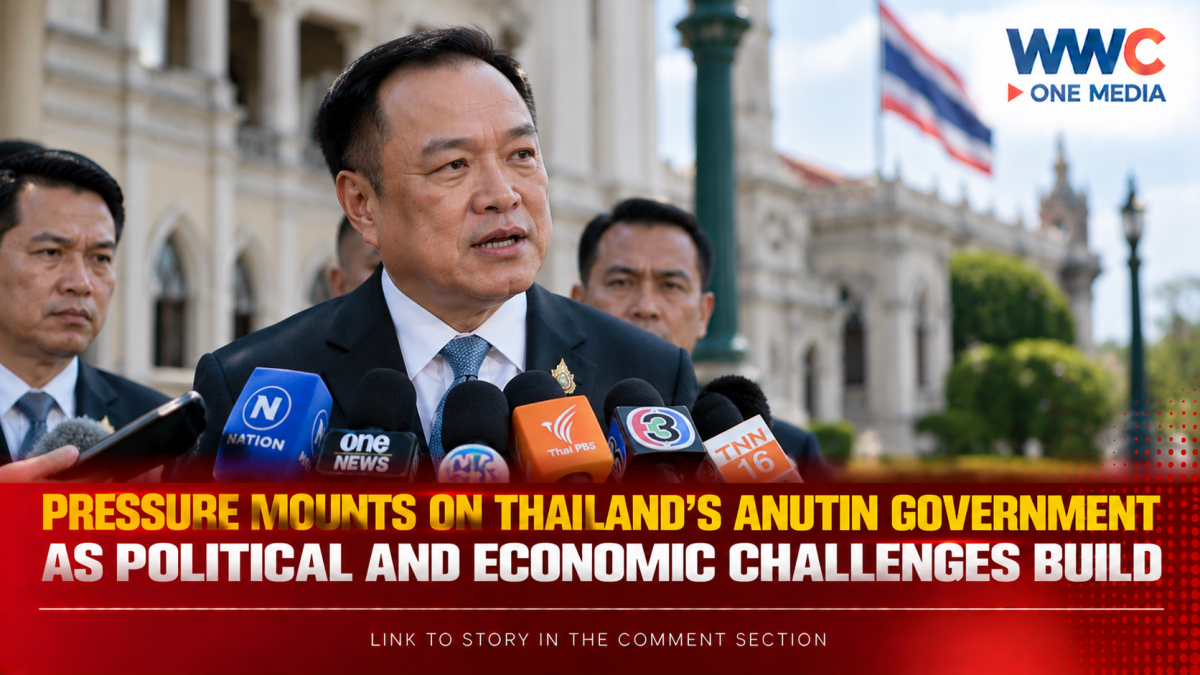
BANGKOK — Thailand’s Bhumjaithai-led government is facing mounting political and economic pressure only months into its latest term, with questions over public support, coalition stability and the country’s uneven economic recovery increasingly testing Prime Minister Anutin Charnvirakul’s administration.
The government entered office promising to tackle Thailand’s economic and social problems, but the challenges have proven difficult to separate from the country’s broader political tensions.
Recent developments have put additional scrutiny on the administration, from clashes inside Parliament to disputes involving coalition partners and legal cases surrounding figures associated with the ruling Bhumjaithai Party.
Political pressure is intensifying
Anutin’s government has faced increasingly sharp exchanges with opposition parties in Parliament, including disputes over budget allocations and government priorities.
A recent parliamentary confrontation involving Bhumjaithai and the Prachachon Party over the 2027 budget highlighted the political friction surrounding government spending and resource allocation.
At the same time, questions surrounding the coalition’s stability remain important.
Relations between Bhumjaithai and its political partners have already come under pressure, with disagreements over the direction of the government and its political future. Anutin recently accused the Palang Pracharath Party of breaching the political agreement between the parties.
There are also potential legal risks. Reports have emerged concerning allegations related to the 2024 Senate election, with several Bhumjaithai figures reportedly facing possible legal action. These remain allegations and legal proceedings, rather than established findings of wrongdoing.
For the government, the issue is bigger than individual cases: prolonged political uncertainty could make it harder to maintain coalition discipline and push through economic policies.
Thailand’s economy offers both good and bad news
The economic picture is similarly complicated.
Thailand’s economy expanded in July, helped by the global technology and artificial-intelligence cycle, stronger electronics exports, recovering tourism and government stimulus measures, according to the Bank of Thailand.
Foreign tourist arrivals and tourism receipts also improved as flight capacity gradually recovered.
But the recovery remains uneven.
The Bank of Thailand said the economy slowed during the second quarter as higher energy prices and disruptions connected to the Middle East conflict affected tourism and domestic activity. Foreign tourist arrivals and tourism-related services declined during that period.
The central bank has also warned about elevated living and production costs, geopolitical risks, U.S. trade policy and the sustainability of the global technology cycle.
Households remain under pressure
Thailand’s economic challenge is not simply about headline growth.
The Bank of Thailand has projected economic growth of 2.3% in 2026 and 1.8% in 2027, while warning that growth remains low and uneven.
Households continue to face weak income growth and higher living costs, while small and medium-sized businesses remain constrained by competition and limited capacity to adapt.
That creates a difficult political equation for the government.
Economic statistics can improve while many households still feel financially squeezed.
For Anutin’s administration, delivering visible improvements in employment, incomes, tourism, investment and everyday living costs could therefore be just as important politically as maintaining macroeconomic stability.
The government is trying to regain momentum
The administration has responded with measures aimed at stimulating investment, supporting businesses and accelerating development projects.
A recent government initiative targeting southern Thailand, for example, involves 96 proposed projects worth about 13.089 billion baht, covering infrastructure, tourism and economic development. The Nation reported that the push also comes as Bhumjaithai seeks to strengthen its political standing in the region.
The government has also been consulting with major industries, including banking, tourism, construction, energy, agriculture and retail, as it develops measures intended to support economic growth and improve living standards.
But implementation will be crucial.
Thailand needs policies that translate into stronger private investment, sustainable tourism growth and better household incomes rather than simply short-term boosts.
The pressure point ahead
The biggest challenge for Anutin may be that political stability and economic performance are now increasingly connected.
A government struggling to maintain coalition unity may find it harder to deliver major reforms. At the same time, a weak economy can increase political dissatisfaction and make coalition partners more reluctant to absorb the costs of unpopular decisions.
Thailand therefore enters the next phase of Anutin’s administration with a mixed picture: tourism and technology-related exports are providing some momentum, but household pressures, geopolitical risks and political disputes remain significant obstacles.
The government still has room to turn the situation around.
But the margin for error is narrowing.
For Anutin, the question is no longer simply whether his government can survive the political pressure. It is whether it can deliver enough economic progress to convince Thais that the pressure is worth enduring.

Leave a Reply