
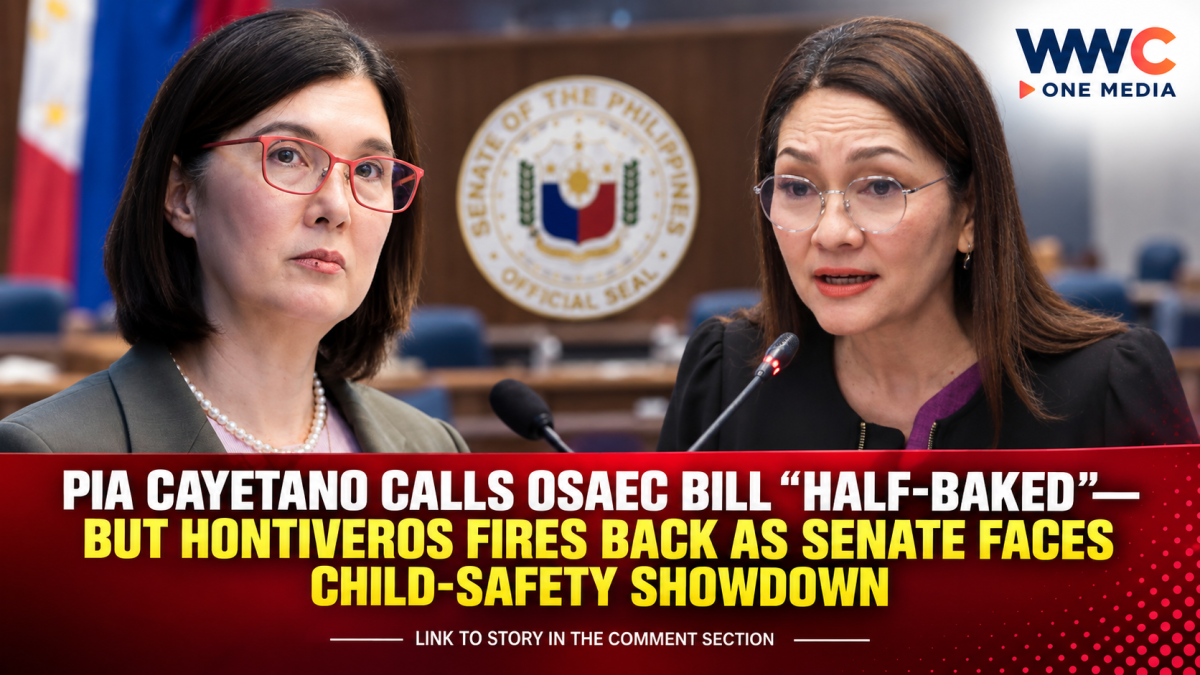
MANILA, Philippines — A proposed overhaul of the Philippines’ online child protection law has triggered a fresh Senate clash, with Sen. Pia Cayetano questioning whether the measure is ready while Sen. Risa Hontiveros maintains that stronger legislation is urgently needed to protect children from increasingly sophisticated online abuse.
The disagreement centers on proposed amendments to Republic Act No. 11930, or the Anti-Online Sexual Abuse or Exploitation of Children (OSAEC) and Anti-Child Sexual Abuse or Exploitation Materials (CSAEM) Act.
Cayetano has described the measure as “half-baked,” according to an ABS-CBN News report published September 14, 2026. Hontiveros, however, disagrees, arguing for stronger and more updated safeguards as technology creates new ways for perpetrators to target children online.
What is the proposed OSAEC law?
The current law, RA 11930, was approved in 2022 and criminalizes online sexual abuse and exploitation of children, including the production, distribution, possession and access of child sexual abuse or exploitation materials.
The law also established a national coordination mechanism, a unified referral pathway for OSAEC cases, an offenders’ registry and age-verification requirements for adult-content platforms.
But lawmakers now argue that the digital environment has changed rapidly since the law was enacted.
The proposed amendments seek to strengthen the country’s response to emerging forms of online exploitation, clarify responsibilities among government agencies and digital platforms, and improve investigation, prosecution and victim protection.
House has already approved a major OSAEC overhaul
The proposed legislation has already moved substantially through the House of Representatives.
House Bill No. 9461, also known as the proposed Child Online Safety and Protection Act of 2026, was approved by the House on third reading on June 3, 2026, and transmitted to the Senate on June 8.
The House measure would repeal and replace RA 11930 with a broader framework intended to strengthen child-protection safeguards, regulatory measures and enforcement mechanisms against OSAEC and CSAEM.
House leaders have described the measure as an effort to create a more coordinated national system for protecting children, improving investigations and prosecutions, and holding offenders and facilitators accountable.
Hontiveros wants stronger protections
Hontiveros has separately championed Senate Bill No. 1819, the Expanded Anti-OSAEC and Anti-CSAEM Act.
The Senate measure was filed in February 2026 and seeks to strengthen the policies and penalties under RA 11930 while updating the law for newer forms of online exploitation. It remains pending at the Senate.
Hontiveros has argued that the country cannot afford to wait for the threat to grow before strengthening the law.
In August, she called for the proposed Child Online Safety and Protection Act to be treated as an urgent measure, citing emerging technology-facilitated threats against children and warning that law enforcement needs stronger tools to respond.
Why the debate matters
The dispute is bigger than a disagreement between two senators.
At stake is how far the Philippine government should go in regulating the digital environment to protect children—and how lawmakers can make those protections effective without creating unclear or difficult-to-enforce rules.
The existing OSAEC law already covers a wide range of conduct, including online grooming, sexual extortion, livestreaming of abuse and the production or distribution of child sexual abuse materials.
Its implementing rules also establish mechanisms for offender registration, information sharing and coordination among government agencies and law enforcement authorities.
The proposed amendments are therefore intended not simply to create another prohibition, but to update the country’s broader enforcement and child-protection framework.
The threat remains real
Recent law-enforcement operations underscore why the issue remains urgent.
In March 2026, the National Bureau of Investigation reported the arrest of an alleged OSAEC facilitator in Zambales after digital forensic examination of a seized mobile phone uncovered child sexual abuse materials.
The NBI said the suspect was charged under RA 11930 and emphasized the government’s continuing efforts to dismantle networks exploiting children through digital platforms.
Government authorities have also continued rescuing minors and pursuing suspects involved in online exploitation, highlighting the continuing challenge faced by investigators and child-protection agencies.
What happens next?
The Senate still has to deliberate on its version of the legislation.
That means Cayetano’s concerns could become important as lawmakers scrutinize the measure’s provisions, definitions, enforcement mechanisms and possible obligations for government agencies and online platforms.
Hontiveros, meanwhile, is pushing for stronger protections and has argued that the country needs to keep pace with rapidly evolving digital threats.
For now, there is no new OSAEC law yet. The existing legal framework remains RA 11930 while Congress considers whether—and how—to replace or amend it.
The coming Senate deliberations could determine whether lawmakers can bridge the divide between those demanding immediate stronger protections and those insisting that the legislation must first be made more precise and workable.
The bigger question now is not whether Filipino children need stronger protection online—but whether Congress can agree on a law strong enough to protect them without leaving new loopholes behind.




Leave a Reply