
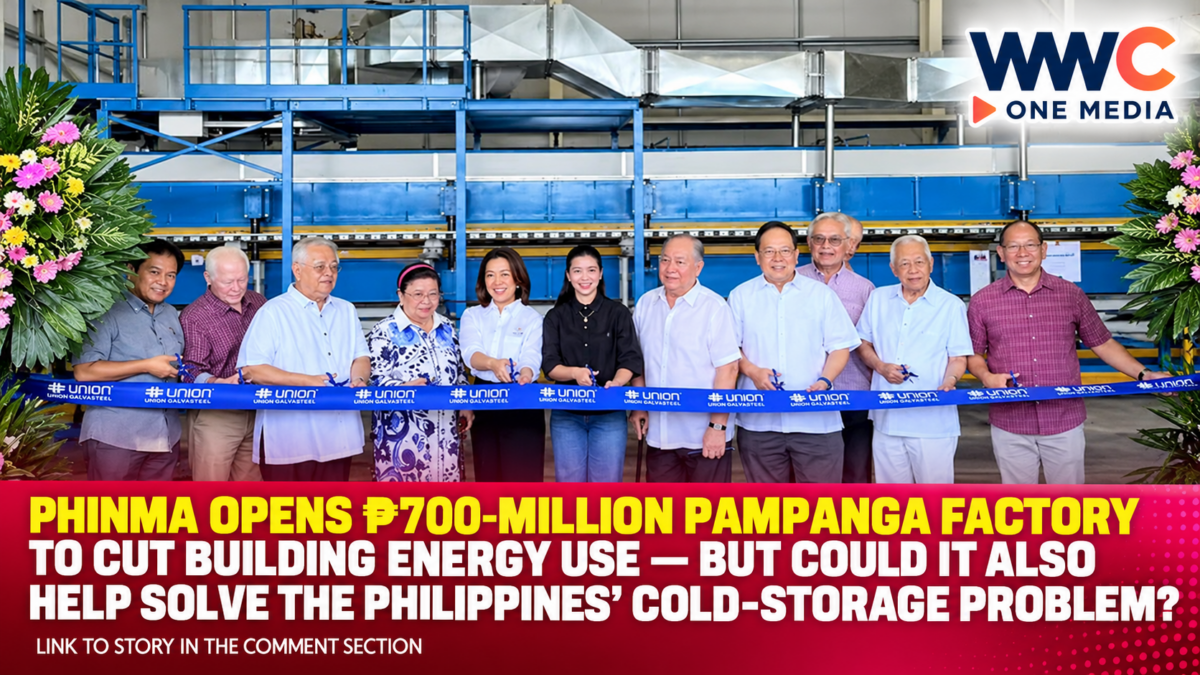
PORAC, PAMPANGA — A ₱700-million manufacturing investment is bringing new momentum to the Philippines’ construction materials industry as PHINMA Group subsidiary Union Insulated Panel Corporation (UIPC) moves to expand the local supply of energy-efficient building materials.
The company inaugurated its new factory in Barangay Manibaug Pasig, Porac, Pampanga, on October 20, with production infrastructure designed to manufacture up to one million square meters of insulated panels annually.
The facility will serve industries ranging from cold-storage warehousing and agriculture to industrial construction, commercial buildings and educational facilities.
But the investment could have implications extending far beyond construction.
By making insulated roofing and wall systems available locally, UIPC hopes to help businesses reduce cooling expenses, build facilities faster and limit dependence on imported materials.
Its expansion also comes as the Philippines faces growing pressure to modernize food storage infrastructure, improve climate resilience and strengthen domestic manufacturing.
The central question is whether more affordable, locally produced insulated building materials can help industries reduce costs while supporting the country’s long-term development.
₱700-MILLION FACTORY MARKS A MAJOR PHINMA MANUFACTURING EXPANSION
The new UIPC manufacturing facility occupies a 2.6-hectare property in Porac, according to reporting by Punto! Central Luzon.
The main production facility measures approximately 200 meters long and 24 meters wide.
With a designed annual production capacity of one million square meters, the investment is intended to strengthen the supply of insulated roofing, walling and cladding panels for Philippine construction projects.
PHINMA Corporation chairman and CEO Ramon R. del Rosario Jr. and UIPC president and CEO Danielle R. del Rosario attended the inauguration alongside other company executives and local government officials.
The development follows the company’s groundbreaking ceremony in May 2024.
At that time, PHINMA identified cold-chain development, agricultural infrastructure and energy efficiency as important objectives of the investment.
The October 2026 inauguration represents a significant step toward delivering that manufacturing capacity.
However, InsiderPH reported on October 26 that the facility was still moving toward full commissioning and commercial operations.
Its annual design capacity should therefore not be confused with verified actual production volume.
WHY INSULATED PANELS MATTER TO THE PHILIPPINE ECONOMY
Insulated panels are prefabricated building components used to reduce heat transfer through roofs and walls.
UIPC’s products use a rigid polyisocyanurate foam core, commonly referred to as PIR, between protective exterior surfaces.
The insulation helps maintain more stable indoor temperatures.
That can be particularly important in buildings requiring refrigeration or controlled operating conditions.
Cold-storage facilities, food-processing plants, warehouses and certain manufacturing operations can use insulated panels to reduce the amount of heat entering temperature-controlled spaces.
In such facilities, cooling equipment often represents a significant operating expense.
By limiting heat transfer, effective insulation may reduce the electricity needed to maintain a specified temperature.
However, actual savings depend on the building’s design, insulation thickness, air leakage, cooling systems, operating schedule and climate conditions.
The materials must also meet applicable fire safety, structural and installation requirements.
UIPC TARGETS UP TO 30% LOWER ENERGY CONSUMPTION
One of the company’s most prominent claims involves potential electricity savings.
According to The Philippine Star, UIPC estimates that its insulated panels can reduce energy consumption by as much as 30% in suitable applications.
Such savings could be commercially important for facilities that rely heavily on refrigeration or air-conditioning.
Electricity is a major expense for cold-storage operators.
Reducing cooling requirements could improve operating efficiency and help businesses manage recurring utility costs.
But the 30% figure is a company estimate.
It should not be interpreted as a guaranteed reduction in every building’s total electricity consumption.
An individual facility’s savings must be established through appropriate engineering analysis, installation practices and measured operating performance.
For investors and property operators, the relevant question is not simply whether insulated panels can reduce heat transfer.
It is whether the resulting energy savings justify the initial construction and maintenance costs.
CONSTRUCTION TIME COULD FALL BY UP TO 50%
UIPC is also promoting faster construction as a benefit of its prefabricated panel systems.
The company estimates that projects using its materials could reduce construction time by as much as 50%, depending on the application.
Prefabricated panels can be manufactured to specifications and installed more quickly than some conventional building assemblies.
For commercial and industrial developers, faster installation may reduce labor requirements and shorten the period before a facility becomes operational.
This can be particularly useful for warehouses, agricultural facilities and industrial buildings working under tight development schedules.
However, faster installation of walls or roofing does not necessarily mean the entire project will be completed in half the time.
Construction schedules also depend on foundations, utilities, permits, equipment installation and other activities.
The 50% estimate should therefore be considered a potential project-specific benefit rather than a universal construction outcome.
LOCAL PRODUCTION COULD REDUCE DEPENDENCE ON IMPORTED PANELS
UIPC’s expansion comes as the Philippines continues importing a substantial portion of its insulated building materials.
In an interview with The Philippine Star, Danielle del Rosario estimated that imported products account for approximately 40% to 50% of the country’s insulated-panel market.
She said imported materials can be price-competitive but may expose buyers to shipping delays, fuel costs and longer procurement schedules.
The company expects local manufacturing to provide a significant advantage.
According to its management, domestically produced panels could be delivered within approximately one to two weeks in certain circumstances.
By comparison, imported orders may require purchasing commitments around 60 days in advance.
Shorter lead times could help developers respond more quickly to changing project requirements.
They could also reduce the need for businesses to place large orders months before materials are required.
Nevertheless, delivery performance will depend on factory readiness, available inventory, product specifications and logistical conditions.
COULD THE NEW FACTORY HELP ADDRESS FOOD LOSSES?
Perhaps the most important long-term opportunity lies in agriculture and food distribution.
Cold-storage facilities help preserve temperature-sensitive products, including vegetables, fruits, meat, fish and other perishable goods.
Without adequate storage and handling, agricultural products may deteriorate before reaching consumers.
This can reduce farmers’ earnings, increase food waste and complicate distribution.
Insulated panels are one component of the infrastructure needed to construct cold rooms and refrigerated warehouses.
By expanding local supplies, UIPC could make it easier for certain businesses to develop or upgrade food-storage facilities.
The investment also supports PHINMA’s stated goal of contributing to Philippine food security.
However, better insulation alone cannot solve the country’s food-storage challenges.
Reliable electricity, refrigeration equipment, transportation networks, financing and effective agricultural logistics are also necessary.
A modern cold-storage facility must operate as part of a functioning supply chain.
CLIMATE RESILIENCE BECOMES A BUSINESS PRIORITY
The timing of the expansion is significant as businesses consider the effects of extreme weather and rising temperatures.
Agricultural producers and food processors face operational risks from heat, drought, heavy rainfall and disruptions to logistics.
Temperature-controlled facilities can help protect perishable products after harvest.
Danielle del Rosario has highlighted the importance of cold-storage development as businesses prepare for climate-related pressures, including El Niño conditions.
For agricultural communities, improved access to storage infrastructure could help reduce preventable losses and provide greater flexibility in deciding when products are transported or sold.
However, the effectiveness of these investments depends on affordability and access.
Small farmers may not be able to finance storage facilities independently.
Cooperatives, commercial logistics providers and public-private partnerships could play a role in making such services more widely available.
PHINMA SEEKS BROADER IMPACT THROUGH MANUFACTURING
The project forms part of the PHINMA Group’s broader construction materials business.
During the inauguration, PHINMA Corporation chairman and CEO Ramon del Rosario Jr. emphasized the importance of investments that support both commercial growth and national development.
The group sees opportunities to supply materials for essential infrastructure while expanding local industrial capacity.
UIPC’s products are intended for cold-storage warehouses, agricultural facilities, factories, commercial buildings and other developments where thermal performance and efficient installation are important.
The company also supplies building materials for classrooms and Learning Continuity Spaces.
The range of applications demonstrates that insulated panels are not limited to refrigerated warehouses.
They can support a variety of projects where appropriate building specifications call for thermal insulation.
However, each application requires technical assessment to determine whether the materials meet its performance and safety requirements.
UIPC EXPLORES SOLAR POWER AND BATTERY STORAGE
The company is also examining ways to improve the resilience of its own manufacturing operations.
According to The Philippine Star, UIPC is studying a solar-and-battery system for the Porac facility.
Such a system could potentially reduce reliance on purchased electricity and provide additional operating flexibility during power interruptions.
For manufacturing companies, stable power supplies are important because disruptions can affect production schedules, equipment and delivery commitments.
However, the proposed solar-and-battery system remains under study.
There is no verified confirmation that the factory has already installed or commissioned the arrangement.
Likewise, possible off-grid operation would depend on the eventual size of the generation and storage systems relative to actual factory demand.
THE PHILIPPINES’ CONSTRUCTION INDUSTRY FACES A SHIFT TOWARD EFFICIENCY
The UIPC expansion reflects growing interest in construction materials that support operating efficiency rather than merely providing structural enclosure.
Developers and industrial operators increasingly consider a building’s lifetime costs, including electricity, maintenance and operational downtime.
A material with a higher initial price can sometimes provide long-term value if it substantially reduces energy consumption or construction delays.
Conversely, a more expensive product may not be economical if actual savings are small or installation is poorly managed.
The appropriate choice depends on the project.
For cold-storage facilities, insulation performance can be especially important because maintaining stable temperatures is central to the business.
For conventional warehouses or commercial buildings, the benefits may vary depending on internal temperature requirements and the existing construction design.
The shift toward performance-based building decisions could create opportunities for local manufacturers capable of supplying consistent quality and technical support.
INDEPENDENT REPORTING ADDS IMPORTANT DETAILS
InsiderPH’s October 26 report highlighted UIPC’s launch and the company’s commitment to sustainable infrastructure.
The Philippine Star’s October 22 coverage supplied additional details about the ₱700-million investment, estimated import dependence, potential energy savings and planned delivery improvements.
Punto! Central Luzon independently reported on the inauguration, the facility’s 2.6-hectare site and its designed one-million-square-meter annual production capacity.
PHINMA’s May 2024 company announcement also confirms that the facility was originally developed to support cold-chain infrastructure, agriculture and climate resilience.
Together, these sources establish the project’s location, scope, announced capacity and intended market.
However, the energy savings, construction time reductions and import-share estimates remain company-provided figures.
They should not be presented as independently measured nationwide outcomes.
WHAT THIS MEANS FOR PAMPANGA AND CENTRAL LUZON
The development adds another manufacturing facility to Pampanga’s industrial landscape.
Local production may create opportunities for suppliers, logistics providers, construction contractors and other businesses serving industrial customers.
Central Luzon’s agricultural economy also makes the expansion relevant to businesses involved in food storage and distribution.
Cold-chain facilities can support the movement of perishable goods from producers to markets.
However, UIPC has not provided a verified public figure for permanent employment created by the new factory in the reporting reviewed.
It would therefore be premature to attach a specific job-creation total to the investment.
The broader economic benefits will depend on the factory’s operating scale, customer demand and sourcing arrangements.
THE BIGGER QUESTION: CAN LOCAL MANUFACTURING MAKE SUSTAINABLE BUILDINGS MORE AFFORDABLE?
UIPC’s new Pampanga facility reflects a potentially important shift in the Philippine construction materials industry.
The company is investing in domestic production while targeting industries that need energy-efficient infrastructure.
Its plans could improve access to insulated materials, shorten delivery schedules and support the development of temperature-controlled facilities.
For PHINMA, the factory creates opportunities to compete in a market that continues to rely partly on imports.
For developers, it offers another potential source of building materials designed to improve thermal efficiency.
And for agricultural businesses, a stronger domestic cold-chain construction supply chain could support investments aimed at preserving food.
But the long-term impact remains to be demonstrated.
The facility must reach full commercial operations, meet customers’ quality requirements and deliver competitive prices.
Its projected energy and construction savings also need to translate into measurable results across real projects.
The ₱700-million investment could strengthen Philippine manufacturing and support more efficient buildings, but its most significant contribution may emerge through the facilities that future customers build using its products.
As the country seeks better cold storage, more resilient infrastructure and stronger domestic industries, one major question remains:
Can PHINMA’s new Pampanga factory help make energy-efficient construction and food preservation more accessible — or will high project costs and infrastructure gaps prevent its full potential from being realized?










