
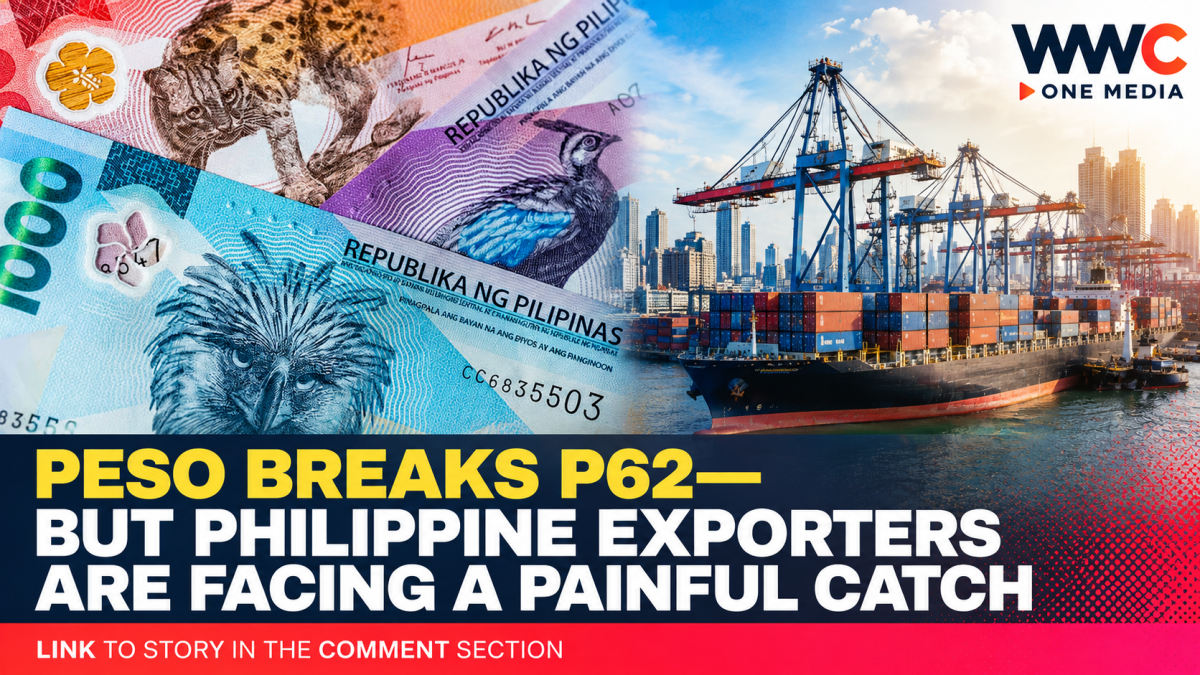
MANILA, Philippines — The Philippine peso’s plunge beyond the P62-per-US-dollar level may appear, at first glance, to be good news for exporters. After all, every dollar earned overseas converts into more pesos.
But Philippine manufacturers are warning that the reality is far more complicated—and potentially more painful.
As the peso sank to historic lows, the Federation of Philippine Industries (FPI) warned that rising costs for imported raw materials, components and other production inputs are threatening to erase much of the foreign-exchange advantage exporters would normally enjoy from a weaker currency.
The result is a troubling economic paradox: exporters may be earning more pesos from their dollar revenues while simultaneously paying far more pesos to keep their factories running.
The P62 problem: more pesos in, but higher costs out
The peso’s weakness has intensified concerns across industries that rely on imported supplies and intermediate goods. A depreciating currency makes Philippine products cheaper for foreign buyers and increases the peso value of export earnings—but it also raises the local-currency cost of imported materials, machinery, fuel and components.
That matters enormously for the Philippines, where manufacturers remain deeply connected to global supply chains.
Official data from the Philippine Statistics Authority (PSA) underscores that dependence. Imports accounted for 63.4% of the country’s total external trade in July 2026, while exports made up just 36.6%. Imported goods reached $14.12 billion, up 19.8% from a year earlier, compared with $8.15 billion in exports, which grew 10.8%. The country’s trade deficit widened to $5.97 billion.
For manufacturers, those numbers help explain why a weak peso is not necessarily a straightforward competitive advantage.
Export growth is real—but so is the import bill
The Philippines’ exports are still expanding, with total export sales rising 10.8% year-on-year in July. Electronics remained the country’s dominant export, accounting for 58.8% of total export earnings during the month.
But the same sector is also heavily dependent on imported inputs.
Electronic products were the Philippines’ largest import category in July, while raw materials and intermediate goods accounted for the biggest share of total imports. That means many exporters face a built-in currency squeeze: they earn dollars from finished products but spend dollars—or peso equivalents—on the materials needed to produce them.
The surge in imported electronic products and mineral fuels also highlights the broader pressure on production costs. When the peso weakens, companies with significant dollar-denominated expenses can see their margins narrow quickly.
BSP: A weak peso can feed inflation
The Bangko Sentral ng Pilipinas has also acknowledged the risks of a sharply depreciating currency.
BSP Governor Eli Remolona Jr. recently said a weak peso increases the cost of imported goods and can put pressure on the prices of goods and services. He stressed that sharp exchange-rate movements have a stronger impact on inflation, while also pointing to the country’s structural trade imbalance and the need to strengthen exports.
The peso closed at a then-record P61.888 to the dollar on August 27, according to reporting by GMA News. It subsequently breached the psychologically important P62 level, adding urgency to concerns over imported inflation and rising business costs.
For consumers, that could eventually mean higher prices. For businesses, it can mean tougher decisions about whether to absorb higher costs, raise prices or accept thinner profits.
The bigger question: Can exporters actually benefit?
A weaker currency can be a powerful advantage for export-oriented economies—but only when exporters can produce competitively without relying excessively on expensive imports.
That is the challenge now confronting the Philippines.
The country’s export sector is growing, and year-to-date exports from January to July reached a record $54.92 billion, according to the PSA. Yet imports climbed even faster, reaching a record $92.26 billion over the same period.
The gap suggests that currency weakness alone cannot solve the country’s trade imbalance.
For Philippine manufacturers, the battle is increasingly about margins. The extra pesos generated by dollar sales may provide relief—but if imported components, energy and production materials rise just as quickly, the supposed foreign-exchange windfall can disappear.
What happens next?
The peso’s slide has put the spotlight on a larger structural question: Can the Philippines build a stronger export base while reducing its dependence on imported production inputs?
Remolona has argued that boosting exports is essential to providing longer-term support for the currency. But manufacturers facing rising costs say the immediate challenge is more urgent: surviving a period when a weaker peso is raising expenses across the supply chain.
For now, the P62 milestone is more than a symbolic currency level.
It is a warning that the benefits of a weak peso come with a price—and for many Philippine exporters, the bill may already be arriving.




Leave a Reply