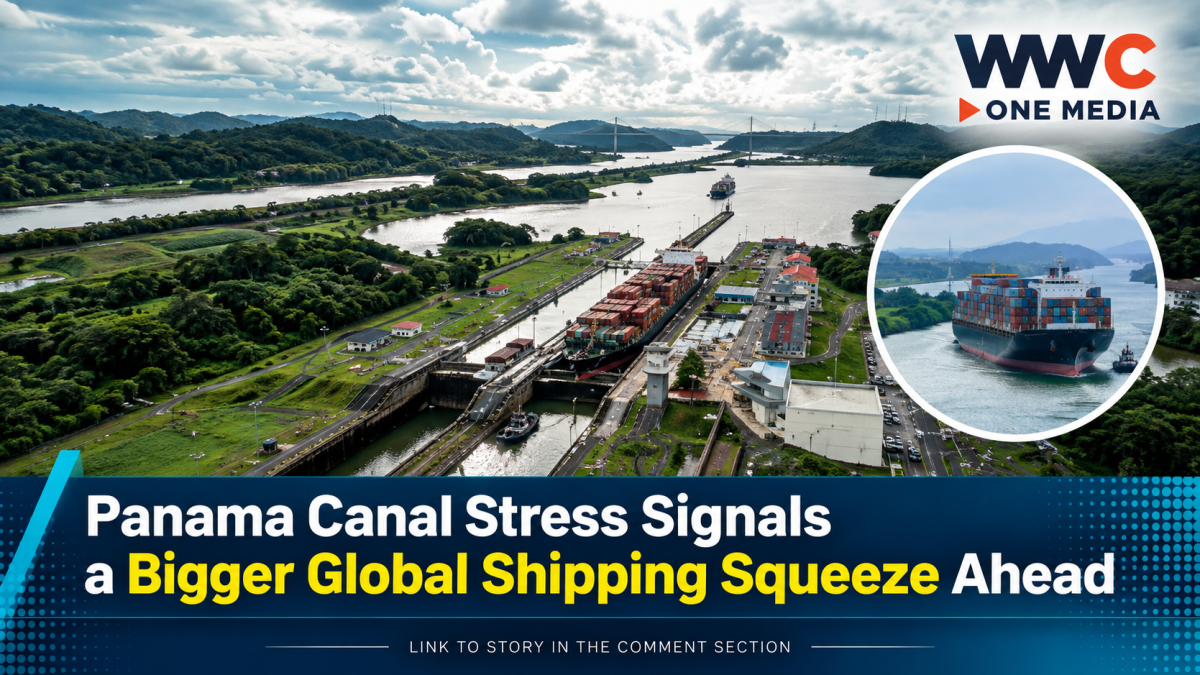
A record-breaking Panama Canal transit payment is emerging as a warning sign for global trade, as Middle East disruptions, rising fuel costs, seasonal demand and limited maritime capacity put increasing pressure on the world’s shipping network.
A shipowner reportedly paid more than US$5 million for a single Panama Canal reservation slot for an LPG carrier — an extraordinary price that highlights how competition for critical shipping routes is intensifying.
The squeeze comes as disruptions around the Strait of Hormuz force some energy cargoes to seek alternative routes, increasing competition for Panama Canal capacity at the same time that container shipping enters its seasonal peak.
Why the Panama Canal Suddenly Matters More
The Panama Canal has become an increasingly important alternative route for vessels attempting to avoid disruptions elsewhere.
But the canal has finite capacity.
Reuters reported that average daily transits had already increased by about 17% earlier this year, while water shortages associated with El Niño have constrained the canal’s ability to accommodate unlimited additional traffic.
That creates a difficult equation: more ships need alternative routes, but the alternative itself cannot expand capacity instantly.
The result is rising competition for transit slots.
A US$5 Million Warning Signal
The reported multimillion-dollar reservation is significant not simply because of its size, but because it demonstrates what shippers may be willing to pay when a strategically important route becomes congested.
Energy carriers are competing for canal access with other vessels, while disruptions in the Middle East are changing established shipping patterns.
The Panama Canal Authority uses a booking and auction system for some transit capacity, meaning operators can face substantially higher costs when demand for available slots increases.
The record payment therefore offers a snapshot of the financial pressure developing across maritime logistics.
Container Shipping Costs Are Already Surging
The pressure is not limited to LPG and other energy shipments.
Reuters reported that the spot rate for a 40-foot container from China to the U.S. East Coast reached US$10,948, more than four times its level before the current Iran war and close to the pandemic-era record of US$11,900 reached in January 2022.
Xeneta’s Sept. 10 data showed similarly dramatic increases:
- Far East–U.S. West Coast: US$7,738 per 40-foot container
- Far East–U.S. East Coast: US$10,955
- Far East–North Europe: US$4,333
- Far East–Mediterranean: US$4,764
Compared with Feb. 28, before the Hormuz crisis, the Far East–U.S. East Coast rate was up 313%, according to Xeneta.
These figures vary by methodology and date, but the direction is clear: shipping costs on several major routes have risen dramatically.
Fuel Costs Are Making the Problem Worse
The shipping industry is also dealing with a major increase in fuel expenses.
Reuters reported that global bunker fuel prices had climbed to around US$901.50 per metric ton, as crude prices rose following attacks and disruptions involving oil infrastructure and tankers in the Middle East.
Higher fuel prices affect shipping economics in two ways.
First, operating a vessel becomes more expensive.
Second, longer alternative routes become substantially more costly because ships must burn more fuel and spend more time at sea.
That makes every additional diversion more painful for carriers and, ultimately, for businesses paying to move goods.
The Red Sea Is Still Under Pressure
The Panama Canal situation is also connected to continuing disruption around the Red Sea.
Xeneta reported that average weekly container capacity through the Bab el-Mandeb Strait was about 212,636 TEU in August 2026, compared with approximately 930,679 TEU in August 2023.
Some carriers have begun returning to the Red Sea as the economics of long Cape of Good Hope diversions change, but security risks and uncertainty remain.
Freightos reported that approximately 19% of Asia-Europe container volumes had returned to the Red Sea by early September, according to Sea-Intelligence data cited in its September outlook.
That partial return does not mean the shipping crisis is over. Instead, carriers are balancing security, fuel costs, transit times and congestion when choosing routes.
Peak Season Could Bring Another Shock
The timing is particularly important.
Global retailers typically increase shipments ahead of Black Friday, Christmas and year-end demand, creating a seasonal increase in container traffic.
That means shipping companies could face additional competition for capacity just as Panama Canal demand is being boosted by energy cargo diversions.
Reuters warned that the combination could push canal passage costs even higher.
For businesses, that could mean higher transportation costs arriving at exactly the time when supply chains are preparing for their busiest period.
Asian Ports Are Also Showing Signs of Stress
The pressure is not limited to waterways.
ICIS, citing Sea-Intelligence data, reported that global container-vessel schedule reliability fell to 56.4% in July 2026, down 6.1 percentage points from June.
Average delays for late vessels increased to 6.06 days, while all 14 of the region’s busiest Asian ports experienced declines in on-time arrivals.
That creates another potential feedback loop.
When ships arrive late, containers and vessels can accumulate at ports. Congestion then causes additional delays, making schedules less predictable and potentially requiring carriers to adjust routes and sailing plans.
What This Could Mean for Consumers
Higher freight rates do not automatically translate into an immediate increase in retail prices.
Companies can absorb some costs, renegotiate contracts, adjust inventory or change shipping routes.
But if elevated freight and fuel costs persist, businesses may eventually face pressure to pass at least part of those costs through supply chains.
That could affect everything from consumer electronics and clothing to industrial components, food products and energy-related goods.
The impact will depend heavily on how long the disruptions last.
The Bigger Warning
The US$5 million Panama Canal payment is therefore more than an eye-catching shipping story.
It illustrates how one disruption can shift pressure onto another part of the global transportation network.
A conflict affecting a major energy corridor can change vessel routes. Those diversions can increase demand at another canal. Seasonal trade can then add further pressure, while fuel costs make every detour more expensive.
The global shipping system is interconnected — and that means bottlenecks can move.
For now, the biggest question is not simply whether shipping rates are rising.
It is how much more pressure the world’s alternative routes can absorb before the next bottleneck emerges.