
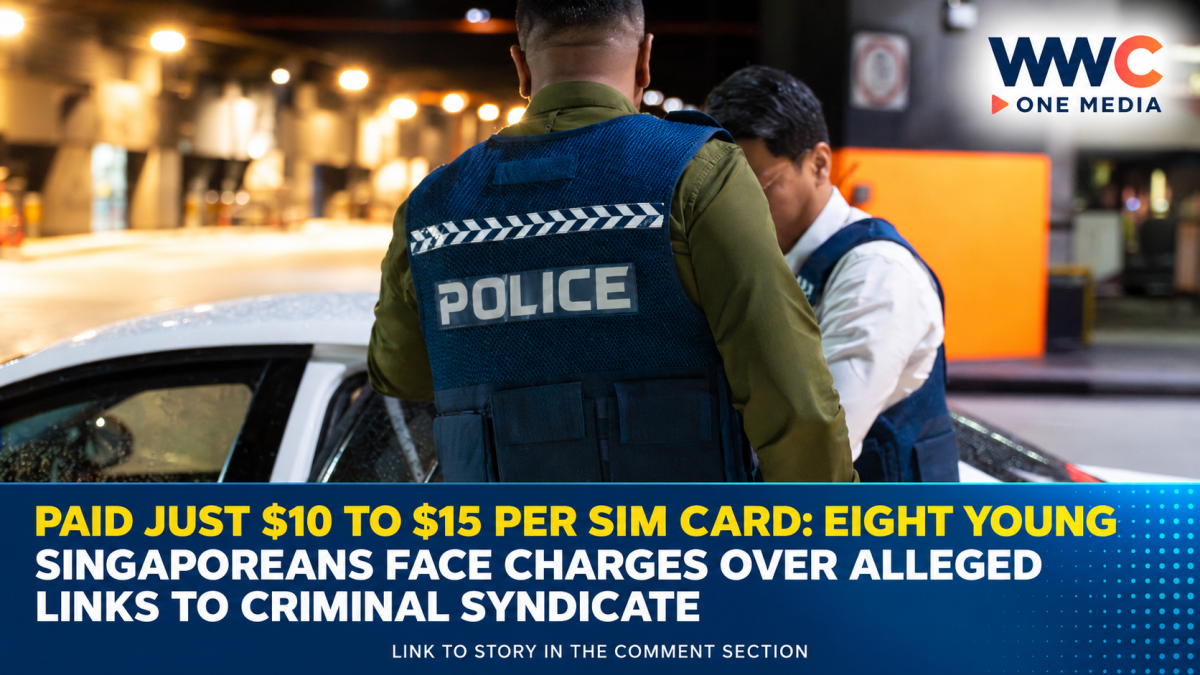
SINGAPORE — Eight young people aged between 17 and 26 are set to be charged after allegedly handing over multiple SIM cards registered under their own names to a criminal syndicate in exchange for cash.
The seven men and one woman allegedly received between S$10 and S$15 for each registered SIM card, according to the Singapore Police Force.
But what may have appeared to be easy money could now lead to serious criminal consequences.
The eight individuals are scheduled to be charged in court between Sept 14 and Sept 18, as Singapore authorities continue their crackdown on the fraudulent registration and supply of SIM cards that can be used to facilitate criminal activities.
How Did the Alleged Scheme Work?
Police said the suspects allegedly registered SIM cards under their own names before handing the cards over to a criminal syndicate.
The individuals were allegedly paid cash for each SIM card they provided.
Such SIM cards can be valuable to criminal groups because they may be used to create communication channels or accounts that are harder to trace directly to the people actually carrying out illegal activities.
Authorities have repeatedly warned that people who provide SIM cards, bank accounts or other personal credentials to criminal syndicates can be held responsible even if they are not the ones directly contacting victims or carrying out the final scam.
The latest case highlights how organised criminal networks may recruit ordinary individuals to obtain resources using legitimate personal identities.
Eight Suspects, Aged 17 to 26, Now Face Court
The eight individuals comprise seven men and one woman.
Police said they are between 17 and 26 years old.
Their cases are expected to be heard between Sept 14 and 18.
The case comes after a series of enforcement operations targeting people suspected of fraudulently registering SIM cards for illicit purposes.
In August, Singapore Police arrested 20 people and placed another 42 under investigation following a two-and-a-half-week islandwide operation targeting suspected fraudulent SIM card registration.
Singapore Is Stepping Up Its Crackdown on SIM Card Mules
The latest charges are part of a much wider crackdown.
Earlier this year, police investigated 72 people following another islandwide operation targeting suspected fraudulent SIM card registration.
That operation involved the Anti-Scam Command and police land divisions, highlighting the growing focus on SIM cards as potential tools used in criminal networks.
In March, another 14 people were set to be charged after allegedly handing over between 17 and 65 fraudulently registered postpaid SIM cards each to a crime syndicate.
Those individuals were allegedly offered between S$5 and S$20 per card.
The pattern is clear: Singapore authorities are increasingly treating the supply of SIM cards for criminal purposes as a serious part of the wider scam ecosystem.
Why Are SIM Cards So Important to Criminal Syndicates?
SIM cards may appear to be ordinary everyday items.
But in the wrong hands, they can become part of a much larger criminal operation.
A fraudulently registered SIM card can potentially be used to support anonymous communications, account registrations and other activities that make it harder for investigators to identify the real people behind criminal schemes.
That is why authorities have increasingly focused not only on scammers themselves but also on the wider network of people who allegedly provide resources to them.
Singapore’s recently strengthened anti-scam framework has also targeted so-called SIM card mules alongside money mules and other individuals suspected of helping criminal networks operate.
“I Didn’t Commit the Scam” May Not Be Enough
One of the biggest warnings emerging from Singapore’s anti-scam campaigns is that people should not assume they are safe from prosecution simply because they did not personally contact or cheat a victim.
Authorities have repeatedly targeted people accused of providing:
- SIM cards
- Bank accounts
- ATM cards
- Singpass credentials
- Online accounts
- Personal information
These resources can allegedly be used by criminal syndicates to carry out scams, money laundering and other offences.
In one recent Singapore case, police said more than 1,200 phone lines had allegedly been registered using compromised Singpass accounts belonging to work permit holders.
Singapore’s Anti-Scam Laws Are Becoming Tougher
Singapore has been strengthening its legal tools to combat scams and the networks that support them.
A new anti-scam law passed in Parliament in September gives police greater powers to request service providers, including banks and telecommunications companies, to restrict or disable accounts linked to suspected scam mules.
The wider framework reflects a growing recognition that scam syndicates depend on more than just the people making fraudulent calls or sending deceptive messages.
They may also rely on networks of individuals willing to provide accounts, phone lines and personal credentials.
As of June 30, authorities had placed more than 1,400 suspected SIM card mules under Singapore’s Facility Restriction Framework, according to information reported in connection with the country’s strengthened anti-scam legislation.
A Few Dollars Could Lead to Serious Consequences
The latest case is particularly striking because of the relatively small sums the suspects allegedly received.
Police said they were allegedly paid just S$10 to S$15 per SIM card.
But authorities are making it clear that small payments do not necessarily mean small consequences.
For young people approached with offers of quick cash, the message is increasingly direct: handing over a SIM card registered in your name can expose you to criminal investigation if it is later linked to illegal activity.
The Police Crackdown Is Far From Over
Singapore has continued carrying out large-scale operations against scams and related criminal activity.
Just days before the latest SIM card case was reported, police announced that 254 people were under investigation in connection with more than 650 suspected scam cases involving estimated losses of about S$7.5 million.
The figures show the scale of the wider challenge facing authorities.
And investigators are increasingly looking beyond the scammers themselves to identify people who allegedly help criminal syndicates obtain the tools and identities they need.
The Bigger Warning Behind the Latest Charges
For eight young Singaporeans, an alleged offer of S$10 to S$15 per SIM card has now led to criminal charges.
For police, however, the case represents something much bigger.
It is another warning about how criminal syndicates can allegedly recruit ordinary people into their operations—sometimes by offering small amounts of money for something as simple as registering and handing over a phone line.
The payment may have been just S$10. The alleged act may have taken only minutes. But the consequences could be far more serious.
As Singapore intensifies its fight against scams and criminal syndicates, one question is now becoming increasingly important:
How many more people are still being tempted by “easy money” without realising they could be handing criminals exactly what they need?
:::




Leave a Reply