
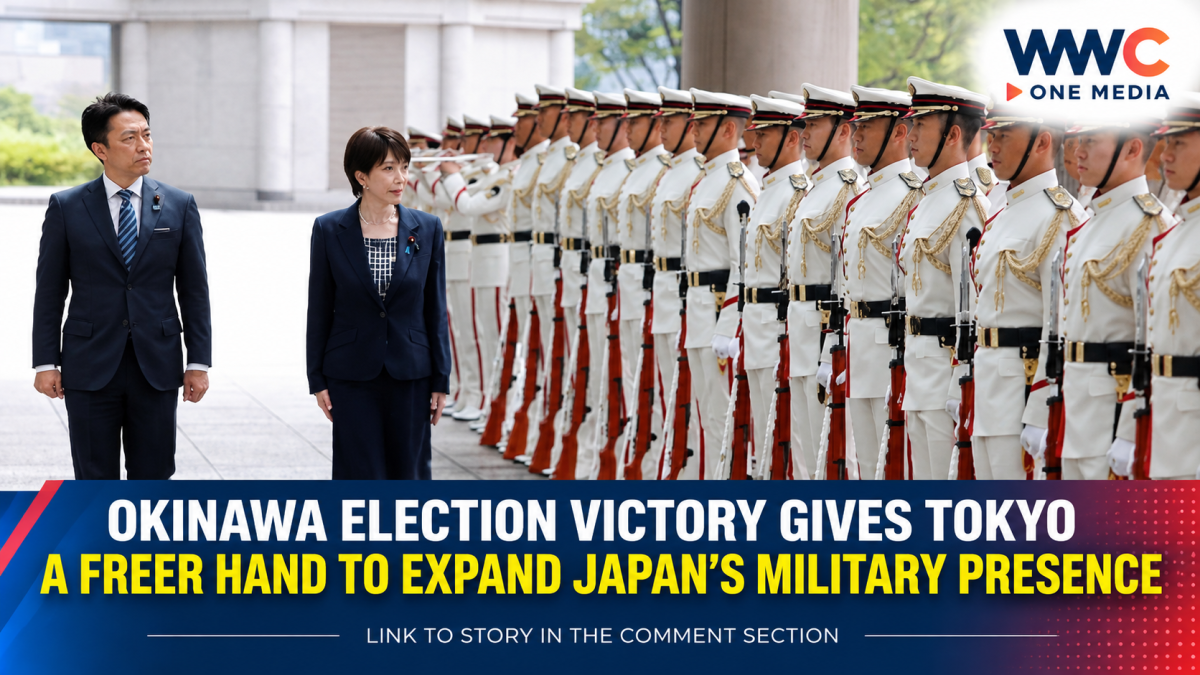
A major political shift in Okinawa could give Japan’s central government greater freedom to expand its military presence on the strategically important island chain near Taiwan and China.
Genta Koja, a 42-year-old candidate backed by Prime Minister Sanae Takaichi’s government, defeated two-term incumbent Denny Tamaki with 59 per cent of the vote in Sunday’s gubernatorial election.
Koja’s victory ends 12 years of Okinawan leadership that frequently clashed with Tokyo over the large US military presence on the islands and plans to relocate a US Marine Corps base.
The result could significantly change the political landscape surrounding Japan’s defence build-up at a time of heightened tensions with China and growing concern over a potential conflict involving Taiwan.
A major setback for Okinawa’s anti-base camp
Tamaki had been one of the most prominent opponents of the relocation of US Marines from the Futenma air station to a new facility at Henoko, on Okinawa’s main island.
Opposition to the relocation has deep roots in Okinawa, where residents have long complained that the prefecture bears a disproportionate share of the US military presence in Japan.
The Futenma base, located in a densely populated area, has become a symbol of the political and social tensions surrounding the US-Japan security alliance.
Koja’s victory could weaken efforts by the prefectural government to challenge the relocation.
Japan’s central government has already indicated that it intends to proceed with the Henoko project.
With a governor more aligned with Tokyo’s defence policies now in office, the political resistance that has complicated the project for years could become considerably weaker.
Civilian airports and ports could see military use
The implications could extend beyond the Futenma relocation.
Koja’s election victory may make it easier for Tokyo to expand military access to civilian airports and ports across Okinawa, according to regional security experts.
That would give Japan’s Self-Defense Forces greater flexibility to move personnel, equipment and supplies through infrastructure that is currently primarily used for civilian purposes.
Such access could become increasingly important as Japan strengthens its defences across its southwestern islands.
The government is also considering a broader expansion of defence infrastructure as part of its efforts to respond to China’s growing military capabilities.
Okinawa’s strategic importance is growing
Okinawa occupies a crucial position in the First Island Chain, which stretches from Japan through Taiwan and the Philippines and forms a strategic barrier along China’s eastern approaches.
Japan has been steadily increasing its military presence across the southwestern islands.
Missile and electronic-warfare units have been deployed on several islands, while ammunition storage facilities are being expanded.
One of the most strategically important locations is Yonaguni, Japan’s westernmost inhabited island, which lies only about 110km from Taiwan.
The island’s proximity to Taiwan gives Okinawa particular importance in any contingency involving the Taiwan Strait.
Tokyo has become increasingly concerned about China’s military activity around Taiwan and the possibility that a conflict there could have direct consequences for Japan.
A turning point for Japan’s defence strategy
Koja’s victory comes as Takaichi’s government prepares a new national security strategy expected to support an even more ambitious military expansion.
The government argues that increased defence spending and stronger military capabilities are necessary to deter China and protect Japan amid worsening regional security conditions.
Japan’s defence posture has already undergone a major transformation in recent years, with greater investment in long-range weapons, missile defence, ammunition stockpiles and military infrastructure.
Okinawa is at the centre of many of those plans because of its location close to Taiwan and the wider East China Sea.
The election therefore carries significance far beyond local politics.
The base issue is changing
The Okinawa campaign was not dominated solely by the long-running dispute over US military bases.
Economic concerns, including rising prices and the cost of living, played a major role in the contest.
That shift reflects a broader change in Okinawan politics, with some voters increasingly focused on economic conditions and regional security rather than making opposition to US bases the central issue.
For Tokyo, the election result could represent an important political opening.
For Okinawa, however, the victory does not mean opposition to the military presence has disappeared.
The prefecture continues to carry a disproportionate share of US military facilities in Japan, and resentment over noise, accidents, land use and the legacy of the US presence remains.
What has changed is the political balance.
After more than a decade of governors challenging Tokyo’s military plans, the central government now has a governor who is considerably more likely to cooperate with its defence agenda.
That could make Okinawa a much easier staging ground for Japan’s military build-up — at a moment when tensions with China and uncertainty over Taiwan are pushing the island chain to the centre of East Asia’s security calculations.




Leave a Reply