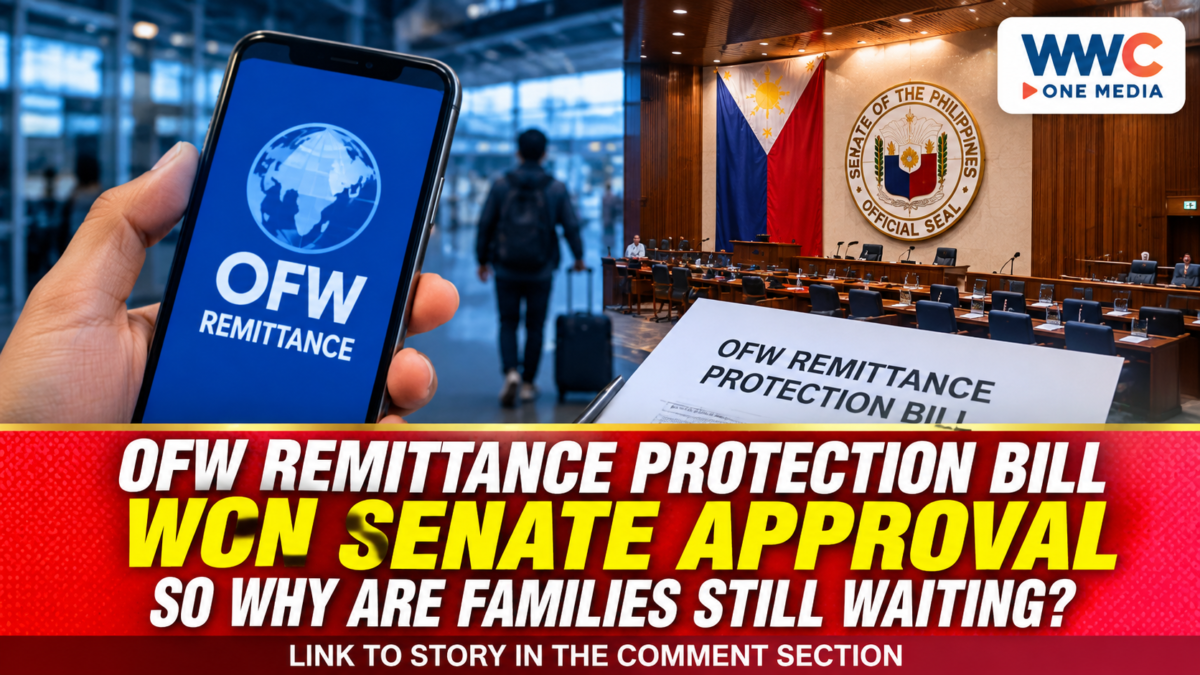
A proposed law to protect overseas Filipino workers from remittance-related charges cleared the Senate on March 16, 2026, but it has not yet completed the legislative process needed to become law.
Senate Bill No. 1917, titled the Overseas Filipino Workers (OFWs) Remittance Protection Act, received the support of all 21 senators who voted during its third-reading approval. The Senate’s legislative record subsequently listed the measure as pending in the House of Representatives. Senate of the Philippines+1
That distinction matters to millions of Filipinos who depend on money sent home from abroad. Senate approval is a significant step, but it does not automatically change the fees charged by banks and remittance companies.
What the Senate actually approved
The Senate journal for March 16 records the third-reading vote on Senate Bill No. 1917. Twenty-one senators voted in favour, with none voting against and none abstaining. The measure was therefore approved by the Senate. Senate of the Philippines
The bill was filed on February 26, 2026. Its principal authors listed in the Senate legislative record include Senators Camille A. Villar, Jinggoy Ejercito Estrada, Raffy T. Tulfo, Joel Villanueva, JV Ejercito, Mark A. Villar and Francis “Kiko” Pangilinan. Senate of the Philippines
Its stated purpose is to protect the remittances of overseas Filipino workers. In practical terms, the proposal seeks to establish safeguards around the money workers send to their families in the Philippines.
Why Senate approval is not enough
A bill must complete the required legislative process in both chambers before it can be transmitted for presidential action. The Senate’s approval alone does not make its provisions enforceable.
The Senate’s published legislative page identifies Senate Bill No. 1917 as pending in the House of Representatives, with the status dated March 17, 2026. That is the latest status shown on the record consulted for this report. Senate of the Philippines
Until the House acts and the remaining constitutional steps are completed, families should not assume that the proposed protections or fee changes are already in effect.
The fee question remains important
The cost of sending money internationally can involve several components, including transfer charges and the exchange rate applied to the transaction. A service that advertises a low upfront fee may still offer a less favourable exchange rate.
For an overseas worker sending money regularly, even a small difference in the total cost can accumulate over multiple transfers. The amount received by a family therefore depends not only on the advertised fee but also on the full transaction terms.
The proposed measure’s progress is worth watching because legislation can establish clearer responsibilities and protections. However, the exact obligations that would apply to remittance providers must be assessed from the final version of any measure that becomes law—not assumed from a bill title or a public appeal for its passage.
Several proposals are moving through Congress
The House legislative records also show other proposals dealing with OFW remittance protection.
House Bill No. 11626, filed by Rep. Edgar R. Erice on October 6, 2026, seeks to protect OFW remittances and promote fair, transparent, secure and affordable remittance services. The House record lists it as pending with the Committee on Overseas Workers Affairs.
House Bill No. 11679, filed by Rep. Elisa “Olga” T. Kho on October 12, 2026, proposes fee caps and transparency in transfer costs, as well as penalties for unauthorised and predatory remittance practices. It was also listed as pending with the same committee. House of Representatives Philippines+1
These are separate House proposals. Their existence does not mean they have been consolidated with Senate Bill No. 1917 or that their provisions have already been adopted.
What happens next?
The next important development is formal action by the House of Representatives on the Senate-approved measure. Readers should watch for an official committee report, plenary consideration, House approval and any bicameral conference proceedings if the chambers pass different versions.
The final text matters. Differences between the Senate and House versions may affect the scope of protection, the agencies responsible for implementation and the rules that remittance providers would have to follow.
For now, the Senate vote is confirmed, but the proposed protections are not yet established as law by the records reviewed here.
What does the OFW Remittance Protection Act mean?
It is the title of Senate Bill No. 1917, a proposed measure intended to protect money sent home by overseas Filipino workers. It is not yet a law.
Did the Senate approve the bill?
Yes. The Senate approved Senate Bill No. 1917 on third reading on March 16, 2026, with 21 votes in favour and none against or abstaining. Senate of the Philippines
Is the remittance protection bill already a law?
The Senate legislative record lists the measure as pending in the House of Representatives. It should not be treated as an enacted law. Senate of the Philippines
Are there other bills addressing OFW remittance fees?
Yes. House Bills Nos. 11626 and 11679 are among the proposals listed in the House records as pending with the Committee on Overseas Workers Affairs. House of Representatives Philippines+1
Will the proposal automatically make remittances free?
No such conclusion can be drawn from the bill’s title or Senate approval. The final enacted text and implementing rules would determine what protections and obligations actually apply.