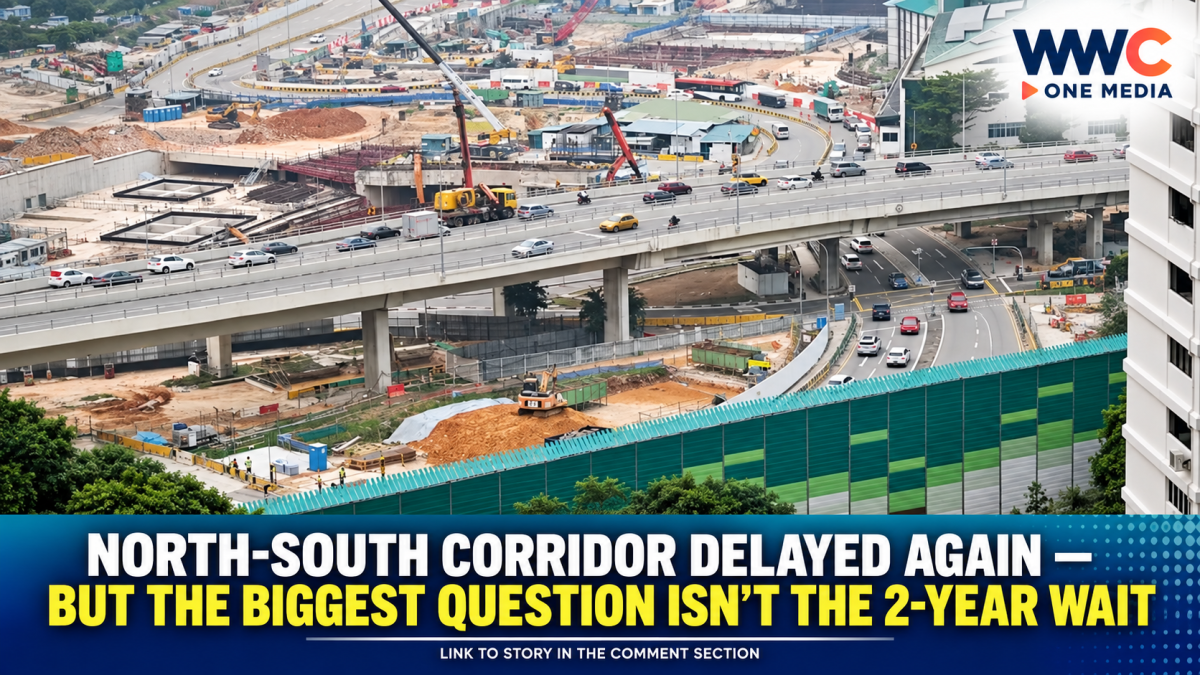
Singapore’s North-South Corridor (NSC) has been pushed back by about two years, and the eventual financial impact of the delay will only become clear after the massive transport project is completed, the Land Transport Authority (LTA) said.
The development comes as businesses and residents along the construction corridor face a longer period of road diversions, construction activity, reduced visibility and disruption.
LTA said on Sept. 18 that it is currently not in a position to disclose the additional cost associated with the delay because construction is still ongoing. It will determine the final additional cost — including how any costs are divided between the contractor and the agency — after the project is completed.
The NSC was originally estimated to cost S$7.47 billion.
That figure, however, should not be interpreted as the current cost of the delayed project. LTA has not announced a final revised project cost.
North-South Corridor opening pushed back
The 21.5km North-South Corridor is designed to connect Singapore’s northern towns with the city centre while providing infrastructure for motorists, public transport users, pedestrians and cyclists.
Under the revised timeline, the 8.8km viaduct from Admiralty Road West to Lentor Avenue is expected to open progressively from 2029, instead of 2027.
The 12.3km tunnel section from Lentor Avenue to East Coast Parkway is now expected to open progressively from 2031, instead of 2029.
The project has been under construction since 2018 and was originally expected to be completed earlier. The latest delay follows a series of complex engineering problems encountered as construction moved into technically demanding sections of the project.
What caused the delay?
LTA said the project encountered unexpectedly challenging ground conditions as well as difficulties associated with working close to existing roads, utilities and operational MRT infrastructure.
At Gambas Avenue and Woodlands Avenue 8, fractured rock and other ground conditions meant some foundation piles had to be driven deeper than initially planned.
The situation was particularly complicated at Novena, where the NSC tunnels pass extremely close to the operational North-South MRT Line.
LTA said fractured rock and groundwater inflows required workers to adopt a more precise and time-consuming excavation method. The NSC tunnel passes both above and below the existing MRT infrastructure, with clearance in some areas as close as 1 metre.
At Thomson, harder-than-expected rock formations and variable underground conditions required controlled blasting, additional rock removal and ground stabilisation before excavation could safely continue.
These delays affected subsequent stages of construction because major works have to be completed in sequence.
LTA said the cumulative effect of the challenges ultimately added approximately two years to the overall completion timeline.
Who will pay for the delay?
This is one of the biggest unanswered questions surrounding the project.
LTA said contractors receive available ground information during the tender process and are expected to account for construction risks when submitting their bids.
However, if actual ground conditions differ from the baseline information provided, contractors can submit claims for assessment.
LTA said it will assess such claims and consider additional payment where the claims are valid under the contractual provisions. The final allocation of additional costs between the parties will only be determined after completion.
In other words, there is currently no confirmed figure for how much the two-year delay will ultimately add to the project bill — or how much of that amount, if any, will be borne by LTA.
Businesses feel the impact
While the final financial bill for the project remains uncertain, some businesses along the construction corridor are already dealing with a more immediate cost.
Businesses located near NSC works told CNA that they have experienced lower earnings, reduced customer footfall and poorer visibility because of construction activities.
Some business operators have even raised concerns about whether they can continue operating if disruption persists.
LTA acknowledged that the revised construction schedule means businesses and residents in affected areas will have to endure the impact for longer.
The authority said, however, that disruption at street level should gradually ease as more construction activities move underground.
From 2027, more works are expected to shift below ground. From 2028, roads, footpaths and other areas currently occupied by construction activities are expected to be progressively reinstated where possible.
LTA also said noise barriers and construction hoardings will be removed progressively as areas are no longer required for construction.
The project is already more than 90% through major foundation works
Despite the delay, construction has made substantial progress.
As of August 2026, LTA said more than 90 per cent of the foundation works for both the viaduct and tunnel sections had been completed.
The viaduct works are moving toward above-ground construction, including columns, crossheads and the installation of viaduct segments.
For the tunnel section, major excavation works are continuing along the 12.3km alignment.
The Straits Times reported that more than 90 per cent of foundation works for the viaduct and tunnel had been completed, while some of the most technically demanding underground works remain.
What the North-South Corridor is expected to change
When fully completed, the NSC will connect northern areas including Sembawang, Yishun, Ang Mo Kio, Toa Payoh, Novena and Rochor with the city.
The corridor is intended to provide an alternative route for traffic and help relieve congestion on the Central Expressway (CTE) and major arterial roads such as Thomson Road and Marymount Road.
It will also connect with major expressways including the Seletar Expressway, Pan-Island Expressway and East Coast Parkway.
Beyond road capacity, the project is designed as a multi-modal transport corridor, with infrastructure for buses, cycling and walking.
With more traffic eventually redirected to the NSC, some existing surface streets are expected to be progressively repurposed to give greater priority to public transport, pedestrians, cyclists and community spaces.
The bigger question now
For motorists and commuters, the revised opening dates mean waiting longer for the full benefits of one of Singapore’s largest transport infrastructure projects.
For businesses along the construction route, the issue is more immediate: how much longer can they absorb the impact of construction before conditions improve?
LTA has said it will deploy additional manpower and equipment where effective, optimise construction sequences and prioritise critical activities in an effort to make up time where feasible.
But the financial consequences of the delay remain unresolved.
The final additional cost — and how much will ultimately be borne by the contractor versus LTA — will only become clear after the North-South Corridor is completed.
For now, Singapore is left with a revised timeline, prolonged disruption for affected communities and businesses, and a multibillion-dollar infrastructure bill whose final number has yet to be determined.