
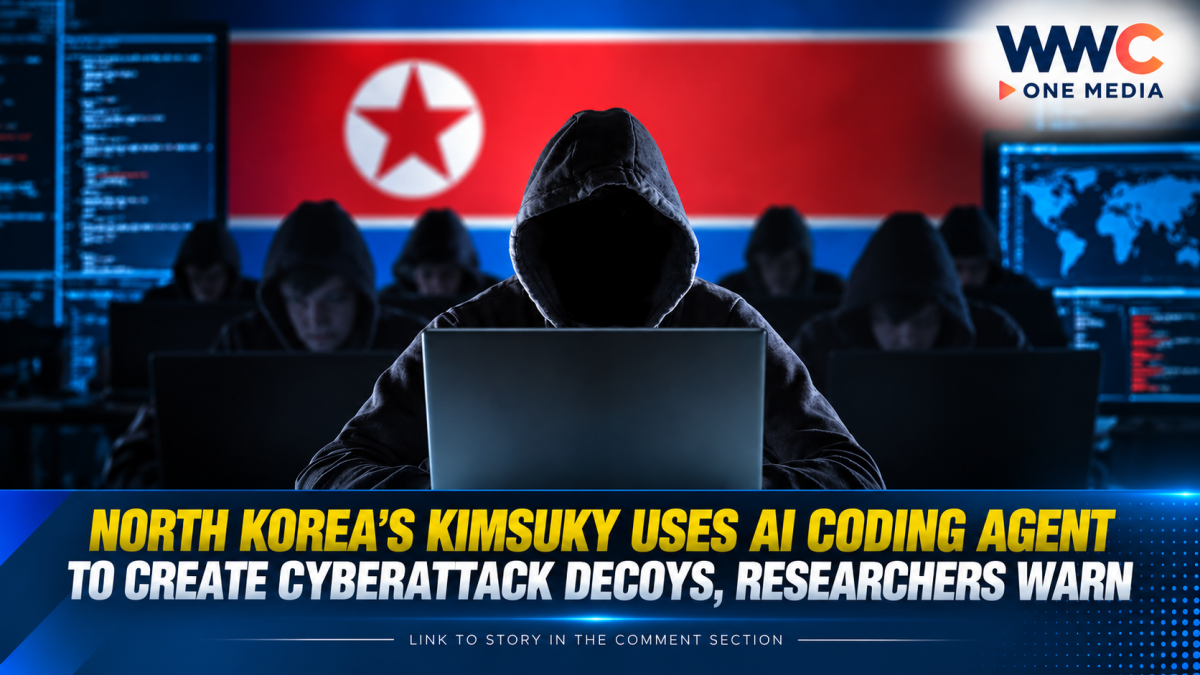
SEOUL — North Korea-linked hacking group Kimsuky is taking its use of artificial intelligence a step further, using an AI coding agent to help create convincing decoy documents for malware attacks, according to new research from South Korean cybersecurity firm Genians.
The discovery raises fresh concerns that artificial intelligence is no longer being used only to polish phishing messages or generate fake documents. Researchers say it is increasingly being incorporated into the production and preparation of malicious attack materials, potentially allowing threat actors to create convincing lures faster and at greater scale.
Genians said its latest investigation examined 13 malicious files collected between Aug. 11 and 19, 2026, which it assessed as being connected to Kimsuky’s ongoing Operation GitPower activity.
The researchers found traces of an open-source AI coding agent known as opencode inside metadata associated with decoy PDF documents.
AI Leaves a Digital Fingerprint
The discovery came from something remarkably mundane: document metadata.
Genians said some of the PDFs had “opencode” listed in their creator and producer fields. The company said those values are not normally produced by standard document-creation software, suggesting the documents were generated programmatically with assistance from the AI coding agent rather than manually assembled.
The findings represent the first time Genians said it had detected evidence of Kimsuky using an AI coding agent in its malicious operations.
That distinction matters.
Kimsuky has previously been linked to the use of generative AI and large language models for creating attack lures. The latest evidence suggests the group is moving toward a broader model in which AI-assisted tools can become part of the technical workflow used to prepare attacks.
The Lures Were Designed to Look Like Everyday Business Documents
According to Genians, the latest campaign used compressed files containing malicious shortcut files disguised as legitimate business material.
The decoy themes included subjects associated with insurance, financial transactions, policy funds, corporate documents, payments and other routine administrative activity.
The goal is straightforward: make a malicious file look sufficiently ordinary that a recipient will open it without immediately suspecting an attack.
Genians said the campaign indicates that Kimsuky’s targeting has expanded beyond its traditional emphasis on diplomacy, security and academia to include financial institutions and corporate personnel.
That broadening could make the threat more difficult for organizations to spot because the lure no longer necessarily looks like an obvious geopolitical or military document.
Kimsuky’s AI Push Goes Beyond Fake Documents
The latest discovery follows a much broader set of findings published by Genians in August.
Researchers said they had found evidence that Kimsuky was experimenting with local large language model environments, including tools such as Ollama, GPT4All and Msty.
Running AI models locally can allow operators to process information without sending potentially sensitive material to an outside AI provider, according to Genians.
Genians also identified evidence involving AI-assisted development tools, including Cursor, and concluded that Kimsuky appeared to be exploring ways to integrate AI into malware development, document analysis and attack preparation.
Reuters reported in August that Genians had found AI tools and software on infrastructure associated with Kimsuky, including technologies that could potentially support automated cyberattacks, analysis of stolen information and more convincing phishing campaigns. Reuters also stressed that the findings had not been independently verified.
Why AI Makes the Threat More Difficult
The significance of the development is not necessarily that AI has suddenly made Kimsuky capable of attacks it could never conduct before.
Rather, researchers are concerned about speed, scale and quality.
AI can help threat actors produce polished documents and tailor social-engineering material to different targets much faster than traditional manual processes.
Genians previously warned that generative AI could enable the mass production of social-engineering materials, potentially allowing attackers to create highly convincing lures across a wider range of subjects.
Al Jazeera likewise reported that Genians had observed AI-generated documents being used in Kimsuky-linked spear-phishing activity targeting areas including military, diplomatic and academic sectors.
The result is a potentially dangerous combination: human intelligence targeting, established malware techniques and increasingly automated AI-assisted content production.
Kimsuky Is Not a New Threat
Kimsuky has been associated with North Korean cyber operations for years.
U.S. and South Korean authorities and cybersecurity researchers have linked North Korean state-backed cyber groups to espionage, financial theft and other operations.
Reuters reported that the U.S. Treasury sanctioned Kimsuky in 2023 and described it as a North Korean government-controlled cyber-espionage group supporting Pyongyang’s strategic objectives.
Genians said the current activity is not a completely new campaign but an evolution of techniques observed in previous Kimsuky operations.
Its Operation GitPower activity continues to use established attack mechanisms while incorporating Git-based infrastructure and increasingly sophisticated AI-related tooling.
The Bigger Warning: AI Is Becoming Part of the Attack Chain
The most important takeaway from the latest findings may not be the name of the AI coding agent.
It is the apparent shift in how AI is being used.
Instead of treating AI simply as a chatbot that can write text, threat actors are increasingly experimenting with AI as a production tool inside a larger cyber operation.
That could allow attackers to generate more decoys, adapt materials to different targets and accelerate parts of the development process.
At the same time, Genians stressed that AI-generated lures do not eliminate the other traces left by an attack. Security teams can still look for suspicious behavior occurring after a malicious file is opened, including unusual execution, persistence and communications patterns.
What This Means for Businesses and Government Agencies
For organizations, the warning is increasingly clear: a professional-looking document should no longer be treated as evidence that a file is trustworthy.
Employees handling financial documents, diplomatic correspondence, research materials, investment information or sensitive corporate data remain attractive targets for spear-phishing campaigns.
The latest Kimsuky findings also reinforce a broader cybersecurity trend: attackers are beginning to exploit the same AI revolution that businesses are embracing.
The technology that can help an employee draft a report in seconds can potentially help an attacker manufacture a convincing lure just as quickly.
And that is what makes this development particularly unsettling.
The next phishing email may not look suspicious because it was badly written. It may be dangerous precisely because it was written — and engineered — with AI.
SEO Package
Primary Keyword:
Kimsuky AI hacking
Secondary Keywords:
- North Korea hackers AI
- Kimsuky hacking group
- Kimsuky AI coding agent
- North Korea cyberattack 2026
- Kimsuky cyberattack
- North Korean hackers
- AI-powered cyberattacks
- AI coding agents cybersecurity
- Operation GitPower
- North Korea cybersecurity threat
- AI phishing attacks
- Genians Kimsuky report
SEO Title:
Kimsuky: North Korean Hackers Used AI Coding Agent for Cyberattack Decoys
Meta Description:
North Korea-linked hacking group Kimsuky used an AI coding agent to create convincing malware decoys, South Korean cybersecurity firm Genians says.
Facebook Headline:
NORTH KOREA’S HACKERS ARE USING AI: Kimsuky Turns Coding Agent Into Cyberattack Tool
Facebook Caption:
A new cybersecurity warning is raising eyebrows: North Korea-linked hacking group Kimsuky has reportedly used an AI coding agent to create convincing decoy documents for malware attacks. Researchers say the group is moving beyond simple AI-generated phishing material and experimenting with AI across its wider cyber operation. The bigger question: how far will this go?
Accuracy & sourcing note
The Sept. 7, 2026 finding comes primarily from Genians’ latest threat-intelligence report, which examined 13 malicious files collected in August. Yonhap independently reported the same finding, including the evidence linking the documents to the open-source AI coding agent opencode.
The broader claim that Kimsuky has been incorporating AI into its cyber operations is supported by Genians’ August research and reporting from Reuters and Al Jazeera. Reuters specifically noted that Genians’ findings had not been independently verified, so the article appropriately attributes the technical findings to the cybersecurity firm rather than presenting them as independently proven fact.


Leave a Reply