
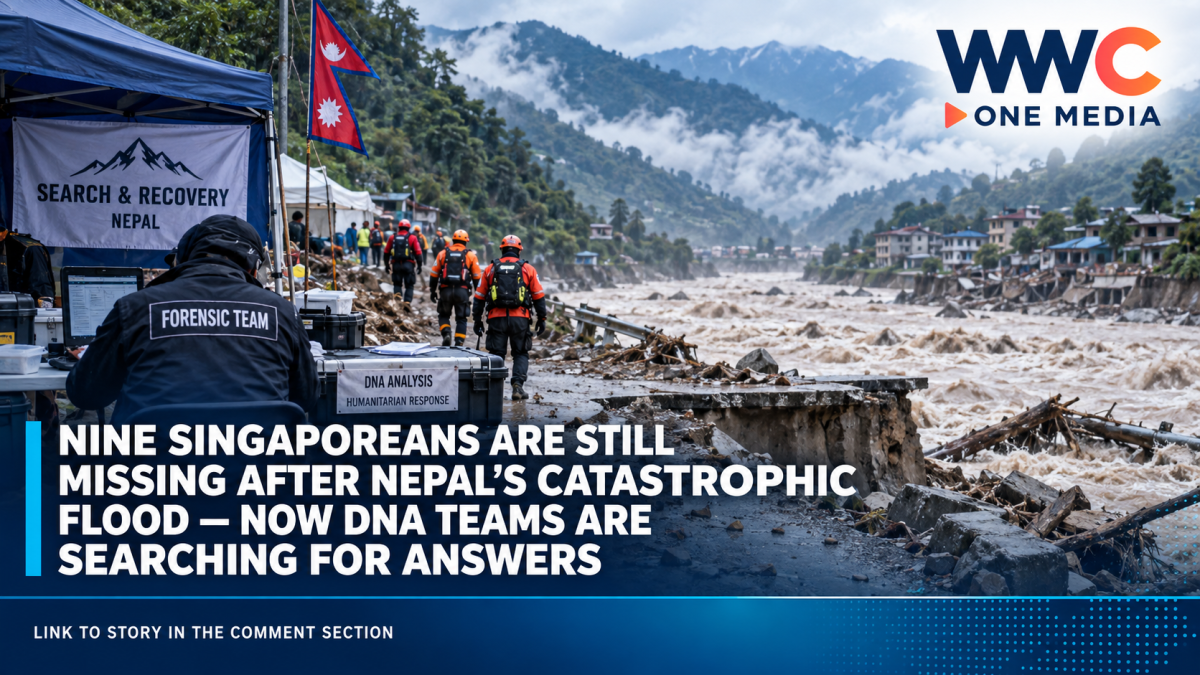
KATHMANDU — More than a week after catastrophic floods tore through Nepal’s northern border region and swept destruction hundreds of kilometres downstream, the disaster has entered another agonising phase: identifying the dead while thousands of families continue searching for the missing.
Among those waiting for answers are the families of nine Singaporeans who remain unaccounted for.
Singapore police forensic specialists are now working alongside Nepali authorities and international teams, using DNA, fingerprints, photographs and other identifying evidence to establish the identities of victims recovered from the disaster zone.
Channel NewsAsia reported on Sunday, Sept. 6, that nearly 4,900 people remained missing or out of contact, while more than 1,300 bodies had already been recovered. The enormous gap between recovered bodies and confirmed identities has put Nepal’s forensic system under extraordinary strain.
And for thousands of families, the central question remains painfully unresolved: Are their loved ones among the unidentified dead — or could some still be alive?
More than 1,300 bodies recovered, but identification is painfully slow
CNA reported that, as of Sept. 5, 1,342 bodies had been recovered but fewer than 100 had been identified and returned to their families.
Nepali authorities had collected more than 2,200 DNA samples, including samples taken from approximately 1,260 recovered bodies and more than 1,000 relatives searching for missing family members. Details of roughly 1,270 unidentified victims had also been published online to help relatives establish possible matches.
A slightly later Nepal Police tally carried by Nepalese media put the number recovered at 1,344, with around 4,887 people still missing, illustrating how quickly the figures are changing as search operations continue.
For that reason, any death or missing-person count in the disaster should be treated as provisional rather than final.
Nine Singaporeans are still missing
Singapore’s Ministry of Foreign Affairs said its Crisis Response Team has been operating in Nepal since Aug. 27, working with local authorities and following possible leads regarding the nine missing Singapore citizens.
Officials have travelled to affected areas, including Nuwakot, Chitwan and Pokhara, when road and security conditions allow.
Singapore authorities have also collected DNA samples from relatives of the missing Singaporeans so they can be compared against samples obtained from unidentified victims.
The collection of DNA should not be interpreted as confirmation that those missing have died. It is part of standard disaster-victim identification procedures when large numbers of casualties cannot be identified visually.
Singapore Minister of State for Foreign Affairs Gan Siow Huang said on Sept. 4 that search teams were continuing to look for the nine missing citizens and that Singapore remained in close contact with their families.
Singapore sends forensic experts to Nepal
The Singapore Police Force announced that an advance group of 17 SPF officers and two Health Sciences Authority forensic specialists departed for Nepal on Sept. 1 and 2, with another 14 officers expected to follow.
The contingent includes specialists in Disaster Victim Identification, or DVI, and aerial surveillance.
CNA subsequently reported that a 35-person Singapore police contingent had begun deploying from Sept. 1, indicating that the mission had expanded as Nepal’s needs became clearer.
Singapore’s specialists are joining experts from countries including India, China and South Korea, as Nepal attempts one of the most difficult forensic identification operations in its recent history.
Flood victims can be exceptionally challenging to identify. Long exposure to water, mud and debris can damage remains, fingerprints can become unusable and bodies may be carried extremely long distances from where people disappeared.
That is why DNA can become the decisive evidence.
Some bodies were carried hundreds of kilometres
The scale of the flood has created another grim problem: many victims were not recovered near the original disaster zone.
Floodwaters surged down the Trishuli River system, transporting mud, wreckage and human remains far downstream.
CNA reported that by Sept. 5, 360 bodies had been recovered in Chitwan, more than twice the number recovered in Rasuwa, near where the disaster originated. Hospitals in parts of Chitwan had mortuary capacity for only around 50 bodies even as more than 200 victims were initially recovered there.
With mortuaries overwhelmed, authorities began temporarily burying unidentified victims after collecting DNA and other forensic evidence.
Each burial location is recorded so remains can later be exhumed and returned to relatives if investigators establish a DNA match.
What caused the catastrophe?
The disaster struck on Aug. 26, sending a massive torrent of ice, rocks, mud and debris through areas near the Nepal-China border.
Reuters reported that experts suspect a glacier collapse triggered the extraordinary flood, although investigations into the precise chain of events have continued.
The destruction was enormous.
Reuters reported that nearly 50 suspension bridges and 31 motorable bridges were damaged or washed away, while roughly 10 percent of Nepal’s electricity-generation capacity was affected. Nepalese officials estimated rebuilding could eventually require billions of dollars.
A later assessment put direct property, housing and infrastructure losses at about 387.5 billion Nepalese rupees, or roughly US$2.56 billion.
Hydropower tunnels remain a major focus
Hundreds of people were also caught at hydropower projects along the flooded river corridor.
Reuters reported that rescue teams have been digging through collapsed entrances and enormous quantities of debris to reach workers believed trapped inside tunnels and underground structures.
Despite the passage of more than a week, there have been remarkable signs of life.
On Sept. 5, Reuters reported that a Chinese worker was rescued alive from a hydropower tunnel 10 days after the flood, following the rescue of two Nepali workers a day earlier. Another woman was also pulled alive from a damaged home.
Those rescues have kept hopes alive — but authorities have warned that conditions are becoming increasingly difficult as each day passes.
Singapore sends more than forensic specialists
Singapore’s response has expanded beyond the search for its own citizens.
On Sept. 4, the government handed over a humanitarian assistance package valued at about S$560,000, including medical supplies, DNA testing kits, personal protective equipment and specialised search-and-recovery equipment.
That comes on top of an earlier US$100,000 Singapore government contribution supporting the Singapore Red Cross appeal.
By Sept. 4, the Red Cross fundraising campaign had collected more than S$3 million, according to Singapore’s Foreign Ministry.
The Singapore Red Cross separately committed another S$170,000 for emergency food, water purification systems and other humanitarian assistance, following an initial S$50,000 commitment.
The search has become a race for answers
At Kathmandu’s Tribhuvan University Teaching Hospital, photographs of missing people now cover improvised notice boards.
Families come searching through images.
Forensic teams examine remains.
DNA laboratories attempt to connect the unidentified with relatives waiting at home.
And every successful rescue — even 10 days after the disaster — complicates an already agonising reality: authorities cannot simply assume that everyone still missing has died.
That is particularly important in the case of the nine Singaporeans.
They remain officially missing.
No reliable evidence cited by Singapore authorities has confirmed their fate.
For their families — and thousands of others across Nepal and around the world — the mission has therefore shifted into two parallel searches: one for survivors, and another for identities.
And until either produces an answer, the waiting continues.
WWC ONE MEDIA M.J.E

Leave a Reply