
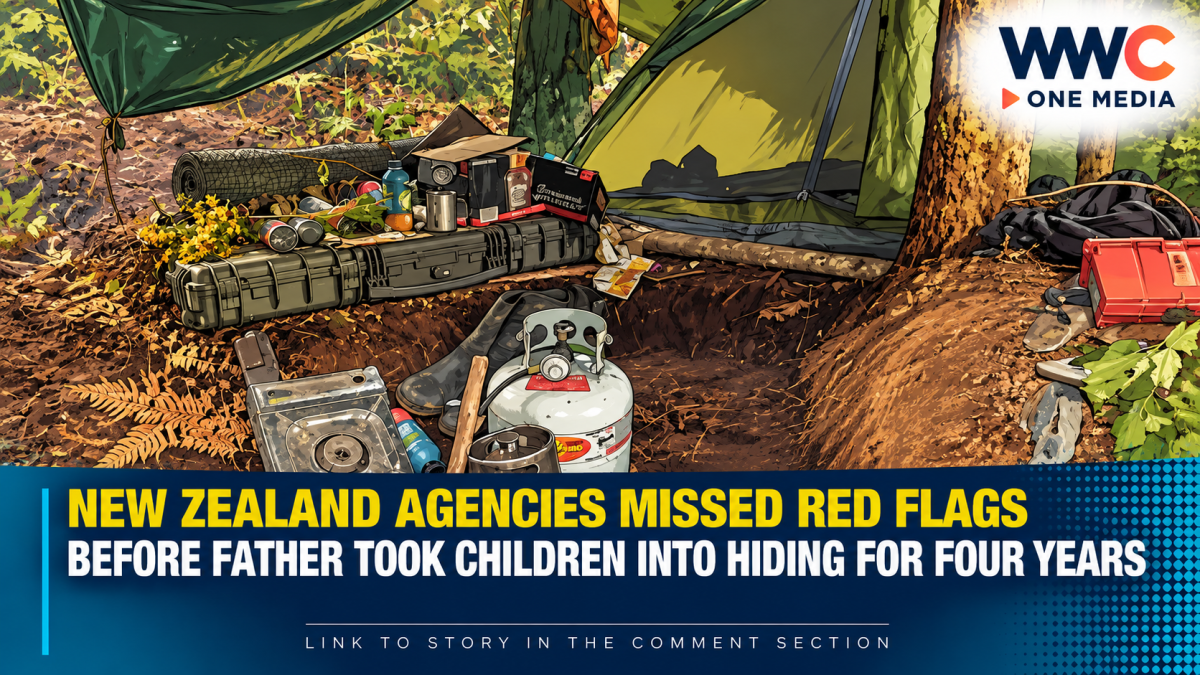
New Zealand authorities failed to act on a series of warning signs before a father disappeared with his children and kept them hidden from authorities for four years, according to a damning inquiry into one of the country’s most high-profile child protection cases.
The inquiry found that multiple agencies had information that should have raised concerns about the children’s safety but failed to connect the warning signs or take effective action.
The case centres on Tom Phillips, who disappeared with his three children in December 2021 after taking them from their family home in the Waikato region.
For years, police and authorities searched for the family as sightings and reports periodically emerged, but the children remained out of reach.
Phillips and his children were eventually located in 2025 after a member of the public reported seeing them in remote farmland.
The case triggered intense criticism of New Zealand’s child protection and law enforcement systems, particularly over whether authorities had enough information to intervene earlier.
The inquiry found that agencies had been alerted to concerns surrounding Phillips, including information about firearms and his behaviour, but those warnings did not result in an effective coordinated response.
One of the central findings was that agencies held pieces of information that, when considered together, could have provided a clearer picture of the potential risk.
Instead, the information remained fragmented across different organisations.
The inquiry highlighted problems involving information sharing, risk assessment and communication between agencies responsible for protecting children and enforcing the law.
Such failures are particularly serious in cases involving children because authorities may need to act before a conventional criminal offence has occurred.
The case also exposed the difficulty agencies face when a parent takes children while claiming to have legitimate reasons for doing so.
Authorities must balance parental rights with their responsibility to protect children from potential harm, making early risk assessment critical.
The inquiry’s findings are expected to put further pressure on New Zealand agencies to improve the way they identify and respond to children who may be at risk.
The country’s child-protection system already allows agencies to share information where necessary to protect a child’s safety and wellbeing.
However, the Phillips case demonstrates that having information-sharing powers is not enough if agencies fail to recognise the significance of information held elsewhere.
The investigation also raised concerns about how warnings involving firearms and potential threats were assessed.
The children spent years living away from normal schooling and community life while the search for them continued.
Their prolonged disappearance meant that authorities had limited opportunities to assess their welfare directly.
The case became a national obsession, with police receiving numerous reports of possible sightings and members of the public assisting investigators.
The eventual discovery of the family brought the four-year search to an end but also intensified questions about how the children could remain hidden for so long.
Phillips died during a confrontation with police shortly after the children were found.
The children were subsequently taken into care and reunited with their wider family.
The inquiry’s findings now shift attention from the search itself to the institutional failures that occurred before and during the disappearance.
Officials will face pressure to ensure that the lessons from the case lead to concrete changes rather than another set of recommendations that fail to prevent similar incidents.
Potential improvements include better information sharing between police and child-protection agencies, clearer escalation procedures and stronger mechanisms for identifying patterns of behaviour that may indicate a serious risk.
The case also highlights the importance of ensuring that agencies do not assess warning signs in isolation.
A single report may appear relatively minor. Multiple reports involving the same individual, however, can create a substantially different risk picture when viewed together.
For New Zealand, the inquiry is therefore about more than one family tragedy.
It is a test of whether the country’s child-protection system can recognise danger early enough to protect vulnerable children.
The four-year disappearance demonstrated how difficult it can be to locate children once they are deliberately removed from normal contact with authorities.
The inquiry’s central warning is that opportunities to intervene can be lost when agencies fail to connect information already in their possession.
New Zealand authorities must now decide how to turn those lessons into practical safeguards — so that future warning signs do not become another missed opportunity to protect children.




Leave a Reply