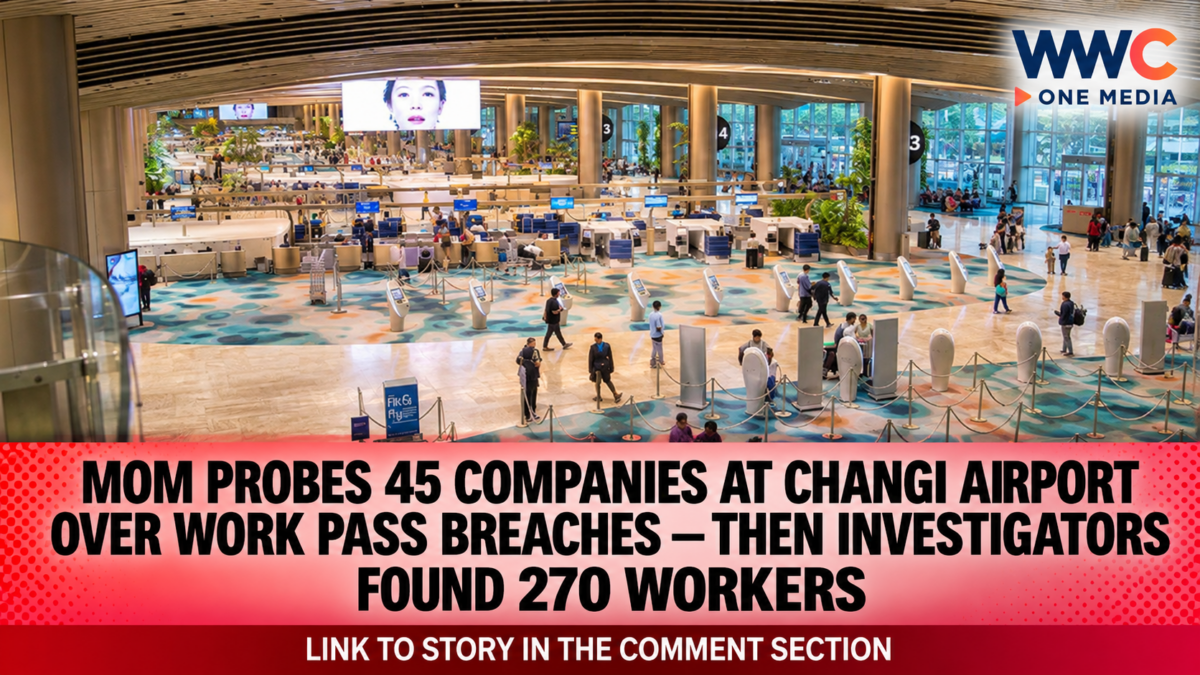
SINGAPORE — November 3, 2026 — Singapore’s Ministry of Manpower (MOM) is investigating about 45 companies involved in operations at Changi Airport over suspected work-pass offences, after inspectors found foreign workers allegedly performing duties that did not match the occupations declared to the authorities.
The investigation has so far identified around 270 workers whose deployment may not have complied with Singapore’s work-pass regulations, according to MOM. The workers were employed by contractors and subcontractors of ground-handling company SATS.
The case raises fresh questions about how large airport operators monitor their contractor networks—and whether companies further down the supply chain are complying with Singapore’s strict foreign-worker rules.
Employment Pass holders found handling baggage
The investigation began after MOM conducted a recent inspection at Changi Airport.
During the inspection, officers found Employment Pass (EP) holders performing baggage-handling duties.
According to MOM, preliminary investigations suggest that the salaries and occupations declared for some of these EP holders were false.
Other work-pass holders were also found performing baggage-handling work that differed from the occupations declared to MOM.
That distinction matters because an Employment Pass is intended for foreign professionals, managers, executives and technicians—not simply as a general authorization for any type of work.
MOM says the suspected practices could amount to offences under Singapore’s Employment of Foreign Manpower Act 1990 (EFMA).
Around 270 workers potentially affected
The scale of the investigation is significant.
MOM said its investigations have identified approximately 270 workers whose deployment may have breached work-pass requirements.
These workers were employed by companies working as contractors or subcontractors for SATS.
However, it is important not to describe the 270 workers as confirmed illegal workers.
At this stage, MOM has said their deployment may not have complied with work-pass regulations, while investigations remain ongoing.
Likewise, the approximately 45 companies are being investigated for suspected offences; they have not been convicted of wrongdoing.
SATS says it discovered irregularities itself
SATS has separately acknowledged that it found work-pass-related irregularities involving workers employed by some of its contractors during a routine internal audit.
The company said it immediately acted against contractor companies that failed to meet required standards and contractual obligations.
SATS subsequently conducted a broader review of its other contractors and provided MOM with a list of companies and affected workers identified through its internal audit process.
The company said it has also completed a comprehensive audit of its contractor workforce deployed in Changi Airport operations.
SATS has since strengthened its internal verification controls to ensure contractor workers are deployed according to the conditions attached to their work passes.
MOM tells SATS to tighten contractor oversight
MOM has directed SATS to strengthen its oversight of the companies it contracts.
That includes verifying that foreign workers are performing work permitted under their respective work passes and correcting any compliance deficiencies.
The ministry has also issued an advisory to other companies involved in SATS’ operations, reminding them of their obligations under Singapore’s foreign-manpower laws.
The move highlights an important issue in large operations such as airports: responsibility does not necessarily stop with the main contractor.
Companies operating through multiple layers of subcontractors still need effective systems to ensure that workers are properly deployed.
What penalties could companies face?
MOM said it takes work-pass offences seriously and will take enforcement action if breaches of the law are established.
Under the EFMA, employers found guilty of making a false declaration in a work-pass application may face:
- A fine of up to S$20,000
- Imprisonment of up to two years
- Or both
Employers that illegally deploy foreign employees may face a financial penalty of up to S$10,000 and may also be barred from hiring work-pass holders.
These are potential statutory penalties, not penalties that have already been imposed on the 45 companies in this case.
Why the case matters for Changi Airport
Changi Airport is one of Singapore’s most important employment and transportation hubs, with a complex ecosystem involving airlines, ground handlers, catering companies, security providers, cleaning companies, logistics operators and numerous contractors.
That means a compliance problem involving subcontractors can potentially affect a much wider workforce than the employees directly hired by a major airport services company.
The latest investigation therefore goes beyond individual work-pass cases.
It also puts the spotlight on contractor management and accountability.
For companies employing foreign workers, the correct work pass is only one part of the equation. The worker must also be deployed according to the conditions associated with that pass.
The investigation comes as Changi faces other operational scrutiny
The latest probe comes at a time when Changi Airport has already been in the news for other operational issues.
Earlier this week, some airline self-service check-in kiosks at Changi were disrupted by what Civil Aviation Authority of Singapore described as a global disruption affecting Advance Passenger Processing systems.
Affected airlines had to use alternative check-in arrangements before normal processing resumed.
WWC One Media previously reported on the wider airport disruption and other developments involving Changi, including:
Singapore Daily Roundup: PM Wong Says Workers Must Keep Pace With Business Transformation
Workers should not automatically be blamed
Another important distinction is between the workers themselves and the companies responsible for deploying them.
MOM’s investigation concerns whether workers were deployed according to the conditions of their work passes and whether declarations made to the authorities were accurate.
The ministry has not said that all 270 workers knowingly violated Singapore’s laws.
The responsibility for accurate work-pass applications and lawful deployment can fall on employers and companies involved in the hiring and deployment process.
That is why the investigation is focused on the approximately 45 companies.
SATS says it is cooperating with MOM
SATS said it is working with MOM and relevant stakeholders as investigations continue.
The company also said it had strengthened its verification procedures and would take appropriate action against contractor companies found to have breached laws or contractual requirements.
The SATS Workers’ Union has also raised the importance of robust checks and controls over contractor workers operating alongside SATS employees.
SATS said it had assured the union that the matter was being addressed and that it would continue working with the union to maintain trust and ensure workers are treated fairly.
What happens next?
For now, the investigation remains open.
MOM has not announced the identities of the 45 companies or confirmed how many of the suspected cases will eventually result in enforcement action.
That means the final outcome could still change as investigators examine work-pass applications, declared occupations, salaries, actual duties and the relationships between SATS and its contractors.
The most significant question may ultimately be whether the investigation uncovers isolated compliance failures—or reveals broader weaknesses in how foreign workers are deployed across Singapore’s airport-services industry.
For Changi Airport, the issue is not simply who was carrying baggage.
It is whether the systems designed to ensure workers are doing the jobs they are legally authorised to perform were strong enough in the first place.
And with 45 companies now under investigation and around 270 workers potentially affected, that question is far from settled.