
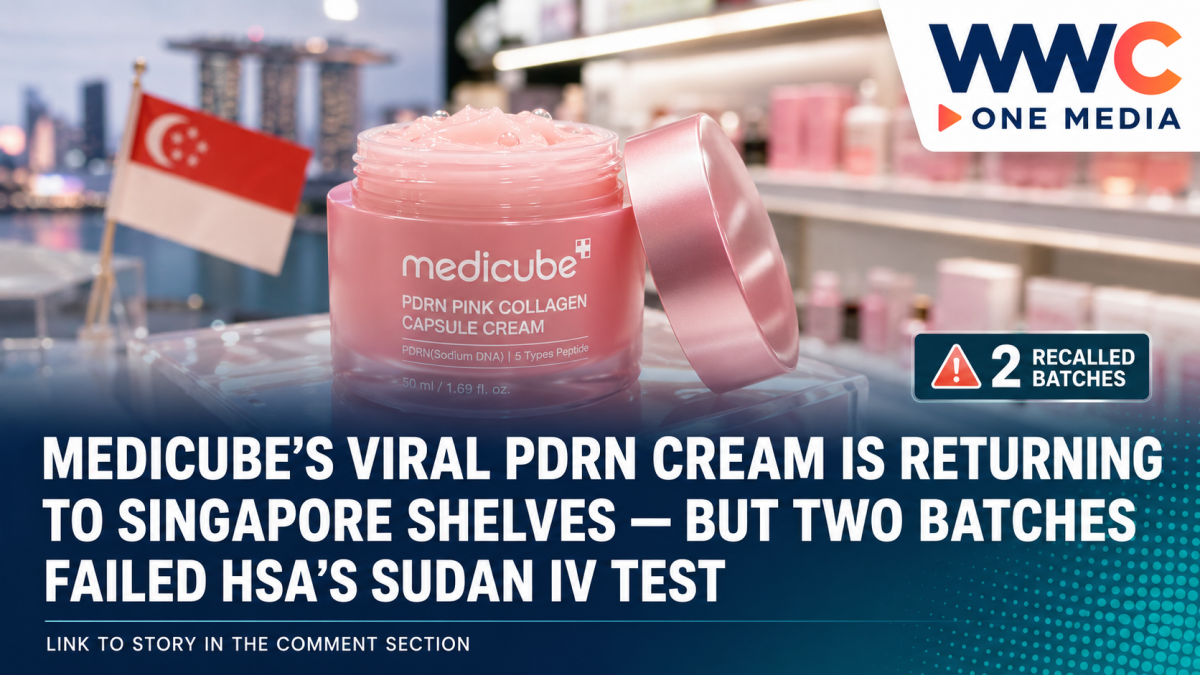
SINGAPORE — One of K-beauty’s most talked-about skincare products is being allowed back onto shelves in Singapore, but consumers are being urged to check their jars carefully after laboratory tests found a prohibited dye in two specific batches.
Singapore’s Health Sciences Authority (HSA) said on August 28 that unaffected batches of Medicube PDRN Pink Collagen Capsule Cream may resume sales after completing an investigation that began with a precautionary suspension.
But two batches supplied by Venus Beauty Pte. Ltd. have been recalled after HSA detected minute amounts of Sudan IV, a dye that is prohibited in cosmetic products.
The affected batch numbers are:
2E122I.2E117I
2E191G.2E193G
HSA ordered a retail-level recall of the two batches on August 26. Retailers and wholesalers holding those batches have been told to stop supplying them and return remaining stock to Venus Beauty.
Most Tested Samples Did Not Contain Sudan IV
The latest findings are significant because the regulatory action does not apply to every jar of Medicube PDRN Pink Collagen Capsule Cream sold in Singapore.
HSA had directed three companies marketing the cream — APR SG Pte. Ltd., Venus Beauty Pte. Ltd. and Rirora International Pte. Ltd. — to suspend sales on July 31 while samples were tested.
Sudan IV was detected in two samples supplied through Venus Beauty.
However, HSA said the prohibited dye was not detected in samples submitted by APR SG and Rirora International.
Those unaffected batches can therefore return to sale.
The Straits Times, CNA, AsiaOne and Mothership separately reported the same key conclusion: the suspension is being lifted for unaffected stock rather than becoming a nationwide ban on the entire product.
But HSA Is Adding a New Safeguard
The controversy has nevertheless resulted in tighter controls.
HSA has ordered all three companies to have every batch of the Medicube PDRN Pink Collagen Capsule Cream intended for Singapore tested by an accredited laboratory for Sudan IV before it is supplied locally.
The companies must also submit those laboratory reports to HSA.
That requirement means the cream can return to stores, but future batches will face an additional layer of scrutiny before reaching Singapore consumers.
What Is Sudan IV — And Why Is It Banned?
Sudan IV belongs to the Sudan Red family of synthetic dyes.
These dyes are commonly associated with colouring industrial materials rather than skincare products and are not permitted for use in cosmetics in Singapore.
Authorities have raised concerns over the dyes’ potential carcinogenic and genotoxic effects, meaning prolonged or significant exposure could potentially be associated with cancer risk or damage to genetic material.
That sounds alarming, but HSA made an important distinction for consumers who may already have used one of the affected jars.
The regulator said the quantities detected were minute and were unlikely to pose serious health risks from previous use.
HSA also said that, as of its August 28 announcement, it had received no local reports of adverse events linked to the product.
Consumers who possess one of the two recalled batches should nevertheless stop using it and contact the seller if they have questions about refunds.
The Controversy Started in Hong Kong
Singapore’s investigation followed an earlier warning from Hong Kong.
On July 24, Hong Kong Customs announced that its Government Laboratory had detected Sudan Red in a collagen cream purchased from the market.
Authorities urged consumers to stop using the product and called on retailers to remove it from shelves. The product was suspected of breaching Hong Kong’s Consumer Goods Safety Ordinance.
Hong Kong Customs also raised a separate labelling issue because the product carried warnings or cautions in English and Korean but not Chinese.
The warning triggered concern across Asian beauty markets and eventually prompted Singapore authorities to conduct their own testing.
Medicube Had Disputed the Earlier Safety Concern
Medicube’s parent company, South Korea-based APR, previously said testing commissioned from third-party laboratories had found Sudan I, II, III and IV to be not detected in the samples it tested.
The company also said Sudan Red was not intentionally used as an ingredient in its legitimate products and questioned whether sufficient information had initially been released to establish the precise batch and distribution history of the sample tested in Hong Kong.
Singapore’s subsequent results offer a more complicated picture.
HSA’s tests did find minute quantities of Sudan IV — but only in two samples associated with Venus Beauty, while the samples submitted by the two other Singapore marketers tested negative.
There has been no official finding from HSA establishing why the results differed between batches, so claims that the issue was caused by counterfeiting, deliberate contamination or a particular supplier would be premature.
Bought the Cream? Check the Batch, Not Just the Brand
For Singapore consumers, the most important step is to look at the batch information on the product.
The recalled batches are:
2E122I.2E117I
and
2E191G.2E193G
If your jar belongs to either batch, HSA advises that you stop using it and contact the seller regarding possible refunds.
The latest announcement does not mean every Medicube product — or even every batch of PDRN Pink Collagen Capsule Cream — has been recalled.
In fact, unaffected batches can now be sold again.
A Bigger Lesson for Singapore’s Booming Beauty Market
The episode also highlights something many consumers may not realise about cosmetics regulation in Singapore.
Cosmetic companies are required to notify HSA before supplying products here, but notification does not mean HSA has evaluated, approved, certified or endorsed the product before it goes on sale.
Responsibility lies with dealers to ensure products meet Singapore’s regulatory requirements, including restrictions on prohibited ingredients, correct labelling and the reporting of serious adverse effects.
Companies that supply cosmetics containing prohibited ingredients can face enforcement action. HSA says offenders may face fines of up to S$50,000, imprisonment of up to two years, or both.
For consumers, HSA’s advice remains straightforward: buy cosmetics from reputable retailers with an established presence, especially when shopping online, so there is a clear avenue for refunds or complaints if a safety problem emerges.
For Medicube, meanwhile, the Singapore controversy has moved into a new phase.
The viral cream is coming back.
But after two batches failed HSA’s testing, every new batch headed for Singapore will now have to prove it is free of Sudan IV before reaching consumers.

Leave a Reply