
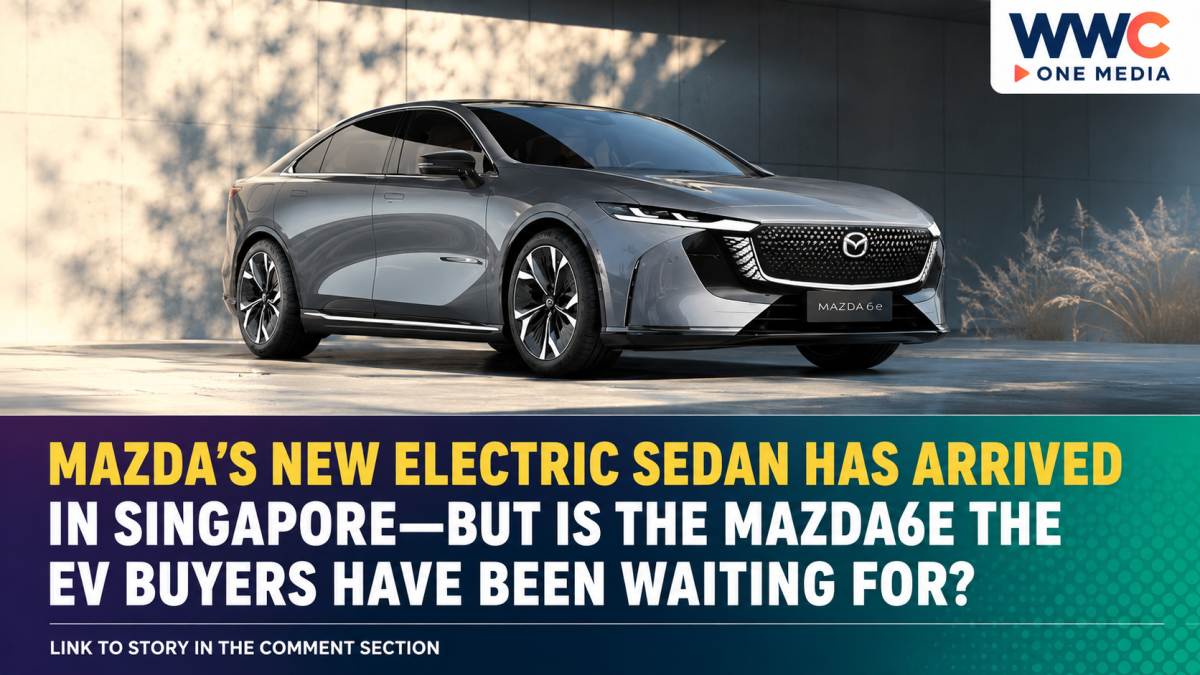
SINGAPORE — Mazda has finally entered one of the world’s most competitive electric vehicle battlegrounds with a car that looks unmistakably Mazda. The all-new Mazda6e, a sleek all-electric fastback sedan, promises premium comfort, elegant design and up to 560km of WLTP range—but can it truly deliver the engaging driving experience the Japanese brand is famous for?
That question could make the Mazda6e one of the most interesting new EVs to hit Singapore’s roads.
The Mazda6e is the brand’s first all-electric fastback and follows the earlier MX-30 as Mazda’s second production battery-electric model. In Singapore, it is offered in Sports and GT variants, with the range-topping GT priced at $235,888, while the Sports starts from $229,888, according to recent local launch information. Both versions use a rear-mounted electric motor producing around 190kW and 290Nm of torque, paired with a 78kWh battery. Mazda Singapore quotes a WLTP range of up to 560km.
A Mazda That Still Looks Like a Mazda
At a time when many electric cars are adopting increasingly futuristic and sometimes polarising designs, the Mazda6e takes a different route.
Its long bonnet, flowing roofline and fastback silhouette give it the proportions of a traditional sports sedan rather than a conventional electric vehicle. Frameless doors, flush door handles, an illuminated front signature and a retractable rear spoiler bring the design into the EV era without abandoning Mazda’s familiar styling identity.
And that could be one of its biggest advantages.
The Mazda6e is entering a market crowded with established names such as the Tesla Model 3, BYD Seal and Hyundai Ioniq 6. Instead of trying to outdo them with radical styling, Mazda appears to be betting that there are still buyers who want their EV to look elegant and recognisable.
The Cabin May Be Its Biggest Selling Point
Step inside the Mazda6e GT, and the experience becomes noticeably more premium.
The Singapore-spec GT features tan Nappa leather and suede trim, while the Sports variant gets a darker interior treatment. The result is a cabin that feels more like a premium lounge than a minimalist technology showcase.
The car also features a 14.6-inch central display, a 10.2-inch digital instrument cluster, an augmented-reality head-up display and voice controls. Mazda Singapore also highlights the fastback’s panoramic sunroof and other technology-focused features.
Space is another strong point. With a length of more than 4.9 metres and a long wheelbase, the Mazda6e offers generous accommodation, while the original Singapore review lists 465 litres of boot space.
But there is one potential frustration.
Like many modern EVs, the Mazda6e places a significant number of functions inside its touchscreen interface. The local review specifically criticised the lack of physical controls for some everyday functions, while international reviewers have also questioned whether the technology-heavy layout is as intuitive as buyers might expect from a Mazda.
Smooth, Comfortable and Surprisingly Capable—Depending on Who You Ask
On Singapore roads, the Mazda6e’s comfort-first approach could be a major selling point.
The original local review praised its refined ride over uneven and patched surfaces, while describing its power delivery as smooth and predictable. With rear-wheel drive and instant electric torque, the 6e has enough performance for effortless city driving and confident overtaking.
The reviewer also found the car composed through Singapore’s South Buona Vista Road’s famous “99 Bends,” arguing that it retains a degree of driver involvement that can sometimes be missing from electric vehicles.
However, overseas reviews suggest the story is slightly more complicated.
Top Gear found the 6e relaxed and quiet but criticised its body movements and steering feel, while Autocar described the car as competent and balanced yet questioned whether it delivers the sporty character traditionally associated with Mazda. CarExpert similarly praised its comfort-oriented ride but noted that the suspension can feel floaty or unsettled when pushed harder.
That doesn’t necessarily make the Mazda6e a poor driver’s car. Instead, it suggests that buyers should approach it as a comfortable and stylish electric cruiser with some Mazda-inspired handling traits, rather than expecting the sharp, playful experience of an MX-5.
And for many EV buyers, that may be exactly what they want.
The Real-World Range Question
Range remains one of the biggest concerns for EV shoppers, and Mazda claims the 6e can travel up to 560km under the WLTP test cycle.
In the Singapore road test, however, real-world driving returned an estimated range of around 500km—a figure that would still be more than sufficient for most daily driving needs. As always, actual range will vary depending on traffic conditions, driving style, weather and air-conditioning use.
International testing has also produced varying results, reinforcing the importance of treating official range figures as a benchmark rather than a guarantee.
So, Is the Mazda6e Worth the Money?
The Mazda6e is not trying to be the cheapest EV on the market. Nor is it the fastest.
What it offers instead is a carefully balanced package: distinctive styling, a genuinely premium-feeling interior, useful driving range and a comfort-focused ride—all wrapped in a body that still carries Mazda’s design DNA.
That balance could be the car’s greatest strength.
But the competition is fierce. Tesla continues to dominate the electric sedan conversation, BYD is pushing increasingly sophisticated EVs at aggressive prices, while Hyundai and Kia remain strong challengers with their own rapidly evolving electric line-ups.
The Mazda6e will therefore need more than good looks to stand out.
Still, for buyers who want an electric car without sacrificing elegance, comfort or a sense of traditional automotive character, Mazda’s newest fastback deserves serious attention.
It may not be the fastest, cheapest or most technologically extreme EV in its class. But the Mazda6e could prove that, in the rush towards an all-electric future, being the most balanced option might be more important than winning the specification war.




Leave a Reply