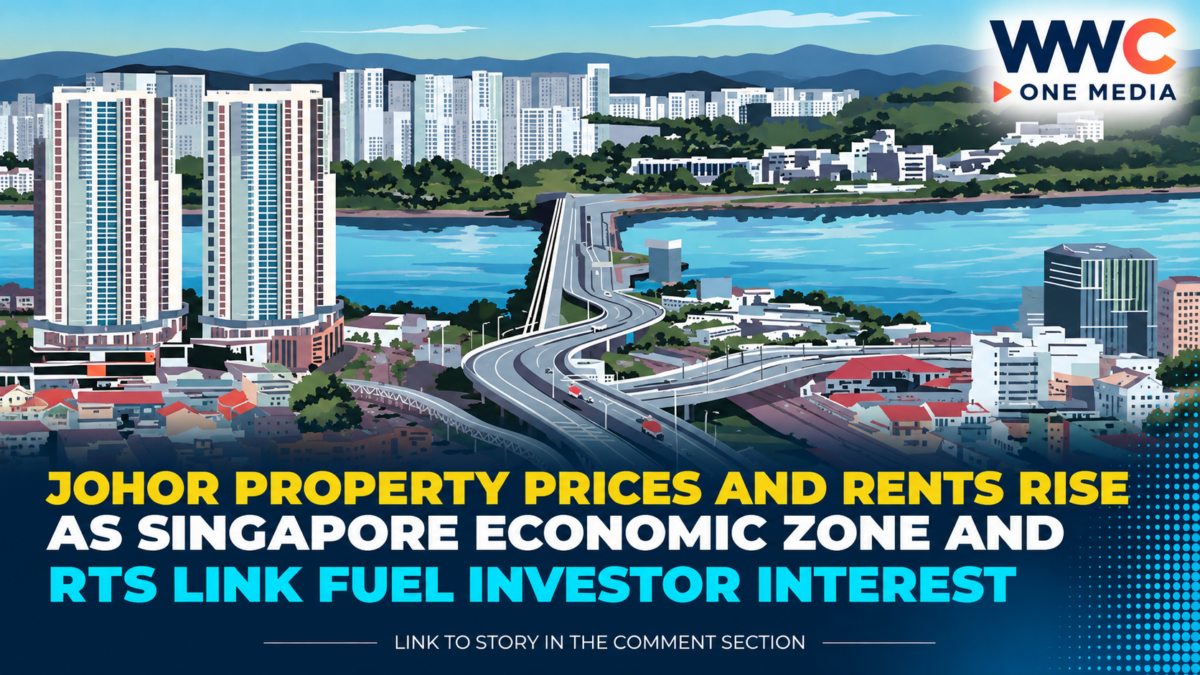
Johor’s property market is gaining momentum as the Johor-Singapore Special Economic Zone (JS-SEZ) and the upcoming Rapid Transit System (RTS) Link reshape expectations for cross-border business, housing and investment.
Residential properties in the zone’s nine flagship areas have recorded annual price growth of around 7% to 9%, compared with approximately 2% to 4% across Johor as a whole, according to market research by property consultancy Savills.
The figures suggest that investors are increasingly factoring in the potential economic benefits of closer ties between Singapore and Johor. However, analysts caution that stronger prices do not guarantee continued gains, particularly as the state faces concerns about housing affordability and an oversupply of certain property types.
JS-SEZ and RTS Link Drive Expectations
The JS-SEZ is designed to strengthen economic cooperation between Malaysia and Singapore, attract investment and encourage businesses to expand their operations across the border.
The agreement, signed in January 2025, covers nine flagship areas in Johor. Its goals include improving connectivity, facilitating business activity and supporting higher-value industries.
The RTS Link is another major part of the picture. Connecting Bukit Chagar in Johor Bahru with Woodlands North in Singapore, the rail service is expected to make cross-border travel easier for workers and visitors.
Together, the two initiatives are raising expectations that demand for housing, commercial premises and business facilities will increase in strategically located parts of southern Johor.
Rental Yields Attract Property Investors
Savills data cited in recent market reporting indicates that residential properties within the JS-SEZ’s flagship zones are generating rental yields of around 6% to 8%, compared with approximately 5% to 6% across Johor overall.
The prospect of stronger rental returns is attracting attention from investors looking to benefit from potential demand by business travellers, professionals and employees working across the Singapore-Malaysia border.
Properties near transport links and employment centres may be particularly well positioned if more companies establish operations in the zone and more people choose to live in Johor while maintaining connections to Singapore.
However, rental yields vary by property, purchase price, occupancy and ongoing costs. Advertised rental rates alone do not establish the income an owner will ultimately receive.
Rising Prices Come With an Oversupply Risk
Despite the positive figures, Johor’s property market is not experiencing uniform growth.
A recent analysis by The Business Times described an increasingly divided market: industrial property demand is being supported by data centres, logistics companies and manufacturers, while some parts of the residential market continue to face a substantial oversupply of premium homes. <Cite refs={[“turn975818search1″,”turn975818news8”]}/>
This creates an important distinction for investors. A property located near an emerging employment hub or transport interchange may benefit from genuine demand, while a development with many competing units could struggle to attract tenants or maintain rental rates.
Investors should therefore look beyond headline price increases and consider local supply, occupancy levels, maintenance fees and the actual rental income achievable.
Local Residents Could Face Higher Housing Costs
Rising property values and rents may benefit existing owners, but they can also place pressure on residents and businesses.
Johor Bahru businesses near the planned RTS station have already reported rental increases as landlords anticipate stronger demand. In some heritage commercial areas, higher rents have raised concerns among long-established shops about whether they can afford to remain in their premises. <Cite refs={[“turn975818search2″,”turn975818search7”]}/>
The wider concern is that prices influenced by Singapore-linked investment may become increasingly disconnected from what local households can comfortably afford.
Whether the JS-SEZ generates broad-based benefits will depend partly on whether new investment creates sustainable employment and business opportunities, rather than simply pushing up property prices.
RTS Link Opening Now Expected in February 2027
The RTS Link is a major factor shaping investor expectations, but its opening timeline has changed.
As of October 2026, passenger services are expected to begin in February 2027, following the completion of testing, safety certification and regulatory approvals. The approximately 4km connection between Woodlands North and Bukit Chagar is expected to make the cross-border journey take around five minutes. <Cite refs={[“turn284651search3”]}/>
The rail connection could make Johor Bahru more practical for people who work, shop or conduct business in Singapore. It may also improve access for visitors and support demand for accommodation and commercial premises.
However, the actual impact will depend on passenger uptake, travel costs, immigration arrangements and how quickly new businesses establish themselves in the economic zone.
What Property Buyers Should Watch Next
For prospective buyers and investors, the key question is whether rising prices are being supported by lasting economic activity.
Before purchasing, investors should examine:
- Location: Proximity to the RTS station, employment centres and established amenities.
- Rental demand: Evidence of actual tenant demand rather than projected returns alone.
- Competing supply: The number of similar units available for rent or sale nearby.
- Total costs: Financing, maintenance, taxes, vacancy periods and property-management expenses.
- Long-term affordability: Whether prices and rents remain sustainable for the people expected to live and work in the area.
The JS-SEZ and RTS Link are creating new opportunities for Johor, but the benefits are unlikely to be distributed evenly across every neighbourhood or property type.
For now, the latest Savills figures point to stronger price growth in the economic zone’s flagship areas. Whether that momentum continues will depend on how successfully investment translates into jobs, businesses and sustained demand for housing.