
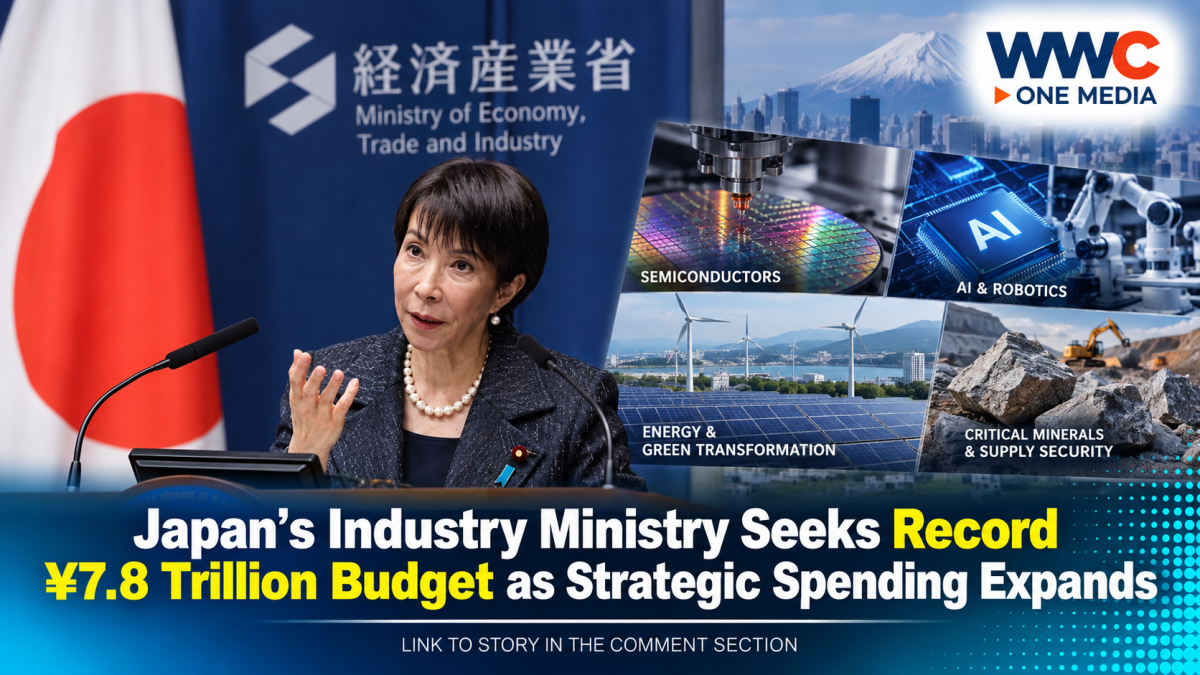
TOKYO — Japan’s Ministry of Economy, Trade and Industry (METI) is seeking roughly ¥7.8 trillion (about US$49 billion) for fiscal 2027, a dramatic increase that puts the ministry at the center of Prime Minister Sanae Takaichi’s push to expand investment in strategic industries.
The request, submitted for the fiscal year beginning April 2027, is more than double METI’s ¥3.07 trillion initial budget for fiscal 2026. However, simply describing the proposal as a doubling of the ministry’s underlying spending would be misleading because the new request incorporates programs that previously could have been funded through supplementary budgets and other mechanisms.
Where the money is headed
A major share of the proposed spending falls under the government’s new “Strong and Prosperous Japan” Investment Framework, which does not impose the conventional spending ceiling.
About ¥6.3 trillion of METI’s request is connected to that framework, according to reporting on the ministry’s proposal. The policy is designed to channel government support toward areas viewed as strategically important to Japan’s economic competitiveness and economic security.
Among the biggest priorities are artificial intelligence, semiconductors and robotics, alongside critical minerals, energy security, quantum technology and other advanced industries.
One analysis of the ministry’s request puts AI, semiconductor and robotics-related demands at roughly ¥2 trillion, highlighting how heavily Japan is concentrating industrial policy on technologies expected to shape future supply chains and manufacturing.
Why the budget looks so bloated
The size of the request has attracted attention partly because Japan is changing the way some industrial investments are budgeted.
Rather than relying as heavily on supplementary budgets later in the fiscal year, the government is attempting to place more long-term strategic spending into the initial annual budget.
That means the ¥7.8 trillion figure should not automatically be interpreted as METI suddenly receiving ¥7.8 trillion in conventional operating funds. An analysis of the ministry’s proposal notes that conventional general-account spending is considerably smaller, while the new investment framework accounts for most of the apparent expansion.
The distinction matters because Japan has increasingly used supplementary budgets to finance large economic and industrial initiatives.
Japan’s bigger spending push
METI’s request is part of a much broader expansion in Japan’s 2027 budget demands.
Reuters reported that ministries and agencies collectively requested approximately ¥143 trillion for fiscal 2027, potentially making it the largest initial budget request on record.
The government’s strategy is closely tied to industrial competitiveness and economic security. Japan is seeking to strengthen domestic capabilities in areas such as advanced chips, AI, robotics and critical resources while reducing vulnerabilities in strategically important supply chains.
For METI, semiconductors have become one of the clearest examples of this approach. The ministry has already committed substantial public support to Japan’s semiconductor revival, including backing for domestic advanced-chip production.
A bigger question for Japan
The enormous request now moves into the next stage of the budget process, where the Finance Ministry will examine the demands and determine how much funding ultimately makes it into the national budget.
So while ¥7.8 trillion grabs attention, the final figure could be substantially different.
The bigger issue is what Japan gets in return for the expansion: whether government-backed investment can translate into stronger domestic industries, technological capacity and economic resilience — and how effectively the government can control costs as strategic spending expands.
For now, METI’s record-setting request signals just how far Japan’s industrial policy has shifted toward large-scale state-supported investment in technology, energy and economic security.
WWC ONE MEDIA G.A



Leave a Reply